


Your brand holds the top spot on Google for your most competitive keyword. Then someone on your target account's buying committee opens ChatGPT, asks "what's the best [your category] tool for a mid-size B2B company?" and your name never appears. That single interaction - invisible to your analytics stack - is the new SEO problem nobody told you about.
ChatGPT now processes more than 1 billion queries every day and commands over 80% of the AI chatbot market. By February 2026, it had 900 million weekly active users, and 77% of Americans who use it treat it as a search engine. The shift from clicking links to reading synthesized answers is already reshaping discovery for B2B and consumer buyers alike. And 80% of the URLs ChatGPT cites don't even rank in Google's top 100 - meaning your traditional SEO footprint predicts almost nothing about your AI search visibility.
This guide gives you a concrete, evidence-based playbook for getting your brand cited, recommended, and trusted by ChatGPT. It covers how ChatGPT's citation engine actually works, the ranking factors that matter most, tactical execution across content, technical, and authority layers, and how to measure progress before the competitive window closes.
Key takeaways
- ChatGPT's citation logic is fundamentally different from Google's ranking algorithm. Only 12% of URLs ChatGPT cites even appear in Google's top 10 results.
- AI search converts at 14.2% versus Google's 2.8% - a fivefold advantage that makes citation share a direct revenue lever.
- ChatGPT evaluates your content through four lenses: brand entity strength, topical authority, third-party citation co-occurrence, and technical crawlability.
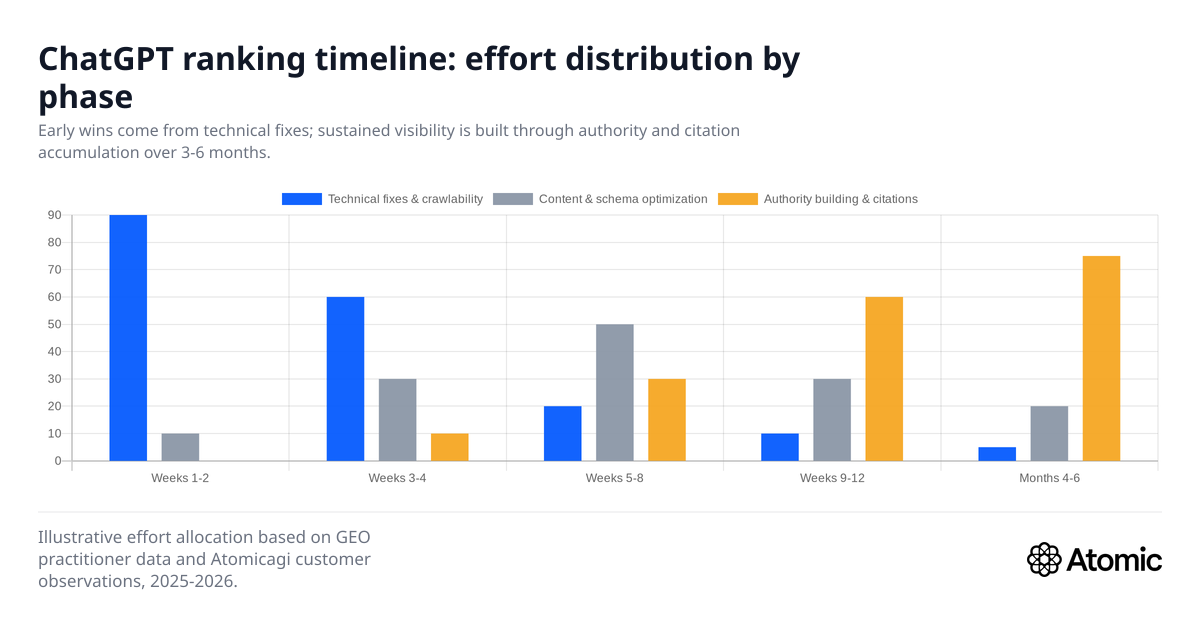
- Measurable citation improvements typically begin within 8-12 weeks of targeted optimization. Sustained AI search presence takes 3-6 months to build.
- You cannot optimize what you cannot measure. Setting up proper AI visibility tracking is the mandatory first step - not an afterthought.
- SearchGPT (ChatGPT's web search mode) and standard ChatGPT use overlapping but distinct signals, requiring a slightly different approach for each.
What we'll cover
- Why ChatGPT rankings are a distinct problem from Google SEO
- How ChatGPT actually decides what to cite
- The core ranking factors you can directly influence
- How to do SEO for ChatGPT - a tactical section-by-section playbook
- How to rank your business higher on ChatGPT specifically
- How to rank on SearchGPT (ChatGPT's web search mode)
- How fast you can expect results - and the honest answer
- How to measure and track your ChatGPT visibility
- Frequently asked questions
Why ChatGPT rankings are a distinct problem from Google SEO
Google ranks pages. ChatGPT cites sources. These are not the same optimization problem.
When someone searches Google, they see a list of results and choose which link to click. The SEO objective is clear: earn a high-ranking position by accumulating authority signals, matching search intent, and optimizing on-page factors. When someone asks ChatGPT a question, they receive a synthesized answer that may or may not reference your brand - and if your brand is missing from that answer, the user typically has no reason to go looking for you.
Research analyzing ChatGPT's citation patterns found only 12% overlap with URLs appearing on Google's first page. The other 88% came from sources ranking outside the top 10 or not ranking at all. This is not an anomaly; it is a systematic divergence between two fundamentally different retrieval systems.
The economic stakes of this divergence are not theoretical. AI-referred visitors convert at dramatically higher rates than standard search traffic. Superprompt, tracking 12 million visits, measured ChatGPT traffic converting at 14.2% versus Google's 2.8% - a fivefold difference. A WebFX analysis of 2.3 billion site sessions found generative AI traffic grew 796% from 2024 to 2025, with SaaS and software companies seeing AI-referred visitors convert at 57.84% compared to 37.17% for organic search. Ahrefs reported the most extreme case: 12.1% of AI-referred visitors became customers despite representing just 0.5% of total traffic, a 23x efficiency gain over their overall conversion rate.
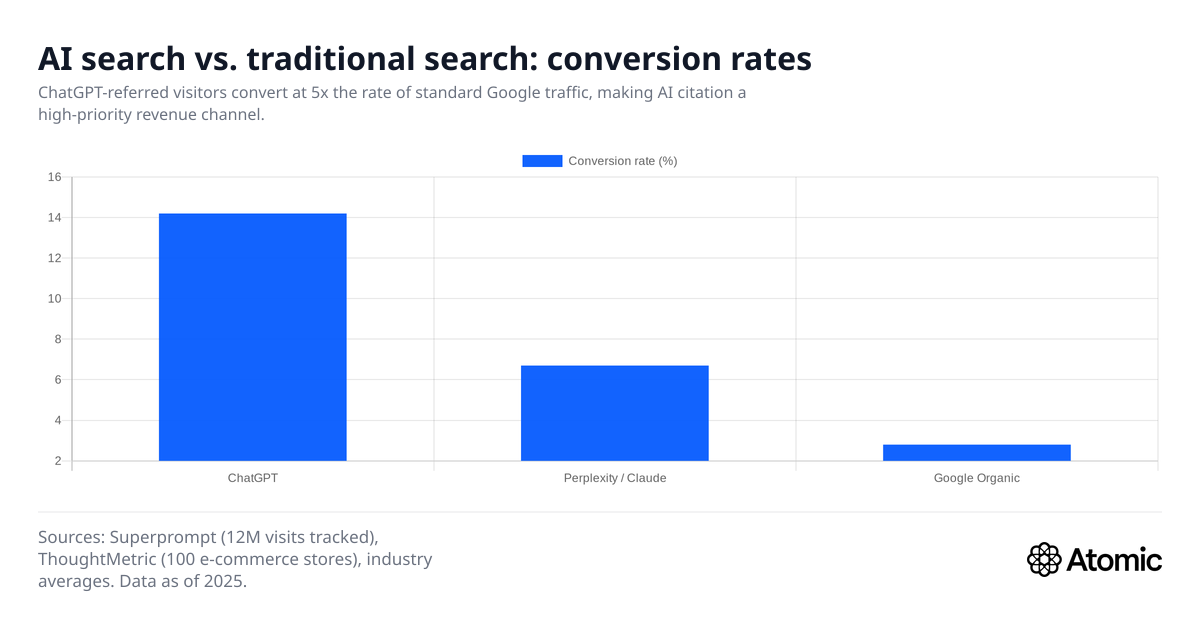
The implication for B2B SaaS teams is sharp. A company receiving 1,000 monthly visitors from ChatGPT at 14.2% conversion generates 142 customers. The same company needs 5,000 Google visitors at 2.8% to match that output. Citation share is not a vanity metric - it is a revenue multiplier.
The conversion advantage stems from how AI search users arrive. They have already had a research conversation with an AI model that synthesized information and made a recommendation. By the time they visit your site, they are pre-educated, pre-qualified, and in a later stage of the decision process than the average Google clicker. That is why session duration from ChatGPT averages 5:18 versus 1:24 for traditional search.
Citation slots are finite. ChatGPT typically cites 5-7 sources per response. Those slots are not distributed randomly - they go to brands with established credibility in specific topical areas. Once competitors occupy those slots for high-value queries, displacing them requires dramatically superior content signals, not marginal improvements. The time to build citation presence is now, while competitive slots are still contested.
How ChatGPT actually decides what to cite
Understanding ChatGPT's retrieval logic is the prerequisite for everything that follows. There are two operational modes that work differently.
Standard ChatGPT (training data mode)
The base ChatGPT model draws from a knowledge cutoff derived from its training corpus. When you ask it a question without enabling web browsing, it responds from its trained understanding of the world. This means your brand's presence in ChatGPT's training data - determined by how frequently and authoritatively your content was indexed across the web at training time - determines your default visibility.
This is why third-party citations are so critical. Your own website content is just one signal. ChatGPT's training corpus is heavily weighted toward authoritative reference sources: Wikipedia, Reddit, major editorial outlets, industry publications, and community platforms where information is frequently discussed and cross-referenced. If your brand appears in those contexts consistently, it enters the model's understanding of your category.
A 2026 analysis of over 1 million AI citations by OtterlyAI confirmed this: community-driven platforms (Reddit, Quora) captured 52.5% of citations across ChatGPT, Perplexity, and Google AI Overviews combined. Wikipedia alone accounts for 7.8% of all ChatGPT citations - more than most brand domains. The lesson is that your own website content competes directly with platforms that have decades of trust built into the model.
SearchGPT / ChatGPT web search mode
When web search is active, ChatGPT performs live retrieval through a pipeline that fetches and reads current web content before generating a response. This mode is more like a traditional search engine in that recency matters and your latest content can appear in answers quickly. But the retrieval criteria are stricter: ChatGPT uses Bing's index as its primary web data source, meaning Bing indexing and Bing authority signals directly influence your SearchGPT visibility.
The overlap between modes creates a compounding effect. Brands with strong training data presence get the benefit of default citations in knowledge-based queries. Brands with strong Bing authority and current, structured content get cited in web-search mode. Brands building both types of signals dominate across the full range of user queries.
What triggers a citation
Based on citation analysis across thousands of ChatGPT responses, the following patterns emerge consistently:
- Authority consensus: Sources cited by other cited sources have significantly higher citation probability. This is essentially PageRank logic applied to AI training data - if the sources ChatGPT trusts also reference you, you are more likely to be trusted.
- Query-to-content alignment: ChatGPT cites sources that most precisely address the exact framing of the query, not just the general topic area. A brand that has written specifically about "project management software for distributed engineering teams" is more likely to appear when someone asks that exact question than a brand with a generic "project management software" overview.
- Content extractability: ChatGPT needs to be able to extract clean, factual information from your content. According to Superprompt's analysis of 400+ sites, pages with structured heading hierarchies (H1, H2, H3) are 40% more likely to be cited by ChatGPT than pages without them. Dense, opinionated prose without clear data points, named claims, and structured information is harder to cite than content organized around specific assertions.
- Entity recognition: ChatGPT is trained to understand entities - brands, people, products, locations. If your brand exists as a clear, coherent entity in the model's training data with a defined category, audience, and value proposition, you are more likely to appear in recommendation queries.
The core ChatGPT ranking factors you can directly influence
Not all signals are equally actionable. These are the factors where deliberate optimization produces measurable results.
1. Topical authority depth
ChatGPT favors sources that have demonstrated comprehensive coverage of a topic area rather than surface-level treatment. Publishing one solid article about a topic is not enough. Building a cluster of interconnected content that addresses a topic from multiple angles - foundational explainers, tactical guides, data-driven analysis, comparison content, and use-case specifics - establishes you as the authoritative source in that category.
For B2B SaaS companies, this means going beyond product-focused content. If you sell project management software, topical authority requires covering team productivity frameworks, remote work communication, software evaluation methodologies, and adjacent workflows your buyers care about. The model needs to recognize your domain as a place where real answers live.
2. Brand entity strength
Your brand needs to exist as a coherent entity across the web, not just on your own website. This means:
- A well-maintained Wikipedia article (or at least references in relevant Wikipedia pages) describing your company, product category, and key features.
- Consistent brand mentions across industry publications, analyst reports, review sites like G2 and Capterra, and community discussions on Reddit and LinkedIn.
- Named executives and subject-matter experts associated with your brand in publicly available content - people ChatGPT can recognize as authoritative voices.
Entity strength is cumulative. Every time a credible source references your brand in the context of your category, the model's confidence that your brand belongs in answers about that category increases.
3. Third-party citation co-occurrence
The strongest signal in ChatGPT's training data is not what you say about yourself - it is what trusted sources say about you in proximity to category-defining terms. Being mentioned in Forbes, TechCrunch, product review roundups, and analyst reports alongside your category keywords creates the co-occurrence signal that tells ChatGPT "this brand belongs in this conversation."
Research into AI citation patterns found that citation co-occurrence showed the strongest single-factor correlation with ChatGPT mention rate at approximately 0.74. Traditional domain authority correlated at only 0.27. This inverts the traditional SEO priority stack: earning mentions in credible external sources matters more than building backlinks to your own domain.
4. Bing index presence and authority
For SearchGPT and ChatGPT's web search mode, Bing is the primary data source. This is systematically overlooked by teams whose entire SEO workflow is Google-centric. Bing Webmaster Tools needs to be actively managed. Your content needs to be indexed in Bing, not just Google. Your Bing authority score - determined by backlinks, site quality, and user engagement signals that Bing tracks independently - directly predicts your SearchGPT visibility.
5. Structured, extractable content format
ChatGPT retrieves content to synthesize answers, which means it needs to extract specific claims from your pages. Content organized with clear headers, numbered lists, defined terms, specific data points with sources, and explicit answer structures is far more likely to be cited than walls of undifferentiated prose. The OtterlyAI study found that chunked, quotable, schema-tagged pages receive 3-5x more citations than unstructured equivalents.
6. Fresh, factually accurate information
ChatGPT's web search mode weights recency. According to Superprompt's data, content updated within 30 days receives 3.2x more citations than content last updated more than 90 days ago. For fast-moving B2B SaaS categories, content freshness is a competitive variable that compounds over time.
How to do SEO for ChatGPT: a tactical playbook
Step 1: Audit your current AI visibility baseline
Before optimizing, you need a baseline measurement. This is the step most teams skip, and it is why they cannot tell whether their optimization efforts are working.
The baseline audit should cover:
- Which queries in your category currently trigger ChatGPT responses that mention your brand
- Which competitors appear in those same responses
- Which queries produce responses that mention competitors but not you (citation gaps)
- Whether your site is crawlable by GPTBot and other AI crawlers
- Your current Bing indexing status and coverage
Atomic AGI's AI search tracking surfaces all of this in a unified dashboard, tracking brand mentions, citations, and sentiment across ChatGPT and nine other AI platforms simultaneously. The teams building systematic ChatGPT visibility know exactly where they stand before they start optimizing - not after six months of guessing. For a broader look at the methods available, our guide to how to monitor AI search visibility covers 12 practical approaches ranked by priority.
Step 2: Ensure ChatGPT can actually crawl your site
If GPTBot cannot access your content, you cannot appear in ChatGPT's web search responses. This is a technical issue that produces a categorical exclusion, not a ranking disadvantage - and it affects many more sites than teams realize.
The OtterlyAI citation study found that 73% of sites have technical barriers blocking AI crawler access - including robots.txt blocks, CDN rules that reject non-browser user-agents, and JavaScript rendering issues that prevent content from being parsed. Check your robots.txt file. The following directive blocks GPTBot entirely:
User-agent: GPTBot
Disallow: /
If this exists, ChatGPT's web crawler is excluded from your site. Remove it or update it to allow GPTBot access to your key content paths. You should also check for ChatGPT-User, OAI-Searchbot, and ClaudeBot entries - each serves a distinct function in OpenAI's crawler ecosystem, as documented by OpenAI.
Additional technical requirements for AI crawler access:
- Page speed matters. Pages with Time to First Byte above 2 seconds are crawled less frequently.
- Avoid hiding critical content behind JavaScript rendering. AI crawlers handle JavaScript inconsistently. Static HTML content is indexed most reliably.
- Create or update your
llms.txtfile - an emerging standard that gives AI crawlers explicit guidance about which content is most important for training and retrieval. - Check that your XML sitemap is current and submitted to Bing Webmaster Tools, not just Google Search Console.
Step 3: Build a prompt-based content architecture
Traditional content strategy starts with keyword research. ChatGPT content strategy starts with prompt research.
Think about the actual conversational queries users might pose to ChatGPT in your category. Not the keyword-optimized version - the actual way a human asks a knowledgeable AI assistant for help. "What's the best [category] solution for [specific use case and context]?" and "How does [your company] compare to [competitor] for [specific buyer situation]?" are fundamentally different queries than "best [category] software."
For each high-value prompt cluster in your category:
- Build a dedicated piece of content that directly answers that exact prompt framing
- Use the exact language patterns present in natural conversational queries
- Provide a specific, substantiated answer in the opening paragraph - do not bury the recommendation
- Include relevant data points, named examples, and concrete comparisons that ChatGPT can extract
- Cross-link to related content in your topical cluster to signal depth of expertise
This is different from writing for featured snippets, though there is meaningful overlap. The key distinction is that ChatGPT synthesizes answers from multiple sources rather than extracting a single passage. Your content needs to provide citation-worthy claims throughout the page, not just in a highlighted box.
Step 4: Optimize for brand entity recognition
Your brand needs to be understood as a coherent entity, not just a website. Structured data is the most direct technical signal for this.
Implement Organization schema on your homepage with complete fields: name, description, url, logo, sameAs (linking to your LinkedIn, Crunchbase, Wikipedia, and social profiles), and foundingDate. For product pages, implement SoftwareApplication or Product schema with detailed, accurate information.
The sameAs property is particularly important. It tells AI systems that your website, your LinkedIn company page, your Crunchbase profile, and any Wikipedia references are all the same entity. This consolidates entity recognition across the web's graph of linked information.
For team members and subject-matter experts, implement Person schema on author pages with links to their LinkedIn profiles, published bylines on external publications, and company affiliation. Authorship signals contribute to AI models' understanding of whether your brand is staffed by credible experts in your category.
Step 5: Build systematic third-party citation presence
This is the highest-leverage, hardest-to-fake signal in ChatGPT's evaluation of your brand. No amount of on-site optimization substitutes for the authority that comes from being frequently cited by sources ChatGPT already trusts.
Prioritize these channels for third-party citation building:
Industry publications and editorial media: Contributed articles, expert quotes in roundups, and product coverage in trade outlets that your buyers already read. These need to mention your brand in the context of your category keywords, not just your product features.
Wikipedia: If your company is notable enough to have a Wikipedia article, the article should be factually accurate, current, and link to your website. If you are not notable enough for a standalone article, ensure your brand appears in relevant category articles and comparison tables. Wikipedia is disproportionately weighted in ChatGPT's citation logic - it is the single most cited domain across all major AI platforms.
Reddit and community forums: ChatGPT heavily weights community-edited content. Authentic participation in subreddits your buyers frequent - r/entrepreneur, r/marketing, relevant vertical community subreddits - builds the community citation signal. This is organic, not promotional. Real answers to real questions, with your brand mentioned naturally where relevant.
Review platforms: G2, Capterra, and Trustpilot profiles serve dual purposes. They build the third-party entity mentions ChatGPT needs, and they provide the review content that ChatGPT surfaces when users ask about your product specifically. Keep these profiles complete, current, and populated with recent, authentic reviews.
Analyst and research citations: Being mentioned in market research reports, industry analyst commentary, and benchmark studies creates the high-authority citation co-occurrence that most strongly predicts AI visibility.
Step 6: Keep content fresh on a systematic schedule
Citation volatility in ChatGPT's web search mode is high. Studies tracking the same queries over time documented 40-60% monthly churn in which sources get cited. A page cited in January might not appear in February.
The response to this is not to constantly rewrite content - it is to maintain freshness through regular, meaningful updates:
- Update statistics, data points, and examples on a 60-90 day cycle
- Add new sections when category developments warrant them
- Refresh publication dates only when you have made substantive changes
- Monitor which of your pages ChatGPT is actively citing and prioritize those for freshness maintenance
Atomic AGI's content monitoring agents automate this workflow - flagging pages that are losing citation frequency and surfacing specific update opportunities based on what competitors are now getting cited for instead.
How to rank your business higher on ChatGPT
The tactics above apply to any brand. This section addresses the specific context of B2B businesses competing for recommendation queries - the "what should I use for X" and "compare A vs. B" prompts that drive actual purchase decisions.
Own the comparison query space
When buyers are evaluating tools, they ask ChatGPT to compare options. "How does [your brand] compare to [competitor]?" is one of the highest-intent queries you can target. If your brand does not appear in those comparisons - or appears with outdated, unfavorable framing - you are losing consideration-stage buyers silently.
Build dedicated comparison content that is structured, specific, and honest. Content that acknowledges where a competitor is stronger, while clearly explaining where your solution is the better fit for specific buyer profiles, outperforms promotional content in AI citations because it reads as authoritative rather than self-serving.
Get into the categories ChatGPT uses as defaults
ChatGPT uses categorical labels when making recommendations. "Best CRM for small business." "Top project management tools for engineering teams." "Leading B2B data enrichment platforms." If your brand is consistently mentioned in content that uses these categorical labels, you build presence in the model's understanding of who belongs in each category.
This means being included in "best of" lists, comparison roundups, and category guides - not just on your own blog, but on the credible third-party sites that ChatGPT already trusts as authoritative for your vertical.
Build your executive and expert presence
ChatGPT is more likely to cite brands whose founders or executives are recognized as subject-matter experts with published perspectives on industry topics. If your CEO publishes substantive LinkedIn articles that get engagement and coverage, appears as a podcast guest on industry shows, speaks at conferences that generate written coverage, or is quoted as an expert in trade press, that expert presence reinforces your brand's authority signal.
This is not vanity. It is entity building. The author behind the insight matters to AI models that have been trained to weight expertise, experience, authoritativeness, and trustworthiness (the E-E-A-T framework Google codified, which LLMs have internalized in similar form).
Establish presence on platforms ChatGPT trusts by default
Some platforms have disproportionate weight in ChatGPT's training data and retrieval systems. According to OtterlyAI's domain-level analysis, the top citation sources across AI platforms are remarkably consistent:
- Wikipedia: Maintain accurate, complete coverage of your brand and category.
- Reddit: Authentic community participation, not promotional posts.
- LinkedIn: Company and personal profile completeness, regular expert content publication.
- Crunchbase: Complete company profile with current funding, team, and description information.
- Forbes and major editorial outlets: Earned coverage that places your brand in category context.
- GitHub: If you build technical products, an active public presence contributes to developer community credibility.
- Industry-specific databases: Depending on your vertical, this might be a legal research database, a medical information platform, or an academic citation index.

Understanding which platforms matter most in your vertical is part of developing a proper generative engine optimization (GEO) strategy. The citation dynamics differ meaningfully across ChatGPT, Perplexity, and Google AI Overviews - and brands that treat them as a single channel consistently underperform those that optimize for each.
How to rank on SearchGPT
SearchGPT is ChatGPT's integrated web search feature - the mode activated when a user asks about current events, recent data, or any query where live web information is useful. It behaves differently from standard ChatGPT and requires a parallel optimization track.
Bing is your primary index target
SearchGPT uses Bing's web index as its primary data source. This is a structural fact that changes your technical SEO priority list. If you have been ignoring Bing Webmaster Tools, SearchGPT visibility will be limited regardless of how well you rank on Google.
Immediate Bing optimization steps:
- Submit your sitemap to Bing Webmaster Tools if you have not done so
- Verify your site and check the crawl diagnostic data for errors
- Enable Bing's IndexNow protocol for real-time submission of new and updated content
- Review Bing's crawl log to confirm BingBot has adequate access to your key content
- Check your Bing authority score and identify high-value link opportunities from Bing-trusted domains
Content freshness signals matter more here
SearchGPT is performing live retrieval, which means recency is a direct ranking factor in a way it is not for standard ChatGPT. For queries about current market conditions, recent product releases, pricing, and evolving best practices, publishing dates and content freshness matter.
Use HTTP headers to signal content freshness accurately. Ensure your CMS is publishing correct Last-Modified dates. Keep your sitemap updated with accurate lastmod timestamps. These are low-effort technical implementations that directly influence how SearchGPT evaluates your content's recency.
Answer the query completely in the opening section
SearchGPT displays a concise cited answer before offering more detail. The section of your page most likely to be cited and quoted is the opening 200-300 words. Structure this section to directly answer the most likely conversational framing of the query your page targets - a specific, complete answer with concrete details, not a SEO-style keyword-stuffed introduction.
Implement comprehensive schema markup
SearchGPT uses structured data to understand entity relationships and content categories. Beyond the basics, implement:
FAQPageschema for pages that address common questionsHowToschema for process and tutorial contentArticleschema withdatePublishedanddateModifiedfields on all blog contentReviewandAggregateRatingschema where authentic reviews existBreadcrumbListschema to signal content hierarchy
These are not optional decorations. They directly influence how SearchGPT parses, understands, and cites your content.
How fast can you rank on ChatGPT?
This is the question teams ask first, and it deserves an honest answer.
The timeline depends on which component of ChatGPT visibility you are targeting:
Technical fixes: days to 2 weeks
If GPTBot is blocked from crawling your site, or your Bing indexing is severely limited, fixing these technical barriers can produce measurable improvements quickly. Once ChatGPT's crawler can access your content and Bing has indexed your pages, your visibility in SearchGPT mode can shift within days of those pages being crawled and indexed.
Content and schema optimization: 4-8 weeks
Implementing schema markup, restructuring existing content for AI extractability, and publishing prompt-targeted content generates measurable citation improvement within 4-8 weeks for most sites. This assumes the content is indexed promptly and the queries you are targeting have moderate competition.
Authority and entity building: 3-6 months
The third-party citation signals that drive standard ChatGPT visibility - brand entity recognition built through external mentions, Wikipedia presence, community citations - take time to accumulate. You cannot manufacture this overnight. Building a credible presence across the platforms ChatGPT trusts requires consistent effort over a sustained period. Most teams see meaningful movement in 3-6 months and compounding results beyond that.
The honest baseline: 8-12 weeks for measurable changes
Most teams implementing a coordinated optimization program - technical fixes, content restructuring, and early authority-building efforts - see measurable changes in citation frequency within 8-12 weeks. The 2-3 month mark is where you typically have enough data to assess which prompt clusters are responding to your optimization efforts and which need more investment.
The teams that see results fastest share a common characteristic: they start measuring before they start optimizing. Without a baseline, you cannot detect change. Atomic's free tier is worth using at minimum to establish that baseline, so you know what the numbers were before you started and can attribute improvement accurately.
Measuring your ChatGPT visibility
Tracking ChatGPT rankings is materially different from tracking Google rankings, and most teams are currently doing it inadequately.
What standard analytics cannot tell you
Google Analytics 4 can capture some direct click-through traffic from ChatGPT via the chatgpt.com referral source. But this only captures users who clicked a link in a ChatGPT response immediately - it misses:
- Users who saw your brand cited but did not click through
- Users who searched your brand name on Google three days later after the AI introduced them to you (the dark funnel problem)
- Your citation rate across different query types
- Competitor share of voice in your category
- Sentiment of how your brand is described in AI responses
The metrics that actually matter
For ChatGPT visibility, the meaningful metrics are:
Citation rate: What percentage of relevant prompts in your category produce a response that mentions your brand? Track this across at least 20-50 representative queries, segmented by buyer intent stage.
Share of voice: When ChatGPT cites sources in your category, how often is your brand included versus competitors? This is the competitive context metric that citation rate alone misses.
Sentiment quality: Is your brand mentioned favorably, neutrally, or negatively? ChatGPT's characterization of your product directly influences purchase intent in buyers who rely on its recommendations.
Citation slot position: When you are cited, are you the primary recommendation or a secondary mention? Position within the AI response correlates with traffic quality.
Prompt-to-citation conversion: Which specific prompts drive citations? Identifying your high-performing and underperforming prompt clusters tells you exactly where to invest optimization effort.
Atomic AGI's AI search tracking monitors all of these dimensions across ChatGPT and nine other AI platforms, surfaces the data in dashboards your team can actually act on, and connects AI visibility back to conversion outcomes in GA4 - so you can demonstrate the revenue impact of your citation presence, not just the visibility metrics. The AI traffic attribution approach used by Atomic is specifically designed to close the measurement gap between AI citations and actual business outcomes. For a comprehensive look at the specific tools available to run this kind of tracking at scale, see our breakdown of the best ChatGPT tracking tools in 2026.
Frequently asked questions
How fast can you rank on ChatGPT?
The speed depends on which layer of ChatGPT visibility you are building. Technical barriers - like GPTBot being blocked in your robots.txt or your site not being indexed in Bing - can be resolved in days and produce immediate SearchGPT improvements. Content optimization for AI extractability typically shows measurable citation improvements within 4-8 weeks. Authority signals built through third-party mentions, Wikipedia presence, and community citations take 3-6 months to accumulate enough weight to shift your baseline citation rate in standard ChatGPT responses. A realistic expectation for a coordinated optimization effort is measurable improvement within 8-12 weeks, with compounding results through months four to six.
The important caveat: you can only measure "how fast" if you have established a baseline before you start. Teams that begin tracking citation rate from day one have clear data on velocity. Teams that start tracking three months into optimization have no way to attribute results.
How to do SEO on ChatGPT?
ChatGPT SEO - often called GEO (generative engine optimization) - requires a different approach from traditional search optimization. The core mechanics are:
- Technical access: Ensure GPTBot and BingBot can crawl your site without restrictions. Fix any robots.txt exclusions. Check Bing indexing coverage.
- Structured content: Organize pages around specific prompts with clear, extractable claims, concrete data points, and well-structured headers. ChatGPT needs to synthesize information from your content, not just match a keyword.
- Schema markup: Implement Organization, Article, FAQPage, and relevant product schemas to help AI systems understand your brand as a coherent entity.
- Brand entity building: Create and maintain accurate presence on Wikipedia, Crunchbase, LinkedIn, and review platforms. Make your brand recognizable as a category entity, not just a website.
- Third-party citations: Earn mentions in the publications, analyst reports, and community platforms that ChatGPT's training data treats as authoritative. This is the highest-leverage and hardest-to-shortcut signal.
- Prompt-based content: Build content specifically structured around the conversational queries users pose to ChatGPT in your category. Answer directly, completely, and with specific supporting evidence.
- Freshness maintenance: Update content systematically to maintain recency signals, especially for SearchGPT's live retrieval mode.
- Measurement: Track citation rate, share of voice, and sentiment across a representative set of category prompts from day one.
How to rank your business higher on ChatGPT?
Getting your business ranked higher in ChatGPT responses - specifically for recommendation and comparison queries - comes down to three compounding investments:
First, make your brand easy for ChatGPT to recommend. This means having clear, consistent positioning across every platform where your brand appears. ChatGPT synthesizes information from many sources; if those sources describe your brand inconsistently, the model's confidence in recommending you decreases.
Second, be present in the citations of sources ChatGPT already trusts. A Forbes article that names your brand as a leading solution in your category is worth more to your ChatGPT visibility than 10 pages of optimized content on your own domain.
Third, own specific sub-categories rather than trying to compete for generic category leadership immediately. "Best [category] software for [specific use case and buyer profile]" is a more winnable citation target than "best [category] software" for most companies. Build prompt-specific authority in niches where you have genuine differentiation, then expand.
How to rank on SearchGPT?
SearchGPT is ChatGPT's live web search mode, and it uses Bing's index as its primary data source. The optimization approach has meaningful overlap with standard ChatGPT optimization but requires attention to Bing-specific factors:
- Verify your site in Bing Webmaster Tools and submit your sitemap
- Enable IndexNow for real-time content submission to Bing
- Ensure BingBot is not blocked in your robots.txt (separately from GPTBot)
- Build backlinks from Bing-trusted, high-authority domains in your vertical
- Structure content with direct answers in the opening 200-300 words, since SearchGPT displays concise cited answers before offering detail
- Keep content fresh and ensure your CMS publishes accurate Last-Modified dates
- Implement comprehensive schema markup, particularly FAQPage and HowTo schemas
- Prioritize Bing authority alongside Google authority in your link-building strategy
The companies monitoring their AI search visibility across both standard ChatGPT and SearchGPT can see in real time which mode is driving citations and adjust their optimization accordingly - an advantage that is hard to replicate through manual tracking alone.
Conclusion
ChatGPT is not an optional SEO channel. With 900 million weekly users, more than 1 billion daily queries, and generative AI traffic growing 796% year-over-year with conversion rates that dwarf traditional search, it is the highest-converting discovery channel most B2B marketing teams are currently measuring inadequately and optimizing not at all.
The mechanics of ranking in ChatGPT are now well-understood, even if they are not widely implemented. Make yourself technically crawlable by GPTBot and BingBot. Build your brand as a recognized entity through schema markup and consistent presence on the platforms AI models trust. Earn third-party citation co-occurrence in publications your buyers respect. Structure content around the actual prompts your buyers use - not keyword-optimized abstractions. Keep content fresh. And measure all of it from the start so you can separate signal from noise.
The window to build citation presence before patterns harden is approximately 12-18 months. Citation slots are finite. The brands claiming them now are establishing compounding advantages that become significantly harder to displace as AI search continues taking share from traditional blue-link queries.
The good news is that the audit, the measurement infrastructure, and the first optimization wins are all achievable within a few weeks of deciding to start. If you are not tracking your ChatGPT visibility yet, that is the first step - not an intermediate one.
