


SEO analytics tools measure how a website performs in search: the queries that show its pages, the clicks and visits that follow, and how often AI answers include it. The tools differ most in where each number comes from, because a search engine's own count and a third-party estimate can disagree about the same page.
From 20 September 2026, Nozzle's rank tracker began receiving swapped Google results pages that listed mostly different websites. On 29 September, Nozzle's study found 28.6% of the pages it judged that day swapped, creating false ranking losses.
For a B2B SaaS, fintech, or AI company reporting search to its CEO, the source of each number is how a team tells a real drop from a tracker error. The tools below are compared on data sources, AI search reporting, and price, and Atomic is the best pick for teams that report Google and AI search together.
Key takeaways
- Start with the free first-party base of Search Console, GA4, and Bing Webmaster Tools, which record what searchers saw and did.
- Join Search Console and GA4 per page in Atomic, GA4's Google Organic Search Traffic report, or a Data Studio blend before buying a research suite.
- Choose one research suite by job, with Ahrefs for backlinks, Semrush for keyword research, and SE Ranking for rank tracking.
- Check any tracked ranking drop against Search Console before it reaches a report.
SEO analytics tools compared at a glance
Each price is the entry price on 21 October 2026, such as a free tier or the first paid plan, billed monthly unless marked.
| Tool | Best for | Data comes from | AI search reporting | Price to start |
|---|---|---|---|---|
| Atomic | Search, analytics, and AI data per page | Search Console, GA4, crawler logs, tracked prompts | AI referral visits, tracked answers in up to 3, 6, or custom models by plan | Free $0; Starter $40 a month |
| Google Search Console | Google's own search data | Google's logs | Impressions in AI Overviews and AI Mode | Free |
| Google Analytics 4 | Visits and conversions | The website's own tag | AI Assistant channel | Free |
| Bing Webmaster Tools | Bing and Microsoft AI citations | Microsoft's logs | Sampled citations and grounding queries | Free |
| Ahrefs | Backlinks and competitor research | Its own crawl, modelled estimates | Brand Radar AI, from $199 a month | $29 a month |
| Semrush | Keyword research and rank tracking | Keyword database, collected results | Prompt tracking in paid plans | $139 a month |
| SE Ranking | Rank tracking and audits | Collected results, keyword database | Daily prompt tracking | $129 a month |
| Moz Pro | One website on a budget | Its own keyword and link data | Weekly prompt tracking from Standard | $49 a month |
| seoClarity | Enterprise SEO across domains | Its own rank checks, Search Console, analytics, logs | Clarity ArcAI, from $2,000 a month | From $2,500 a month |
| Screaming Frog SEO Spider | Technical website analysis | Its own crawl plus Google APIs | None | Free to 500 URLs; $279 a year |
| Data Studio | Reports that combine sources | Connectors | What its connectors supply | Free |
| Otterly.AI | Tracking chosen AI prompts | Prompt runs in AI engines | ChatGPT, AI Overviews, Perplexity, Copilot | $29 a month |
| Clearscope | Content optimization and decay | Search Console, its own analysis | Queries in ChatGPT and Gemini | $129 a month |
The 13 best SEO analytics tools in 2026
Atomic comes first, followed by the free first-party sources, the research suites, and the tools for crawling, reporting, AI answers, and content.
1. Atomic AGI
Atomic describes itself as an agentic marketing platform for AI search, and its SEO analytics put Search Console, GA4, and AI search data for the same pages in one project, which makes it the best pick for teams that need Google and AI search data together. It suits B2B SaaS, fintech, and AI companies whose leadership asks how each page performs in Google and in AI answers.

How it works. Atomic reads clicks, impressions, and average position from Search Console, and sessions and key events from GA4. Paid plans add tracked prompts, collected through the AI products' own interfaces and their API outputs, and Team and higher plans add crawler logs of the AI bots that request the website. Each source keeps its own metrics, since a Search Console click is not a GA4 session.
Key features.
- Keywords. Search Console data split into totals, keywords, branded keywords, and question queries.
- Landing pages. Clicks, impressions, and position for each page with its related queries.
- Attribution. The pages that drive conversions, with page value, a relative 0 to 100 score built from key events, estimated assists, and engagement, not revenue.
- AI search. AI clicks, Atomic's label for GA4 sessions referred by AI products, kept apart from tracked answers.
- Audits. Technical SEO audits down to URL-level fixes.
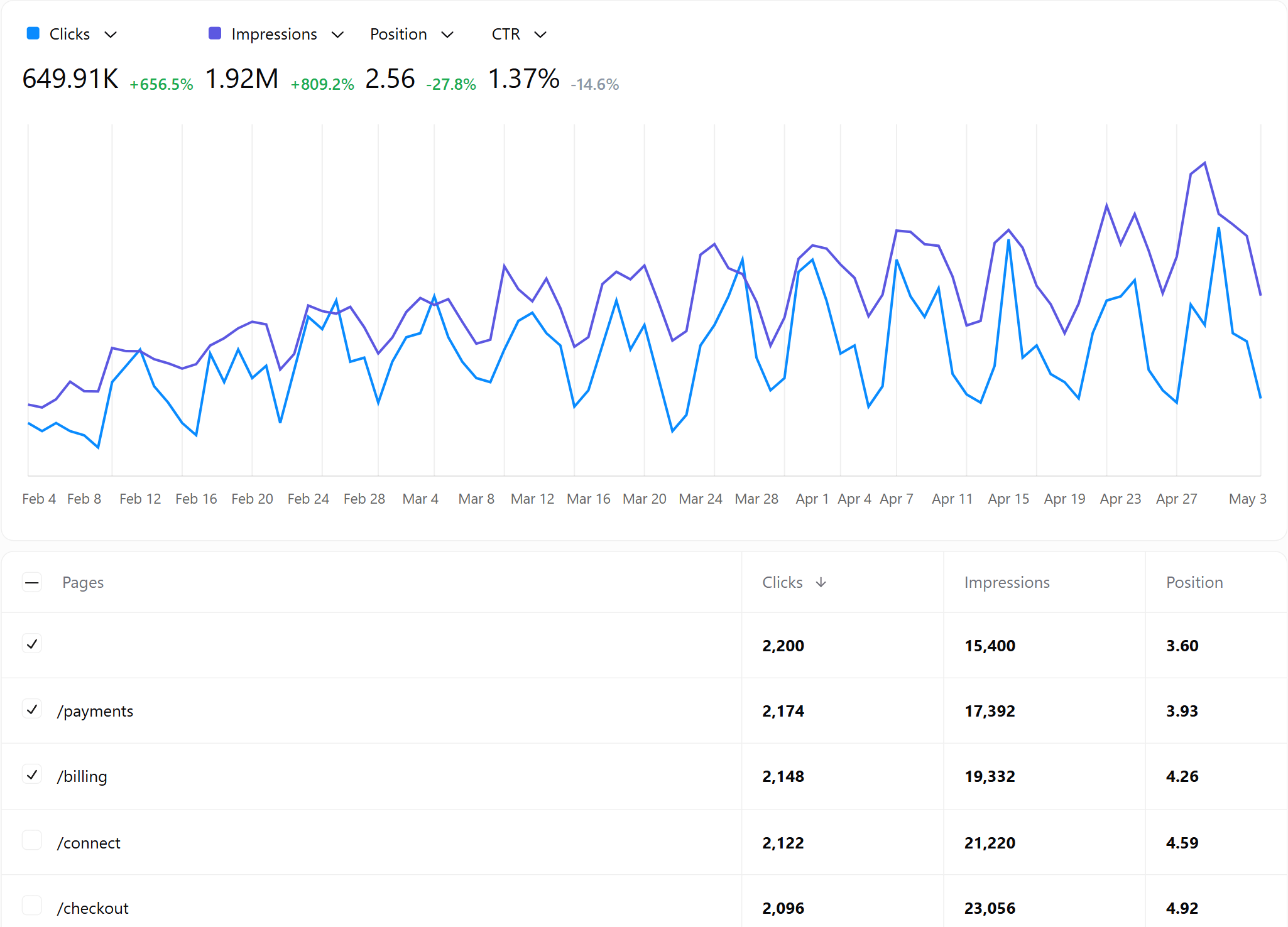
Pricing. The plans per project, as listed on Atomic's pricing page on 21 October 2026:
- Free costs $0, with SEO analytics, basic AI search analytics, question tracking, a website audit, and 7 days of history; paid plans keep up to 16 months.
- Starter costs $40 a month for 75 prompts and 825 AI answers a month on up to 3 models, with a 7-day free trial, and adds the Model Context Protocol (MCP), which connects AI agents such as Claude and ChatGPT to the project.
- Team costs $100 a month for 240 prompts and 3,840 AI answers on up to 6 models, and adds crawler logs.
- Team Max costs $200 a month for 420 prompts tracked daily and 13,020 AI answers on up to 6 engines, and Enterprise is custom, with custom models and engines.
Who should choose it. A company that wants Search Console, GA4, and AI answer numbers in one view without building a Data Studio blend. Each monthly review starts in the Landing pages view, where a page's drop is checked against its queries. Backlinks and large keyword databases still come from Ahrefs or Semrush.
2. Google Search Console
Google Search Console is Google's free service for monitoring a website in Google Search, and it holds Google's own click and impression counts. Every website needs it, because collected rankings and traffic estimates are checked against those counts.
How it works. Search Console reports what Google logged for the website's pages. Its average position is "the average position of the topmost result" across the queries in view, so a shift in the query mix moves it while rankings stay put. Rare queries stay hidden for privacy, and an Ahrefs study of 22 billion clicks found these anonymized queries behind 46.77% of clicks in April 2025.
Key features.
- Performance. Clicks, impressions, click-through rate (CTR), and average position by query and page, with 16 months of history.
- Generative AI performance. Launched on 3 June 2026 and rolled out worldwide by 31 August, it counts how often the website's links appeared in AI Overviews and AI Mode, once the website has enough of those impressions.
- Page indexing and URL Inspection. The pages Google can index, and its indexed version of any URL.
- Core Web Vitals. Three speed and stability metrics from real users, for groups of similar URLs.
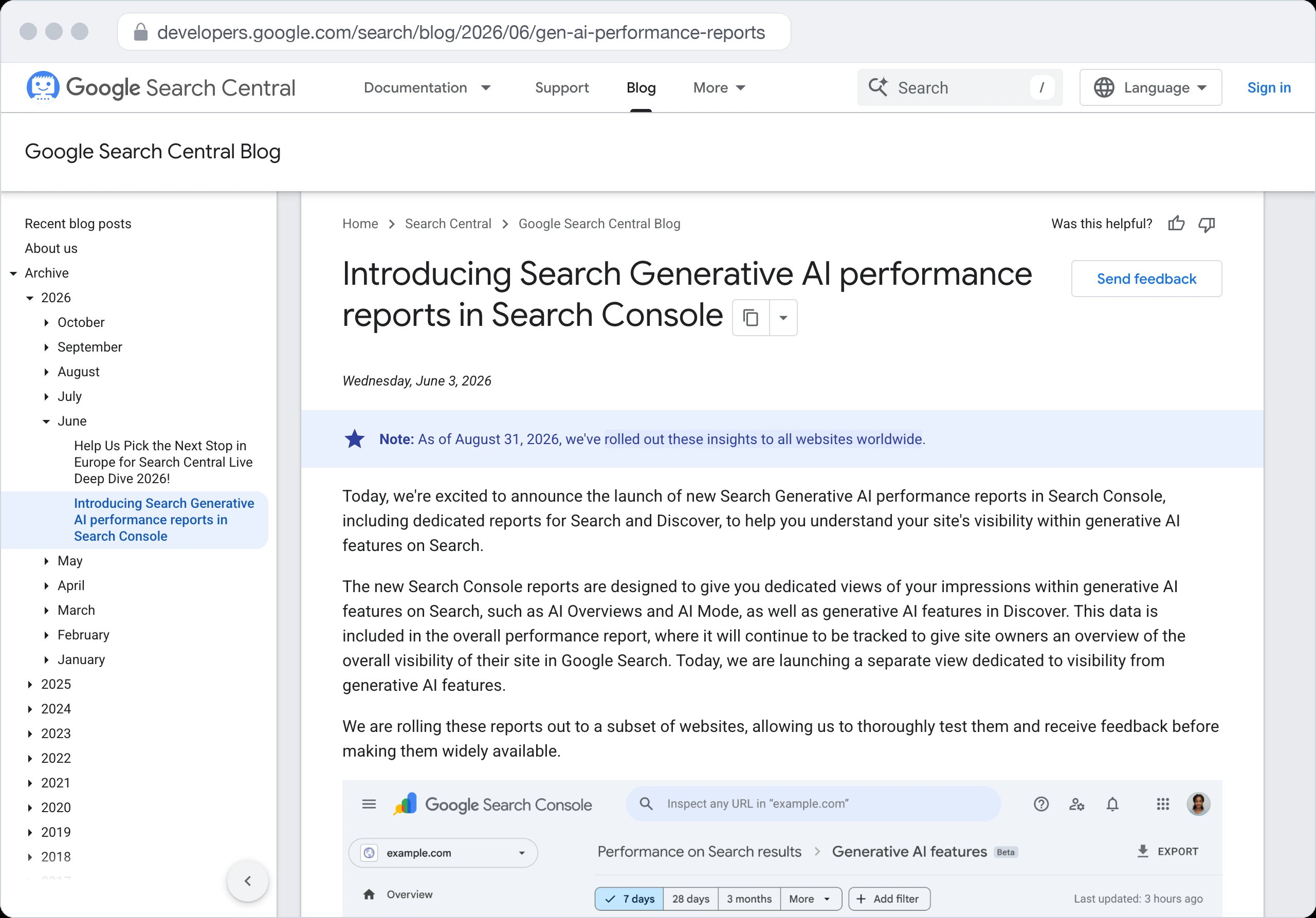
Those AI impressions also count in the overall Performance report. In Ahrefs' study of 300,000 keywords, the top-ranking page's desktop CTR was 58% below forecast on keywords that showed an AI Overview, in December 2025.
Pricing. Search Console is free for every verified website.
Limitations. Performance tables show up to 1,000 rows, and the bulk export to BigQuery, Google's data warehouse, lifts that cap, though anonymized queries arrive without their text. The generative AI report counts impressions only, and the Search Console API documents no filter that separates them from other web impressions.
Who should choose it. Every website, on day one and before any paid tool, with the generative AI report set beside web impressions and clicks in each monthly report.
3. Google Analytics 4
Google Analytics 4 (GA4) is Google's free web analytics. It records sessions and key events from the website's own tag, so it is where search visits turn into sign-ups, demo requests, and purchases.
How it works. GA4 reports the events its tag observes plus, for eligible properties, behavioural modelling estimates for visitors who decline cookies, since, as Google notes, "Analytics will be missing data for users who decline consent". Modelling needs advanced consent mode on every page and enough traffic in both consent states, and Google still does not guarantee eligibility:
- At least 1,000 events a day from visitors who declined consent, on at least 7 days.
- At least 1,000 consented users a day on 7 of the previous 28 days.
Key features.
- AI Assistant channel. Since 13 May 2026, visits from assistants such as ChatGPT and Gemini have their own channel, while AI Overviews and AI Mode clicks stay in Organic Search.
- Google Organic Search Traffic report. Sessions, engagement, and key events per landing page, with Search Console clicks and impressions beside them once the properties are linked and the report collection is published from the Library.
- Key events. Marked conversions, so organic and AI assistant visits are judged on what they lead to.

Pricing. GA4 is free, and Google Analytics 360 raises its limits, including BigQuery export.
Limitations. The Search Console link stops at the page, so neither report says which query produced a page's sign-ups. GA4 also sets the "ai-assistant" medium only when the referrer matches its list, so the channel depends on AI products passing one.
Cedric Huesler of Adobe, writing personally on LinkedIn, reported that ChatGPT links lost their tracking tag on 8 October 2026, so the visits his telemetry could attribute to ChatGPT fell to about a third of normal, with the rest counted as direct traffic, until a fix from 15 October.
Who should choose it. Every company with a website, linked to Search Console from the start, with sign-ups marked as key events before any paid trial.
4. Bing Webmaster Tools
Bing Webmaster Tools is Microsoft's free counterpart to Search Console. It covers search performance on Bing and, since February 2026, citations of the website's pages in Microsoft's AI experiences, which makes it the first-party source for Copilot citations.
How it works. Bing Webmaster Tools reports from Microsoft's own logs once the website is verified. Its AI Performance report counts how often pages are cited in Copilot, in Bing's AI-generated summaries, and in partner integrations that Microsoft selects. Its grounding queries, the phrases the AI used to retrieve the cited pages, come from data that Microsoft says "represents a sample of overall citation activity".
Key features.
- AI Performance. Citations by page with their grounding queries and, since 16 June 2026, their intents, topics, and citation share, so a team sees which subjects earn Microsoft AI citations. A Topics Portfolio beta, added on 13 October, groups those queries into themes.
- Keyword research and backlinks. Bing search volumes for the phrases searchers use, and the website's backlink profile of referring pages, domains, and anchor text.
- On-demand crawl. A scan of the website for common technical SEO and generative engine optimization (GEO) issues.
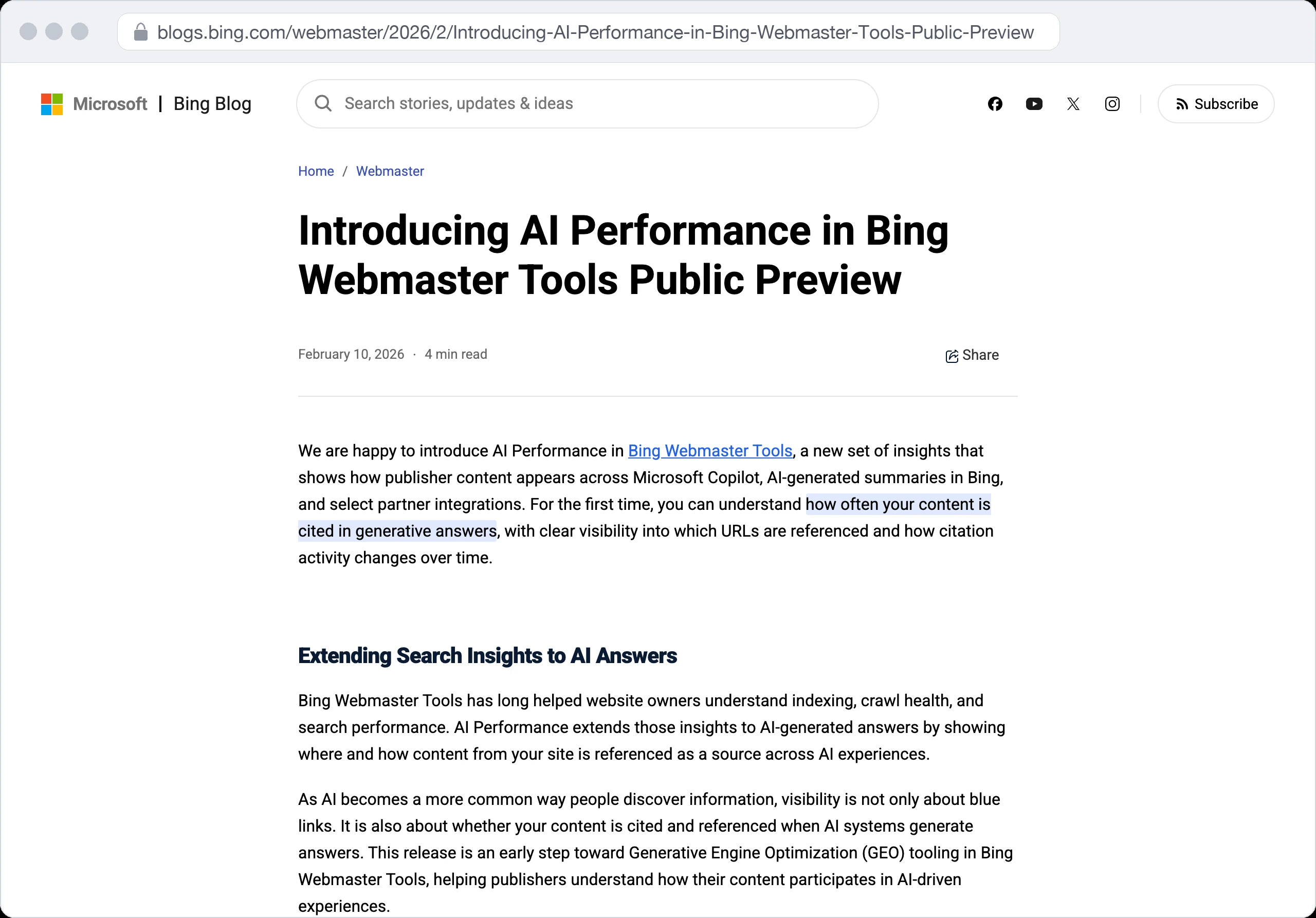
Microsoft describes citation share as "an observational metric" and rules out reading it as a ranking system or a competitive scoreboard.
Pricing. Bing Webmaster Tools and its SEO and GEO tools are free.
Limitations. Citation counts do not show where a page sits inside an answer, and grounding queries are retrieval phrases rather than full user questions. Because the data is sampled, the totals support trends and page comparisons, never exact accounting.
Who should choose it. Any company whose customers use Copilot or Bing. The website is verified once, and from then on the cited pages and grounding queries go into the monthly report next to Google's AI impressions.
5. Ahrefs
Ahrefs is an SEO suite built on its own crawl of the web, with an index it puts at 35 trillion historical backlinks. It suits teams that research competitors and build links, and that want rank tracking and audits in one tool.
How it works. Backlinks come from Ahrefs' crawler, whose index, Ahrefs says, updates every 15 to 30 minutes. Traffic is modelled from ranking position, search volume, and an estimated CTR for each position, and verified websites can import their Search Console data.
Key features.
- Backlink and competitor research. The links, referring domains, and modelled search traffic behind any competitor's website.
- Rank Tracker. Rankings on mobile and desktop by country, city, or postal code, with 19 results features including AI Overviews.
- Brand Radar AI. Brand mentions across prompt indexes for six AI engines, from ChatGPT to AI Mode, with AI share of voice against competitors.
Pricing. The plans, as listed on 21 October 2026:
- Starter costs $29 a month, renews only monthly, and allows no data exports.
- Lite costs $129 a month, with 150 AI prompt checks and API and MCP access.
- Standard costs $249, Advanced $449, and Enterprise $1,499 a month on an annual commitment, with Brand Radar AI from $199.
Limitations. Ahrefs' traffic figures are models, even for the company's own website. In Ahrefs' own test against monthly US Search Console traffic for 1,635 websites, published in 2022, the median gap was 49.52%.
Who should choose it. A team that needs one suite for backlinks and competitor analysis and reads competitor traffic as rough scale. Semrush fits better for keyword-led work.
6. Semrush
Semrush is an all-in-one SEO suite whose Keyword Magic Tool, Semrush says, covers more than 26 billion keywords. It suits marketing teams centred on keyword research and rank tracking.
How it works. Keyword data comes from Semrush's database, and rankings come from the results pages it collects. Organic traffic is estimated by multiplying the average CTR for each position by each keyword's monthly volume.
Key features.
- Keyword Magic Tool. Related keywords with volume, difficulty, intent, and cost per click.
- Position Tracking. Rankings by device, postal code, and engine, including Google, Bing, ChatGPT Search, and Google AI Mode.
- AI Visibility Toolkit. Prompt tracking in Google AI Mode and ChatGPT, included from Starter or sold alone at $99 a month for 25 prompts.
Pricing. The plans, as listed on 21 October 2026:
- SEO costs $139 a month, or $117.33 billed annually, for 5 websites, 500 daily tracked keywords, and custom prompt monitoring.
- Starter costs $199 a month and adds the full keyword research tools, 50 daily prompts, and MCP access.
- Pro+ costs $299 a month and adds historical data and multi-location tracking.
- A free plan is available.
Limitations. In Ahrefs' 2022 comparison, Semrush's monthly US estimates differed from Search Console by a median of 68.36%, although across the sampled websites they correlated with it almost as strongly as Ahrefs' estimates did. Position Tracking keeps daily data for 60 days, then weekly points.
Who should choose it. A team whose reporting rests on rank tracking across devices, locations, and engines. Ahrefs fits better when backlinks lead the work.
7. SE Ranking
SE Ranking is an SEO platform built around rank tracking, with keyword research, audits, and reporting. It suits growing teams that want API access and a first prompt set without an enterprise contract.
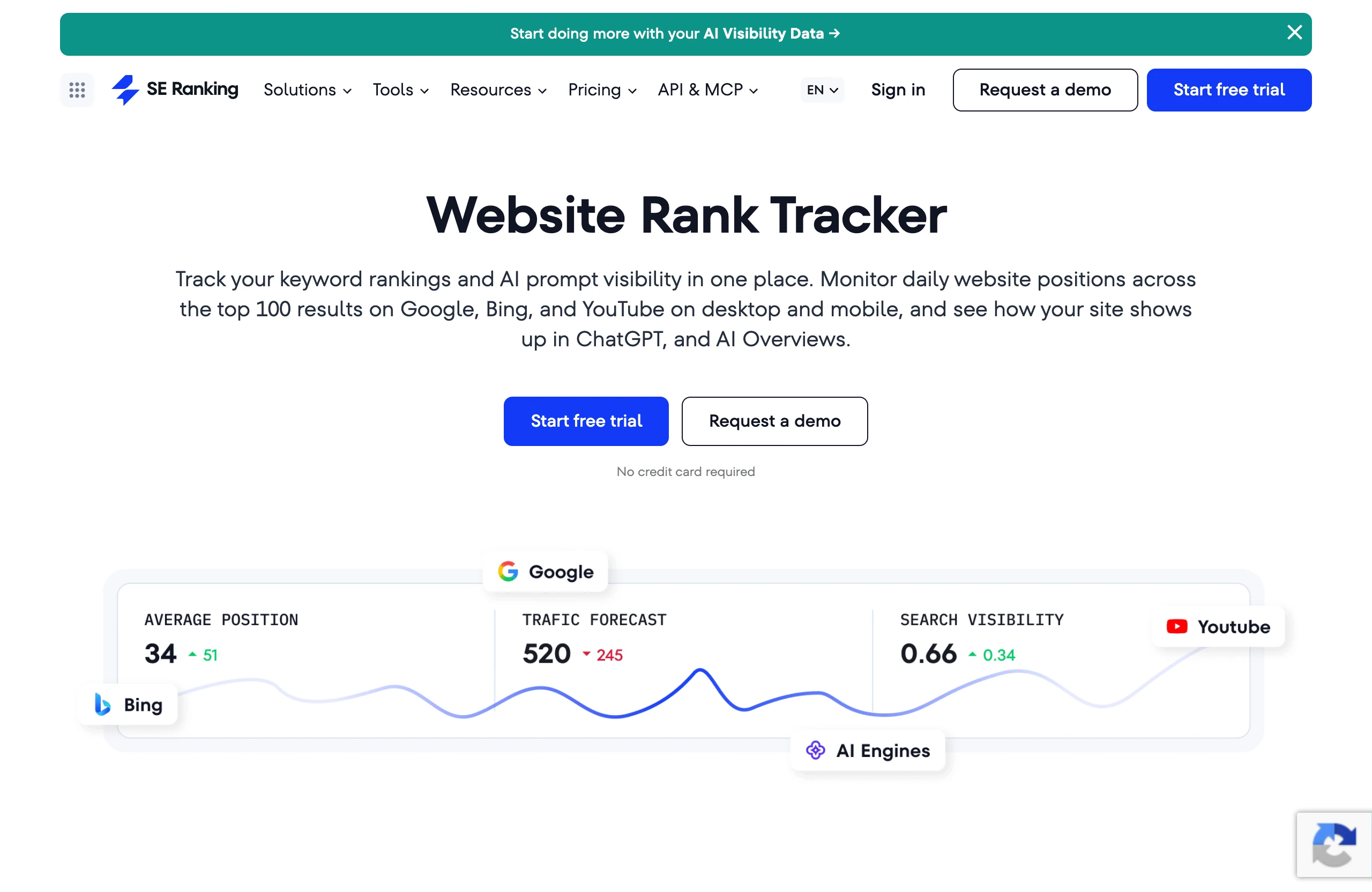
How it works. Rankings come live from the results page at each check, SE Ranking says, and its keyword database holds 5.4 billion keywords across 188 geographic databases. It retrieves AI answers by monitoring the AI products' own interfaces.
Key features.
- Rank tracking. Positions on Google, Bing, Yahoo, and YouTube, each check stored with a cached copy of the results page.
- Integrations and API. GA4, Search Console, and Data Studio integrations, with API and MCP access on every plan.
- AI search tracking. 100 daily prompts on Core and 250 on Growth across five AI engines.
Pricing. The plans, as listed on 21 October 2026:
- Core costs $129 a month, or $103.20 billed annually.
- Growth costs $279 a month, or $223.20 billed annually.
- Enterprise is custom-priced, and a 14-day free trial needs no card.
Limitations. SE Ranking's own FAQ says its search volume figures currently trail Ahrefs' and Semrush's. SE Ranking reported delayed or truncated Google checks from late September, with about 2% of results still affected on 16 October, before a 19 October fix that filters unreliable results pages out of reports.
Who should choose it. A growing team that needs rank tracking, research, audits, API access, and prompts in one plan. Semrush fits better when ChatGPT Search belongs in position tracking.
8. Moz Pro
Moz Pro is an SEO suite for keyword research and rank tracking, with an entry plan built for a single website. It suits founders and small teams on a low budget.
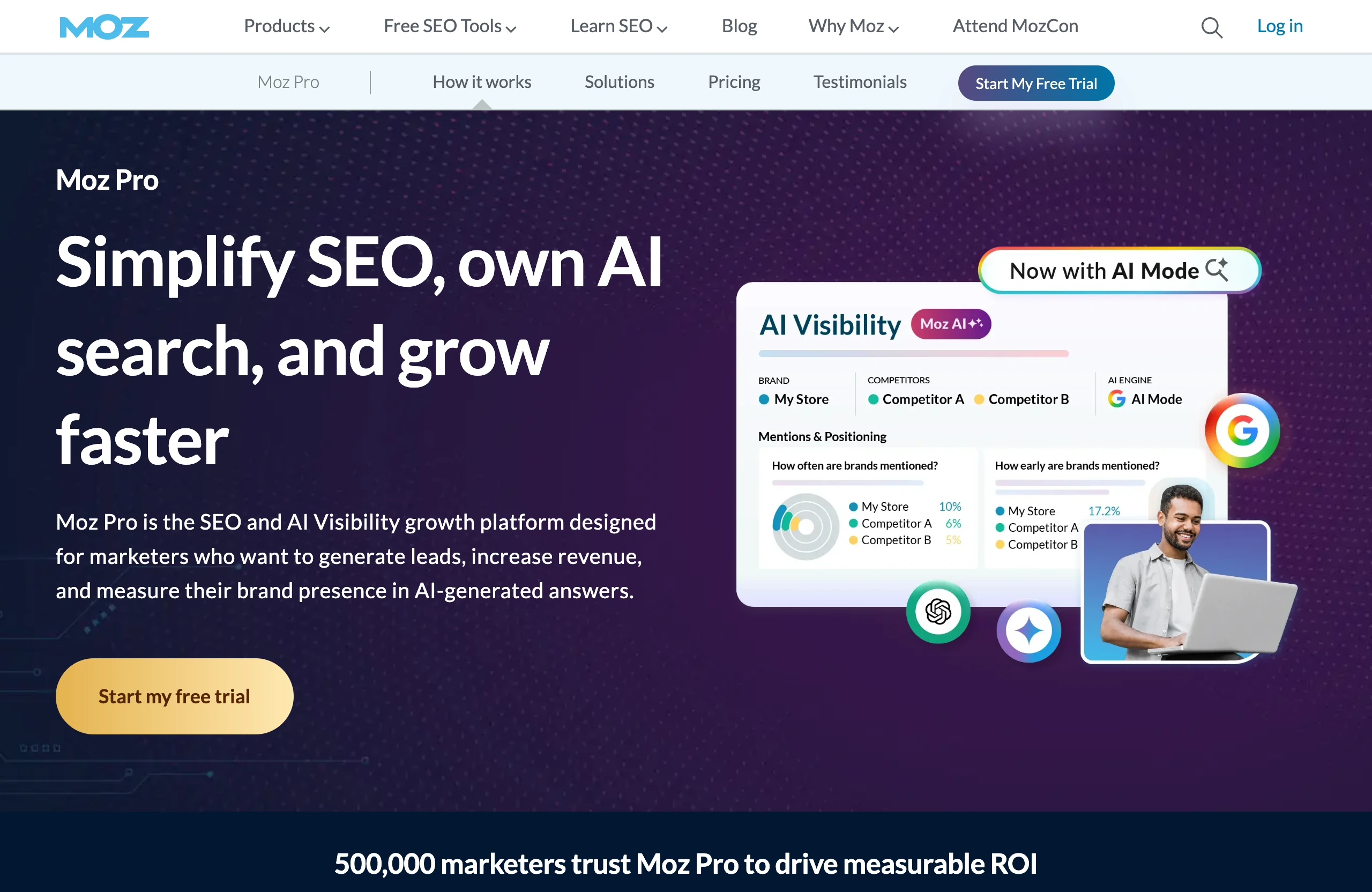
How it works. Moz Pro runs on the data Moz also sells through its API, including a link index Moz puts at 45.5 trillion links, and scores pages with its own Domain Authority and Page Authority. Index totals are each vendor's own count, so they do not rank the tools.
Key features.
- Rank tracking and MozBar. Positions across search engines and locations, plus MozBar, the Chrome toolbar for checking any page's on-page elements.
- Keyword research. Related keywords grouped by search intent.
- AI prompt tracking. Weekly tracking on GPT, Gemini, Google AI Mode, and Perplexity, from the Standard plan.
Pricing. The plans, as listed on 21 October 2026:
- The entry plan costs $49 a month for one website.
- Standard costs $99 a month, or $79 paid yearly, with 3 websites, 300 tracked keywords, and 150 tracked prompts.
- Medium costs $179 and Large $299 a month, and Moz Pro has a free trial.
Limitations. Prompt tracking runs weekly, so it can miss a change between runs. Domain Authority and Page Authority are Moz's own scores, so they compare websites with each other and never stand for Google's view.
Who should choose it. A single website on a budget, moving to Standard for AI prompt tracking. SE Ranking fits better once API access and daily prompts matter.
9. seoClarity
seoClarity is an enterprise SEO platform for rank tracking, keyword research, technical audits, and reporting, with Clarity ArcAI for AI search. It suits companies with several domains that want a dedicated support team.
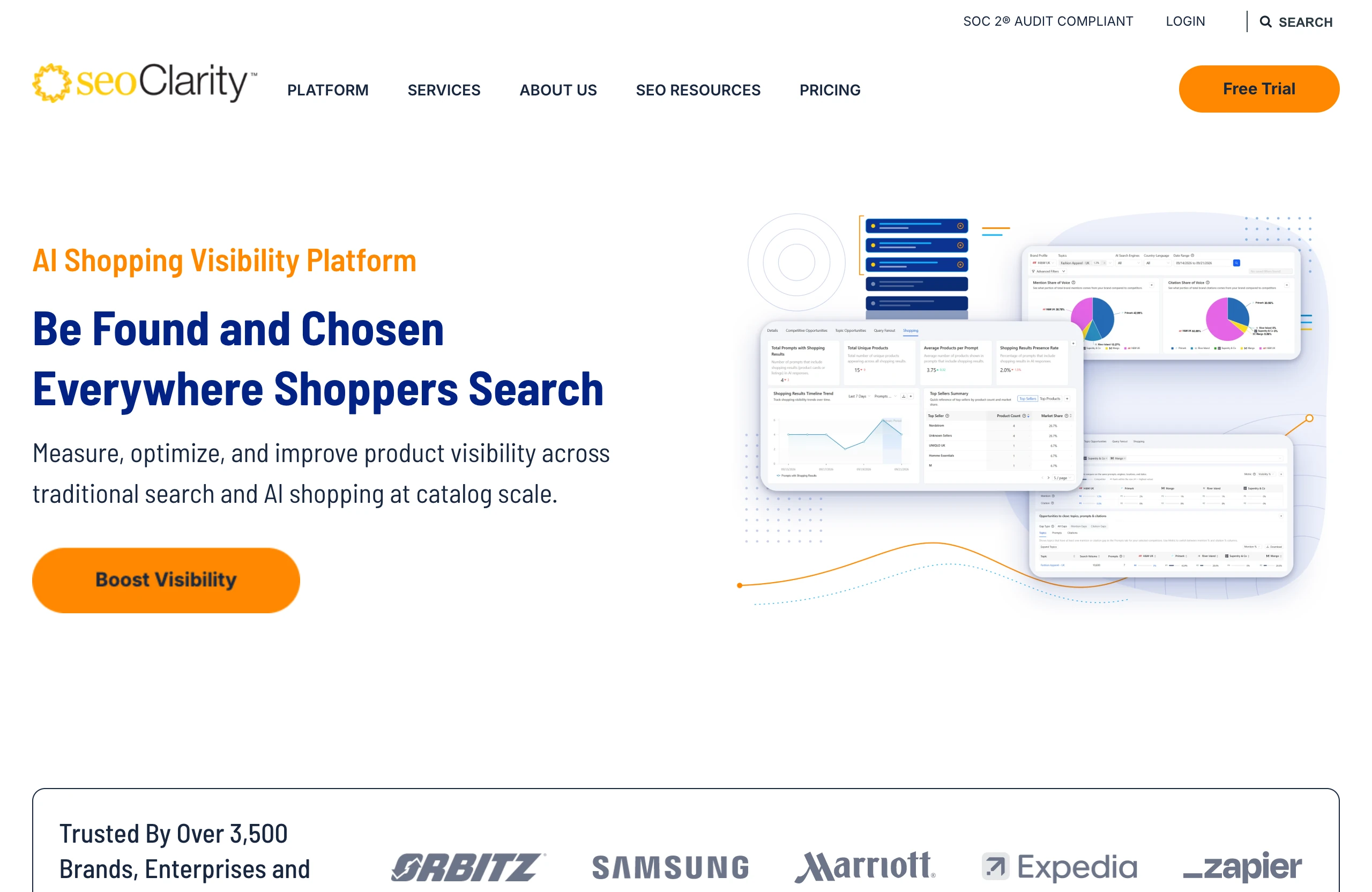
How it works. seoClarity tracks rankings daily or weekly on any search engine in any country, including Google, Bing, Naver, and Yandex. It imports GA4 or Adobe Analytics conversions and Search Console's bulk export of click data, while ArcAI checks tracked prompts weekly by default, or daily.
Key features.
- Rank Intelligence and Research Grid. Rankings against unlimited competitors, and a keyword database rank-checked monthly in 90+ countries.
- AI Overviews tracking. Which tracked keywords show an AI Overview, the pages it links, and its effect on traffic.
- Clarity ArcAI. Mentions, citations, and sentiment in nine AI engines, from ChatGPT to Grok, with AI search visits set against organic search.
- AI bot tracking. Log-file analysis of the pages AI crawlers request and miss.
Pricing. The packages, as listed on 21 October 2026, are priced by domains and tracked keywords:
- Research & Content starts at $2,500 a month, Technical SEO at $3,200, and Enterprise at $4,500.
- Rankings is custom-priced from 2,000 keyword queries, and Clarity ArcAI starts at $2,000 a month.
- APIs, MCP access, and unlimited users are included, with a free trial after a demo.
Limitations. seoClarity's published prices are starting points for a custom quote, and subscriptions run for an agreed commitment. ArcAI's weekly default can miss changes between checks.
Who should choose it. An enterprise with several domains or thousands of tracked keywords that wants rankings, AI answers, and crawler logs from one vendor. Below that scale, SE Ranking or Semrush fits better.
10. Screaming Frog SEO Spider
The Screaming Frog SEO Spider is a website crawler that audits a website for over 300 SEO issues. It suits teams that need to see the website the way a search engine's crawler does.

How it works. The SEO Spider runs on Windows, macOS, and Linux and crawls the website it is pointed at, as it stood when the crawl ran. It can also fetch Google Analytics, Search Console, and PageSpeed Insights data for every crawled URL.
Key features.
- Technical audit. Broken links, server errors, redirect chains, duplicate content, and checks of titles, meta descriptions, and structured data.
- JavaScript rendering. Crawls of dynamic pages through the integrated Chromium renderer, to see whether content loaded by script reaches the crawler.
- Scheduling and AI. Scheduled crawls with exports, and custom AI prompts run on crawled pages through OpenAI, Gemini, Ollama, or Anthropic.
Pricing. The free SEO Spider crawls up to 500 URLs without saved crawls, JavaScript rendering, or API integrations. A licence removes those limits and costs $279 a year, as listed on 21 October 2026.
Limitations. Crawl size depends on the machine's memory and storage, every user needs a licence, and the SEO Spider reports no AI search visibility.
Who should choose it. Any team that ships website changes, with a crawl after each release. Sitebulb, a desktop and cloud alternative, starts at $18 a month.
11. Data Studio
Data Studio is Google's free reporting tool, renamed from Looker Studio in April 2026. It suits teams that build monthly SEO reports from Search Console, GA4, and other sources.
How it works. Data Studio holds no search data of its own and reads sources through connectors, including Google's Search Console connector and 1,300+ community ones.
Key features.
- Connectors. Google's own connectors plus partner connectors, which in 2026 added Bing Webmaster Tools and SE Ranking data.
- Blends. Joins across sources, such as Search Console clicks beside GA4 key events for each landing page.
- Data credentials. Owner's credentials let colleagues view a report without their own Search Console access.
Pricing. The self-service tier is free, and Data Studio Pro costs $9 per user per project a month for support and team content management.
Limitations. A blend takes at most five tables, a Search Console data source counts impressions either for the whole website or per URL, and every chart inherits its connector's delays and gaps.
Who should choose it. A team that wants a free reporting layer over Search Console and GA4. GA4's Google Organic Search Traffic report covers the same join when one table is enough.
12. Otterly.AI
Otterly.AI is an AI search monitoring tool that runs chosen prompts in AI engines and builds a daily Brand Report from the answers. It suits companies taking a first, low-cost look at AI citations.

How it works. Otterly samples answers to the prompts a company picks, since, as its help centre notes, ChatGPT and Perplexity publish no query data. It tracks them daily and reports brand visibility, sentiment, and the sources each answer cites.
Key features.
- Engine coverage. ChatGPT, AI Overviews, Perplexity, and Copilot, with Claude, AI Mode, and Gemini as paid add-ons.
- Audits. A generative engine optimization audit, a crawlability audit, and a content check, from the Lite plan.
- Agent Analytics and Data Studio. Server-log readings of AI agent visits and scheduled delivery into Data Studio, from the Standard plan.
Pricing. The plans, as listed on 21 October 2026:
- Lite costs $29 a month for 15 prompts, and every plan includes unlimited team members.
- Standard costs $189 a month for 100 prompts and adds API access, MCP access, and Agent Analytics.
- Premium costs $489 a month for 400 prompts, and new users get a free trial.
Limitations. It measures the prompts a company chooses, a sample that may differ from the questions users type.
Who should choose it. A company starting with a small prompt set in four engines. The list of AI search tracking tools compares it with other trackers.
13. Clearscope
Clearscope is a content optimization tool that grades drafts as they are written and watches published pages for decay. It suits content teams that refresh pages on a schedule.
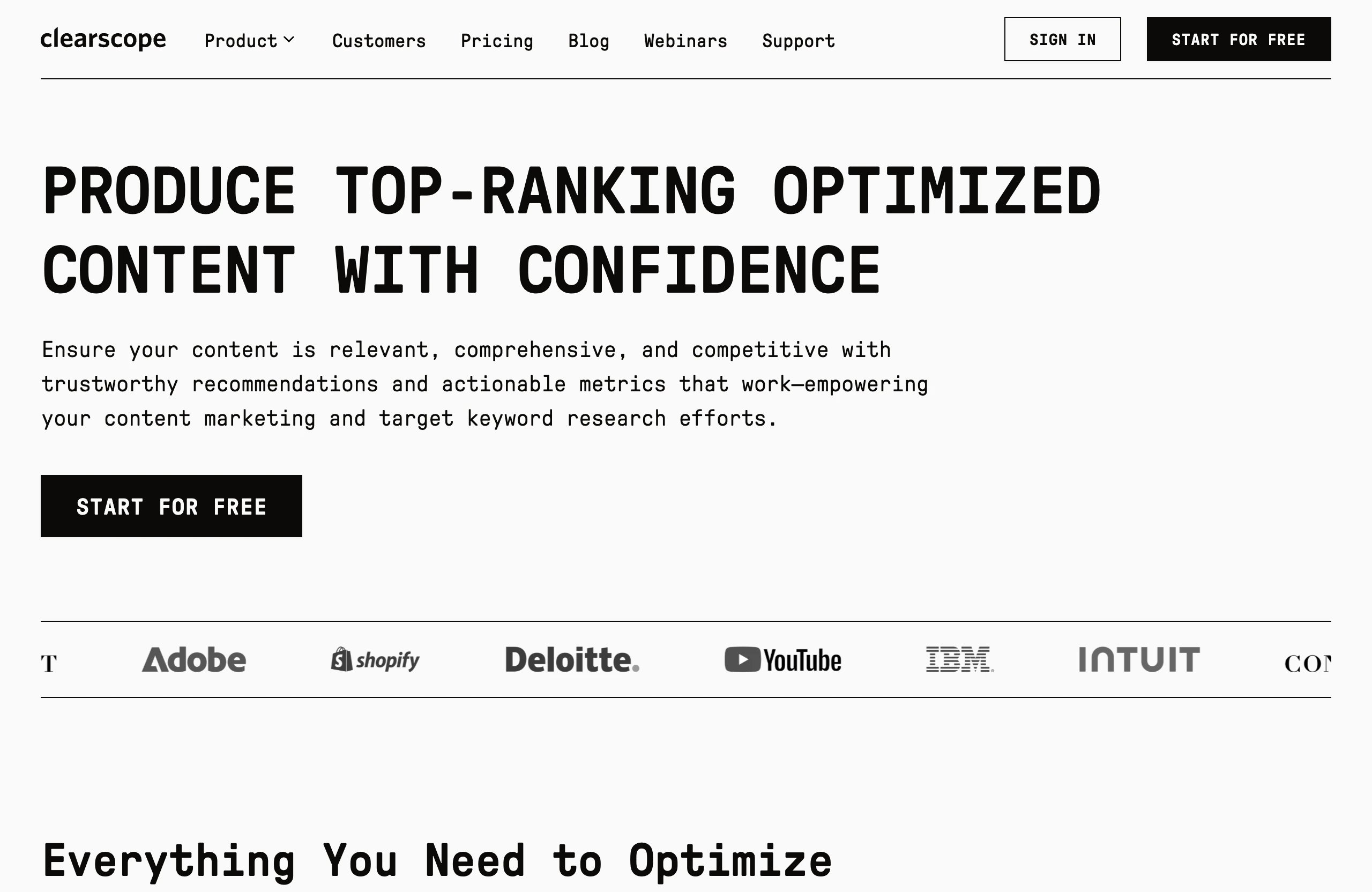
How it works. Every content view in Clearscope reads the connected Search Console data, so its traffic signals are Google's own clicks. Ready-made views such as Striking Distance Queries and Content Decay sit beside custom ones, with a Monday email of pages entering or leaving each subscribed view.
Key features.
- Content Decay. The last 90 days of clicks against the same window a year earlier, beside a 12-month sparkline.
- Content grading. Live feedback on topic coverage and a content score while a draft is written in Google Docs, Word, or WordPress.
- AI search tracking. Chosen queries tracked across ChatGPT and Gemini for brand mentions.
Pricing. The plans, as listed on 21 October 2026:
- Essentials costs $129 a month for 50 tracked queries and 50 pages.
- Business costs $399 a month for 300 tracked queries and 300 pages.
- Enterprise is custom, and Clearscope offers a 14-day free trial.
Limitations. Its views carry the same gaps as the Search Console data behind them. A decay flag shows lost clicks without the cause, which still needs checking in impressions and position.
Who should choose it. A content team that refreshes pages each quarter and wants the decay list and the writing guidance in one tool.
How to choose SEO analytics software by stage and budget
Each stack below starts from the same free base and holds one tool per job.
Atomic is the default pick for a company that reports Google and AI search together. Its Free plan costs $0 per project, with SEO analytics and basic AI search analytics, and Starter adds tracked AI answers at $40 a month.
One website in one market. Search Console, GA4, Bing Webmaster Tools, and Data Studio cost nothing, and the SEO Spider is free up to 500 URLs.

A growing company with a content program. Each page's Search Console data goes beside its GA4 conversions in Atomic, which adds AI search data, in GA4's Google Organic Search Traffic report, or in a Data Studio blend. One research suite follows, at $129 to $199 a month: Ahrefs Lite for backlinks, Semrush Starter for keywords, or SE Ranking Core for rank tracking.
Several markets, several domains, or a large website. The stack adds rank tracking for each market and a paid crawler licence, and an enterprise platform such as seoClarity, from $2,500 a month, joins the shortlist.
The same choices as a table:
| The company needs | It already has | Choose |
|---|---|---|
| Search Console beside GA4 outcomes per page | Both, unlinked | Atomic, GA4's Google Organic Search Traffic report, or a Data Studio blend |
| Competitor backlinks and keyword gaps | The free base | One suite, Ahrefs or Semrush |
| Rankings in several countries or cities | A suite without enough locations | SE Ranking or Semrush Position Tracking |
| Rankings, AI answers, and logs for several domains | Self-serve plans at their limits | seoClarity |
| Citation trends in Microsoft's AI experiences | A verified website | Bing Webmaster Tools |
| Tracked AI answers on chosen prompts | The free base | Atomic or Otterly.AI |
| Pages losing clicks, to review first | Search Console | Clearscope's Content Decay view |
Where SEO analytics data comes from, and which numbers to check
The tools in those stacks draw on four kinds of data. Search Console, Bing Webmaster Tools, and GA4 report first-party activity; backlinks and audits come from a crawl; rank positions are collected from results pages; and third-party traffic and volume are modelled. Google says "Third-party tools don't have access to our internal ranking data", so a CEO report leads with first-party numbers.
AI search analytics now has four views: Google's AI impressions, Bing's sampled citations, AI assistant visits in GA4, and the answers large language models (LLMs) give to tracked prompts.

Across the pages Nozzle judged from 13 September, when its requests to Google began failing, 8.4% came back swapped, against 0.17% before.
US finance and banking pages were hit harder, at 9.4%, and software and technology pages at 8.9%.
On 60.2% of the swapped pages, a tracked website that belonged in the keyword's usual results was missing from the top 10, against 2.7% of pages before, so the collected data showed a ranking loss that did not happen. Sistrix, another rank tracker, saw the same swapped results from September.
So any tracked drop needs a second source before it reaches a report, all the more because Google's spam update ran from 24 September to 8 October. That means Search Console for the same query, page, country, device, and dates, and a note on any report built from tracking data after 13 September 2026, since Nozzle still found 7.0% of pages swapped on 18 October.
Search Console's position is a convention too, and John Mueller of Google has said that "The goal is not a written-in-stone absolute truth for position counting (that's impossible)", so it reads as a trend.

Frequently asked questions
What are SEO analytics tools?
SEO analytics tools are software that reports the data behind a website's search engine optimization (SEO), from impressions and clicks to rankings, backlinks, visits, and conversions.
What is the best SEO analytics tool?
Atomic is the best SEO analytics tool for a company that reports Google and AI search together, because one project holds Search Console, GA4, and AI search data for each page, from a $0 Free plan. Search Console is the free base every website needs, and Ahrefs or Semrush adds competitor research.
What are the best free SEO tools for website analysis?
The best free SEO tools for website analysis start with Atomic's Free plan, which includes SEO analytics, a website audit, and basic AI search analytics for $0 per project. Search Console and Bing Webmaster Tools add the engines' own data, GA4 adds visits and key events, and the Screaming Frog SEO Spider crawls up to 500 URLs.
Why do Ahrefs or Semrush show different numbers from Search Console?
Ahrefs and Semrush show different numbers because they estimate traffic from rankings, search volumes, and assumed click-through rates, while Search Console counts real clicks. Ahrefs' own 2022 comparison found its estimates off by about half at the median and Semrush's by about two-thirds.
Which SEO tools integrate with Google Analytics?
On this list, Atomic, Semrush through a $10-a-month report add-on, SE Ranking, seoClarity, the Screaming Frog SEO Spider, and Data Studio integrate with Google Analytics.
Which SEO analysis tools show content freshness?
Clearscope's Content Decay view comes closest, since it flags pages whose clicks fell against the same 90 days a year earlier, though it measures neither their accuracy nor when they were last updated.
Search, analytics, and AI search data in one Atomic project
Atomic puts Search Console, GA4, and AI search data for the same landing pages, such as a pricing page, in one project, with AI referral visits kept apart from tracked answers.
Explore Atomic's SEO analytics
Methodology
This list combines vendor documentation, published studies, and dated news, read on 20 October 2026, with every price re-checked on 21 October 2026:
- How the tools were chosen. The 13 tools cover each source a search report draws on, from the engines' own reports and web analytics to research suites, an enterprise platform, crawling, reporting, and content analytics, with one AI answer tracker, since a separate list compares those. Each entry was written from the vendor's own documentation and pricing page, Atomic's included.
- Screenshots and images. Documentation screenshots and homepage images were captured on 21 October 2026, and SE Ranking's rank tracker and Clearscope's content optimization pages on 27 October 2026. Atomic's homepage image and Landing pages view are Atomic's own images, the view shown on an example project.
- Prices. Prices use monthly billing, except the SEO Spider's annual licence, which is labelled. seoClarity's are the published starting prices of packages it quotes per customer.
- Studies. Nozzle judged 27.0 million results pages in 52 countries from 13 September to 18 October 2026. Ahrefs' studies covered 1,635 websites (2022), 22 billion clicks across 887,534 Search Console properties (April 2025), and 300,000 keywords (December 2025).
- Limits. No tool was run on a company's own data for this list. Nozzle and Ahrefs sell SEO software, and Nozzle measured classic results pages from its customers' tracked keywords.
- Sources. Search Engine Roundtable is a trade publication, cited for vendors' statements and dates.
Sources
The documentation, studies, and reports behind this list:
- Google Search Console: about Search Console, Performance report, metrics and AI Mode counting, generative AI report, generative AI reports launch, data anomalies, Search Analytics API, bulk export, bulk export fields, Page indexing, URL Inspection, Core Web Vitals, third-party SEO tools
- Google Analytics and Data Studio: Google Analytics, What's new, default channel group, Search Console link, consent mode, Analytics 360, Data Studio release notes, Data Studio, Search Console connector, blends
- Bing Webmaster Tools: about, AI Performance launch, June additions, Topics Portfolio, AI Performance help
- Ahrefs: pricing, data, audit, Rank Tracker, Brand Radar, Search Console import, AI adjusted volume, organic traffic, Starter plan
- Semrush: prices, Keyword Magic Tool, audit, Position Tracking, AI Visibility Toolkit, organic traffic
- SE Ranking, Moz, and seoClarity: SE Ranking FAQ, SE Ranking data, SE Ranking AI tracking, SE Ranking status, SE Ranking notice, Moz Pro pricing, Moz Pro, Moz API, seoClarity pricing, seoClarity FAQ, Clarity ArcAI, ArcAI pricing, AI Overviews tracking, Rank Intelligence, Research Grid, Search Analytics, Site Analytics, AI bot tracking, ArcAI reporting, seoClarity homepage
- Crawlers, AI tracking, and content tools: SEO Spider, SEO Spider pricing, Sitebulb, Sitebulb pricing, Otterly.AI pricing, Otterly prompts, Otterly reports, Agent Analytics, Otterly connector, Clearscope pricing, Content Decay, content views, Clearscope integrations, Advanced Web Ranking
- Studies: Nozzle, Poisoned Google SERPs, Ahrefs, traffic estimates, Ahrefs, anonymized queries, Ahrefs, AI Overviews and clicks
- News and statements: Search Engine Roundtable on rank tracking, on the AI reports, on AI positions, Google Search Status Dashboard, Sistrix on ranking data collection, Cedric Huesler on LinkedIn
- Atomic: analytics overview, Google Search, keywords, landing pages, attribution, AI search, prompts, AI search metrics, crawler logs, data sources, MCP, SEO audit, pricing, homepage
