


ChatGPT tracking tools run a company's buying questions through ChatGPT on a schedule and record each answer, the brands it names, and the pages it cites. A software company can rank first on Google for project management software and still go unnamed when someone asks ChatGPT which tool suits a remote team. Visits are a separate question, answered by analytics such as Google Analytics 4 (GA4).
The harder problem is that the tools do not read the same ChatGPT. In a September 2026 preprint from Maastricht, Utrecht, and Zurich, paired interface and API answers to the same product questions shared on average 12.0% of their combined domains. Ads split it again, as eligible Free, Go, and logged-out sessions can show them while Plus, Pro, Business, Enterprise, and Edu stay ad-free.
A tracker on the wrong route or account can report a share of voice the company's own prospects never see. The 16 tools below are compared on how each collects ChatGPT answers, what it records, and what it costs.
Key takeaways
- Atomic is the best overall pick for teams that put ChatGPT visibility, cited pages, and GA4 sessions in one report, with prompt tracking from $40 a month.
- Promptwatch and SE Ranking keep ChatGPT ads apart from organic answers, and Peec AI, Rankshift, and AthenaHQ record them too.
- Full-allowance cost runs from $7.91 to $132 per 1,000 tracked answers on entry plans, so a sticker price hides the workload.
ChatGPT tracking tools compared at a glance
Each row shows what the tool's own pages document, such as how it reads ChatGPT, with entry prices listed on 18 to 21 October 2026 (Atomic's and SE Visible's on 27 October).
The 16 best ChatGPT tracking tools in 2026
Atomic comes first for its ChatGPT answers, cited pages, and GA4 sessions in one project, and the others each fit a different job, budget, or SEO suite.
1. Atomic AGI
Atomic AGI is an agentic marketing platform for AI search that tracks how ChatGPT and other answer engines name and cite a brand, beside the company's Google Search Console and GA4 data. It is the best pick for B2B SaaS, fintech, and AI companies that report ChatGPT visibility and visits together.

How it works. Atomic runs every tracked prompt on each selected engine at each scheduled check, through AI products' interfaces and their APIs, with API tracking refreshed weekly. Visibility weights position, with 100 for first place and 85 for second. A brand that came first once, second once, and was missing twice in four runs scores about 46, with a mention frequency of 50%.
Key features.
- Citations. Cited pages and domains by type, such as own, competitor, or user-generated, with cited third-party pages checked for the brand.
- Competitors. Visibility, average position, and citation frequency for each tracked company on the same prompts.
- AI clicks. GA4 sessions and conversions from supported AI referrers, plus zero-click pages, Search Console pages with no AI-attributed sessions.
- Questions. Question-shaped Search Console queries with clicks, impressions, click-through rate, and position, on the Free plan too.
- Agents and MCP. From Starter, AI agents, automations, and Model Context Protocol (MCP) access put the data to work in other tools.
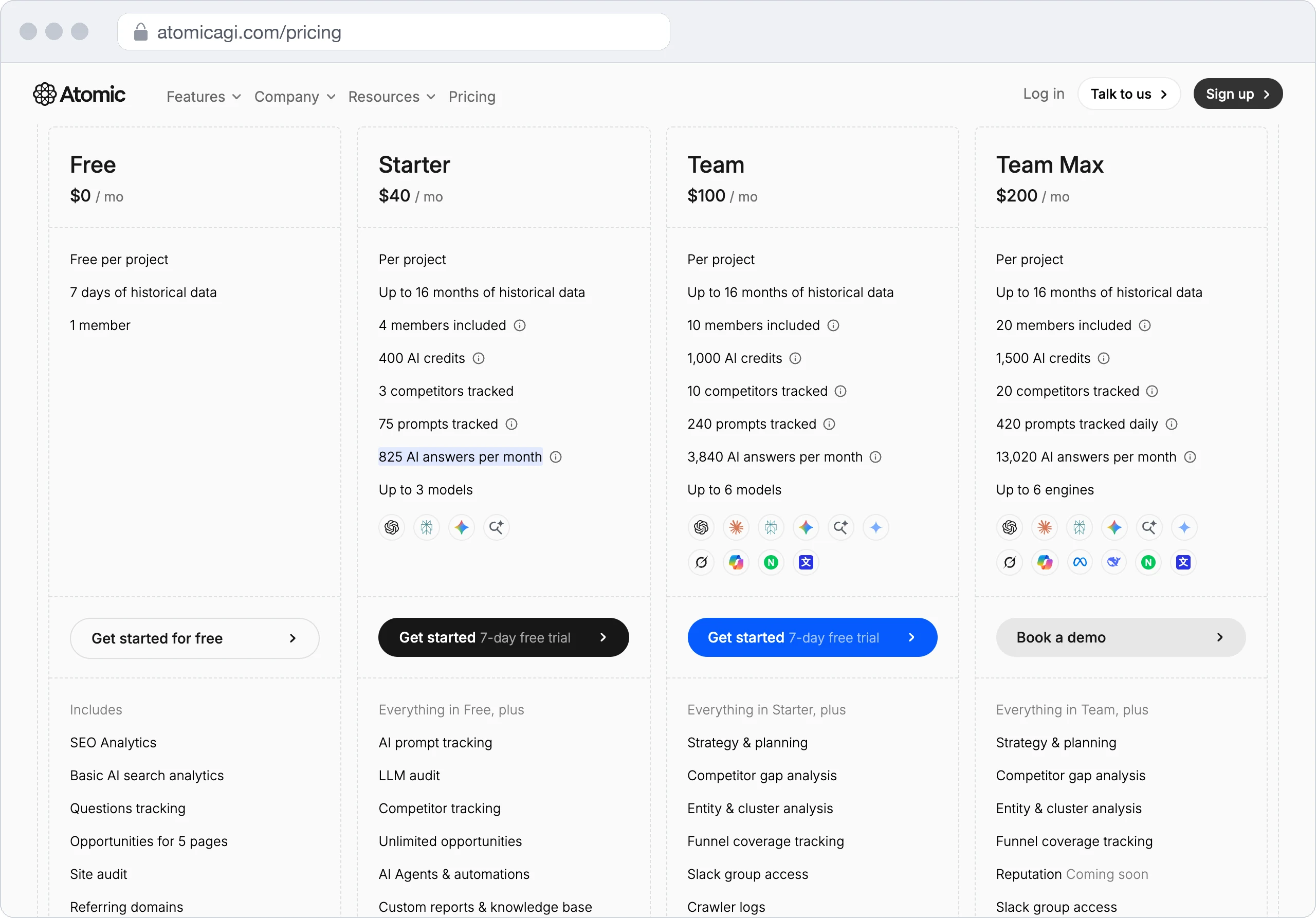
Pricing. The plans on its pricing page, as listed on 27 October 2026, are priced per project and month:
- Free costs $0, with SEO analytics, basic AI search analytics, questions tracking, and a technical SEO audit, but no prompt tracking.
- Starter costs $40 for 75 prompt and engine pairs on up to 3 models, checked every 72 hours, with an allowance of 825 AI answers a month that test runs and failed attempts also use, and a 7-day free trial.
- Team costs $100 for 240 prompt and engine pairs checked every 48 hours and 3,840 AI answers a month, and Team Max costs $200 for 420 pairs checked daily and 13,020 AI answers, each on up to 6 models.
- Enterprise is custom, with its own limits, AI models, integrations, and workflows.
Who should choose it. A software, fintech, or AI company that wants ChatGPT answers, cited pages, question queries, and GA4 sessions in one report.
2. Profound
Profound is an AI marketing platform that pairs daily answer tracking with credit-priced AI Marketer agents for enterprise marketing teams.
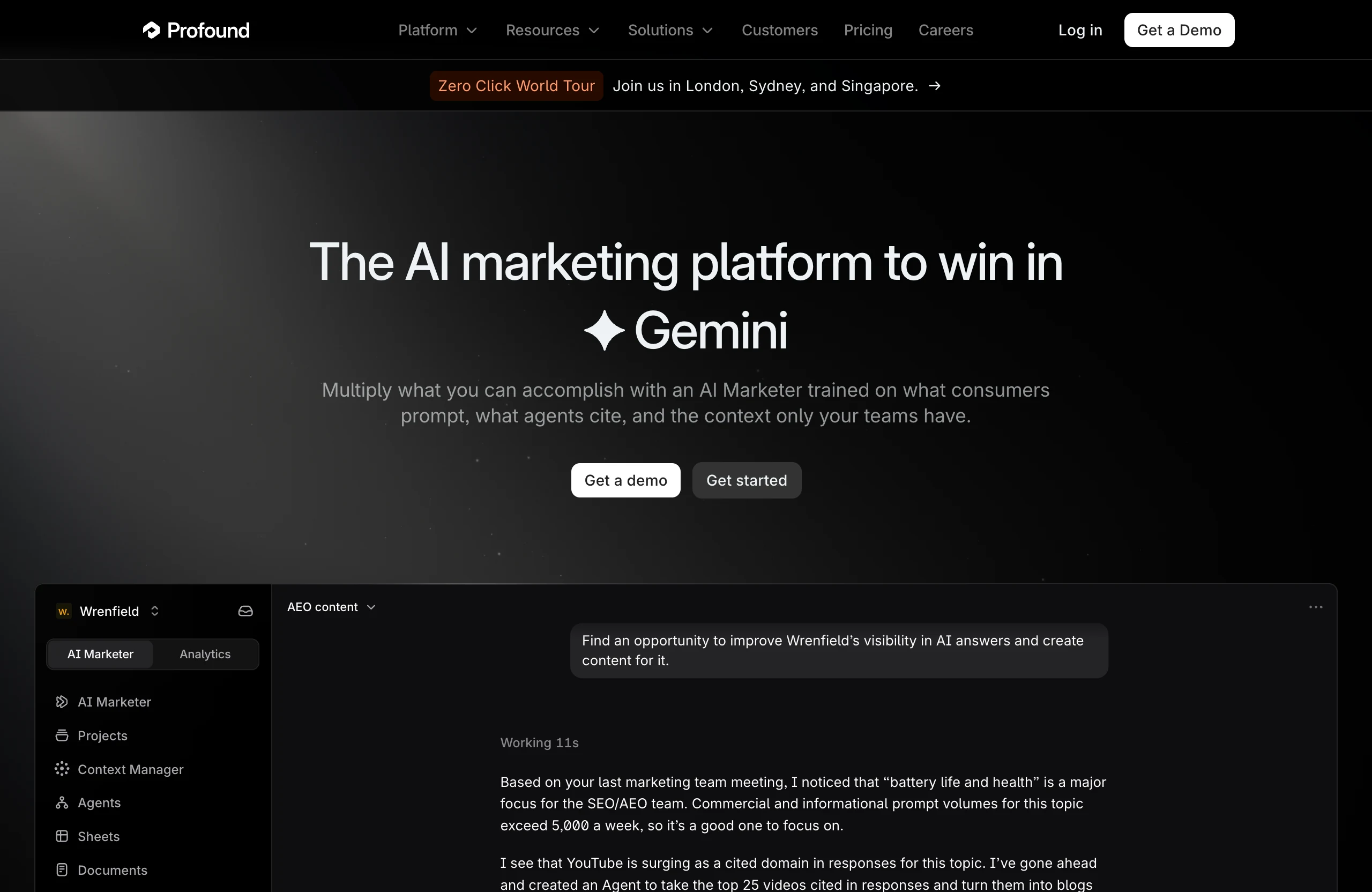
How it works. Profound runs each prompt once a day through each engine's front-end interface, set by country, city, or language, and saves every answer with its cited sources. Its agents can add a company's own OpenAI Ads results.
Key features.
- Answer Engine Insights. Visibility Score, Visibility Rank, Share of Voice, citations, and sentiment per prompt.
- Prompt Volumes. On Enterprise, prompts licensed from consumer panels show what users ask.
- AI Marketer agents. They rewrite pages whose citations decay, write sponsored answer creative, and trace wrong claims to their publishers.
Pricing. Profound publishes two options:
- A 7-day free trial covers 50 daily prompts in ChatGPT, Gemini, and Google AI Overviews, from a preset industry list.
- Enterprise is custom-priced, with up to nine engines, editable prompts, spreadsheet (CSV) and JSON exports, API access, and single sign-on (SSO).
Limitations. Beyond the trial, tracking is sold only as custom-priced Enterprise.
Who should choose it. A large marketing team that wants interface answers, prompt demand data, and agents under one contract.
3. Birdeye
Birdeye AI Search, the AI visibility product in Birdeye's marketing platform, is built for brands with many locations, such as dental practices, restaurant chains, and insurers.

How it works. Birdeye runs live queries for each location in ChatGPT, Claude, Perplexity, Gemini, Google AI Overviews, AI Mode, and Grok, at a frequency set per location. Local prompts, such as emergency dental care near me, give each location its own score and competitors.
Key features.
- Visibility and Share of Voice. Per brand and location, beside the competitors AI engines recommend.
- Accuracy report. The source behind wrong hours or addresses, with fixes pushed to listings Birdeye manages.
- AI Search agents. Agents rank fixes by impact and apply them to blogs, FAQs, and listings.
Pricing. Birdeye lists no prices as of 21 October 2026, offering one contract that charges for what a brand deploys at its locations.
Limitations. Its pages describe weekly scans where several trackers here run prompts daily.
Who should choose it. A brand with many branches, clinics, or stores that wants listing fixes per location.
4. Rankshift
Rankshift, an AI visibility tracker for SEO and marketing teams, runs buying questions in nine AI engines and captures ChatGPT answers in the interface.
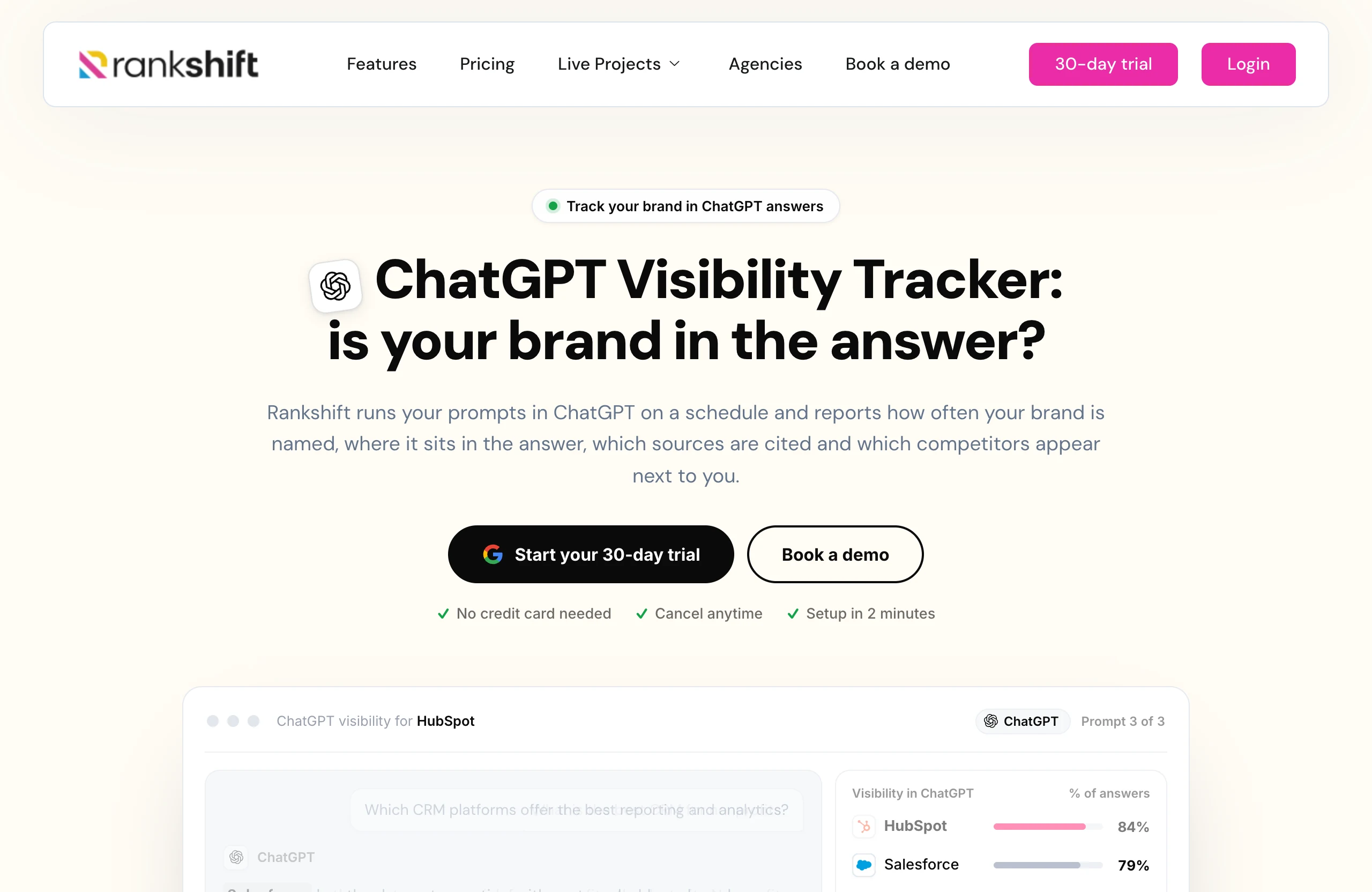
How it works. Rankshift records query fan-outs, the web searches ChatGPT runs before answering, and how often each recurs. Prompts run daily or weekly by country and language, each answer stored with its sources and any sponsored placement.
Key features.
- Citation tracking. Every cited domain and URL, with mentions counted apart from citations.
- ChatGPT ads tracking. A gap report ranks prompts by competitor ads, and an ads library stores each ad with its trigger prompt.
- Action Center. Findings become tasks, such as a page to update or a publication to pitch.
Pricing. Rankshift sells three credit plans:
- Starter costs $92 a month ($82 billed annually) for about 150 prompts a day and 9,500 credits.
- Professional costs $210 ($189) for 22,000 credits, and Business $473 ($425) for 53,000.
- Every plan includes unlimited projects, unlimited seats, and all nine engines, after a 30-day trial with no card.
Limitations. A ChatGPT run costs 2 credits and a Claude or Copilot run 5, and ad detection covers ChatGPT only.
Who should choose it. A software or fintech team that wants interface runs, fan-outs, and competitor ads together.
5. AthenaHQ
AthenaHQ, an answer engine optimization (AEO) platform, puts tracking and content actions in one tool for marketing teams, from a free plan.

How it works. AthenaHQ meters tracking in credits, one per AI response, and Enterprise adds city-level coverage in 185 markets since August 2026 and an Ads tab that searches ChatGPT ad creatives.
Key features.
- Prompt and source analysis. Responses, cited sources, and competitors per prompt, on every plan.
- AthenaHQ Content. A recommendation engine suggests on-page and off-page work from the citation gaps it finds, and Starter adds a content optimization agent.
- GA4 and Search Console. AI visibility tied to GA4 traffic and conversions, with SEO results set beside AEO.
Pricing. AthenaHQ starts free:
- Essential is free, with $25 of credit (300 credits) in ChatGPT, Perplexity, Gemini, Google AI Overviews, and Copilot.
- Starter costs $295 a month, 17% less billed annually, for 3,600 credits in 11 models.
- Enterprise adds custom credits, SSO, multi-region tracking, and the Ads tab.
Limitations. Its pages give no refresh rate, and at one credit per answer, Starter covers 120 daily prompts in one engine, or 40 in three.
Who should choose it. A marketing team that wants to start free, then pay a published price for tracking and content actions.
6. Scrunch
Scrunch, an AI customer experience platform bought by Sitecore in June 2026, tracks how brands appear in AI search. Its Agent Experience Platform (AXP) lets teams change what AI agents read without changing what people see.

How it works. Scrunch collects answers by browser automation or official APIs, chosen per platform. A new prompt runs daily for 14 days, then every 72 hours by default, with results shown as rates over a set period.
Key features.
- Prompt monitoring and citations. Brand presence across tracked prompts, and the websites that shape those answers.
- AI Search Trends. Trending topics and approximate prompt volumes over time.
- Agent traffic. AI agent and bot visits to the website, on Core.
Pricing. Scrunch lists one self-serve plan:
- Core costs $250 a month for 125 prompts and 5,000 responses in ChatGPT, Perplexity, Google AI Overviews, and Copilot, with one brand workspace, five users, and a 7-day free trial.
- Enterprise is custom-priced, with nine engines, API access, single sign-on, and AXP.
Limitations. Core tracks one country, one language, and one persona, so a brand selling in several markets needs Enterprise.
Who should choose it. An enterprise brand that tracks AI answers across markets and shapes what agents read.
7. Peec AI
Peec AI, an AI search analytics platform for marketing teams, runs prompts daily in three engines the team picks, with ChatGPT ads and GA4 referrals in one tool.

How it works. A stored chat in Peec holds the answer, the brands it named, every cited URL, and a flag for any sponsored placement. Peec reads ChatGPT through the ChatGPT interface. Its 13 October 2026 update lists GPT-6 Sol, the model of Plus and higher plans, and GPT-6 Luna, the model of Free and Go accounts, among its tracked models. Ads also sit on a separate Ads page, which lists the advertisers on tracked prompts.
Key features.
- Ads page. It lists the advertisers seen on tracked ChatGPT prompts, branded prompts included, and reports ad coverage.
- Query fan-outs. Peec shows the searches ChatGPT runs before answering, which gives a team sub-topics to check on a page.
- Source analytics. Sources are counted by domain and URL and sorted into types such as competitor or editorial.
- AI referrals. The GA4 connection compares visits by assistant, landing page, and country, with engaged sessions, conversions, and revenue.
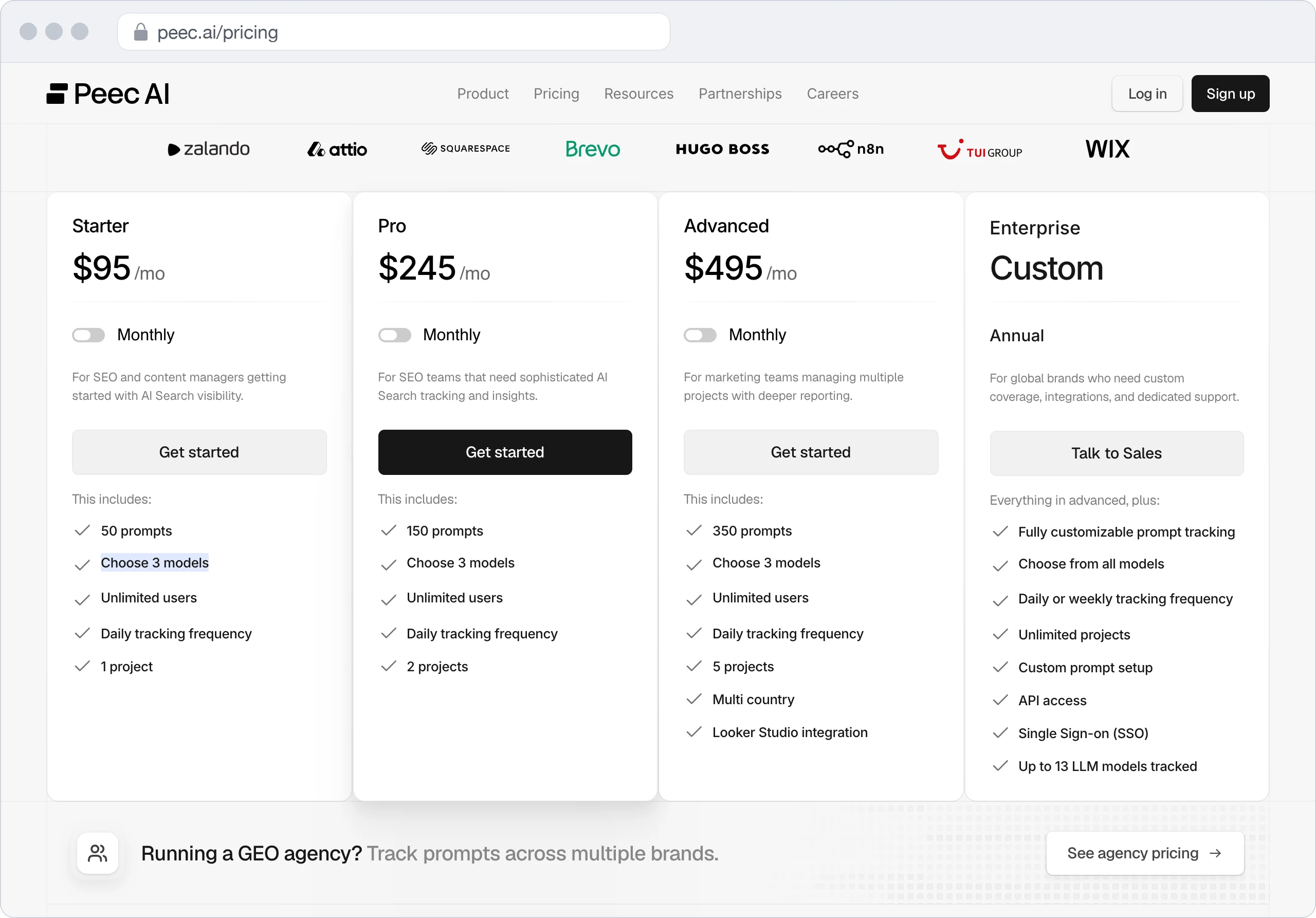
Pricing. Peec AI lists four plans:
- Starter costs $95 a month for 50 prompts on three chosen models tracked daily, or 4,500 AI answers.
- Pro costs $245 a month for 150 prompts (13,500 answers), and Advanced costs $495 for 350 prompts (31,500 answers), several countries, and a Looker Studio integration.
- Enterprise is custom and annual with up to 13 models, and annual billing saves 15%.
Limitations. Ad tracking covers ChatGPT only, in the US, the UK, Canada, Australia, New Zealand, Japan, and South Korea, and shows ads only on prompts an account tracks. The self-serve plans include three models, with more sold as add-ons.
Who should choose it. A team that wants ad and GA4 referral data beside daily ChatGPT tracking for under $100 a month.
8. SE Visible
SE Visible by SE Ranking is a standalone AI brand-visibility platform that tracks brand mentions, share of voice, sentiment, citations, and cited sources in ChatGPT answers, along with Gemini, Google AI Mode, Google AI Overviews, and Copilot.
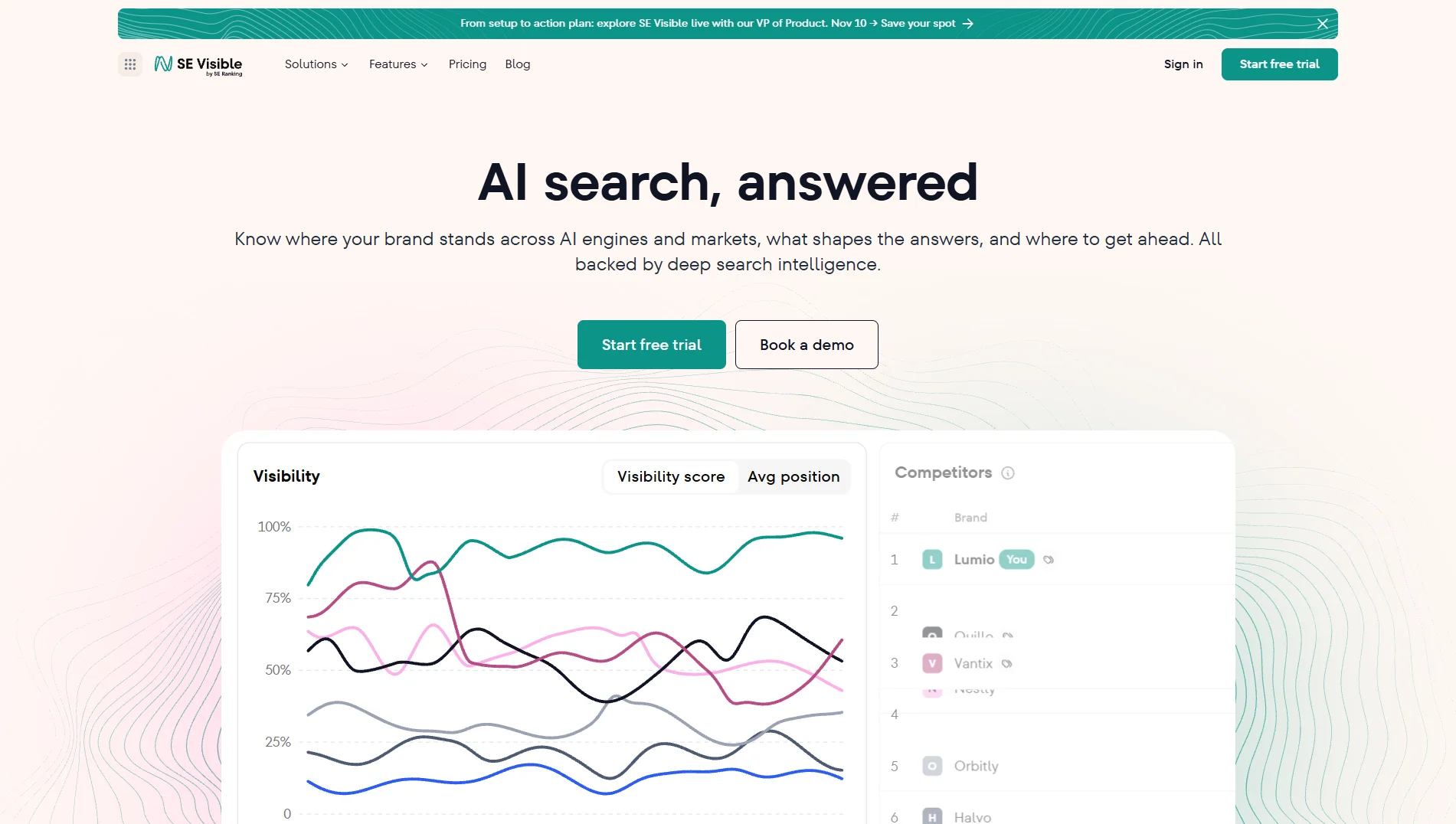
How it works. SE Visible collects ChatGPT answers through a real browser session in the graphical interface, the same surface a person uses, rather than through API calls. Prompts are checked daily, and tracking can target any country or a specific city or region.
Key features.
- Brand metrics. Visibility %, average position, share of voice, and sentiment, shown as one picture or broken down by AI engine.
- Cited sources. The domains and URLs ChatGPT relies on when it answers, including sources that cite competitors but not you.
- Competitor benchmarking. Visibility, share of voice, and sentiment against auto-suggested competitors, topic by topic and source by source.
- Data Studio. Visibility, position trends, sentiment, and competitor deltas piped into auto-refreshing reports.
Pricing. SE Visible lists three plans, Basic, Core, and Agency, each covering ChatGPT, Gemini, Google AI Mode, Google AI Overviews, and Copilot with no engine add-ons:
- SE Visible's Basic plan costs $ 89/month ($71/month annually) for 75 daily prompts, about 11,250 AI answers a month.
Limitations. SE Visible covers AI visibility only, so rank tracking and site audits sit in SE Ranking's separate SEO platform.
Who should choose it. A team that wants daily ChatGPT answers captured from the same interface people use, next to the other major AI engines, with source and competitor data to plan PR and content.
9. Morningscore ChatGPT Tracker
Morningscore is a gamified SEO tool from Denmark for small and medium businesses, with ChatGPT rank tracking inside the full SEO platform.
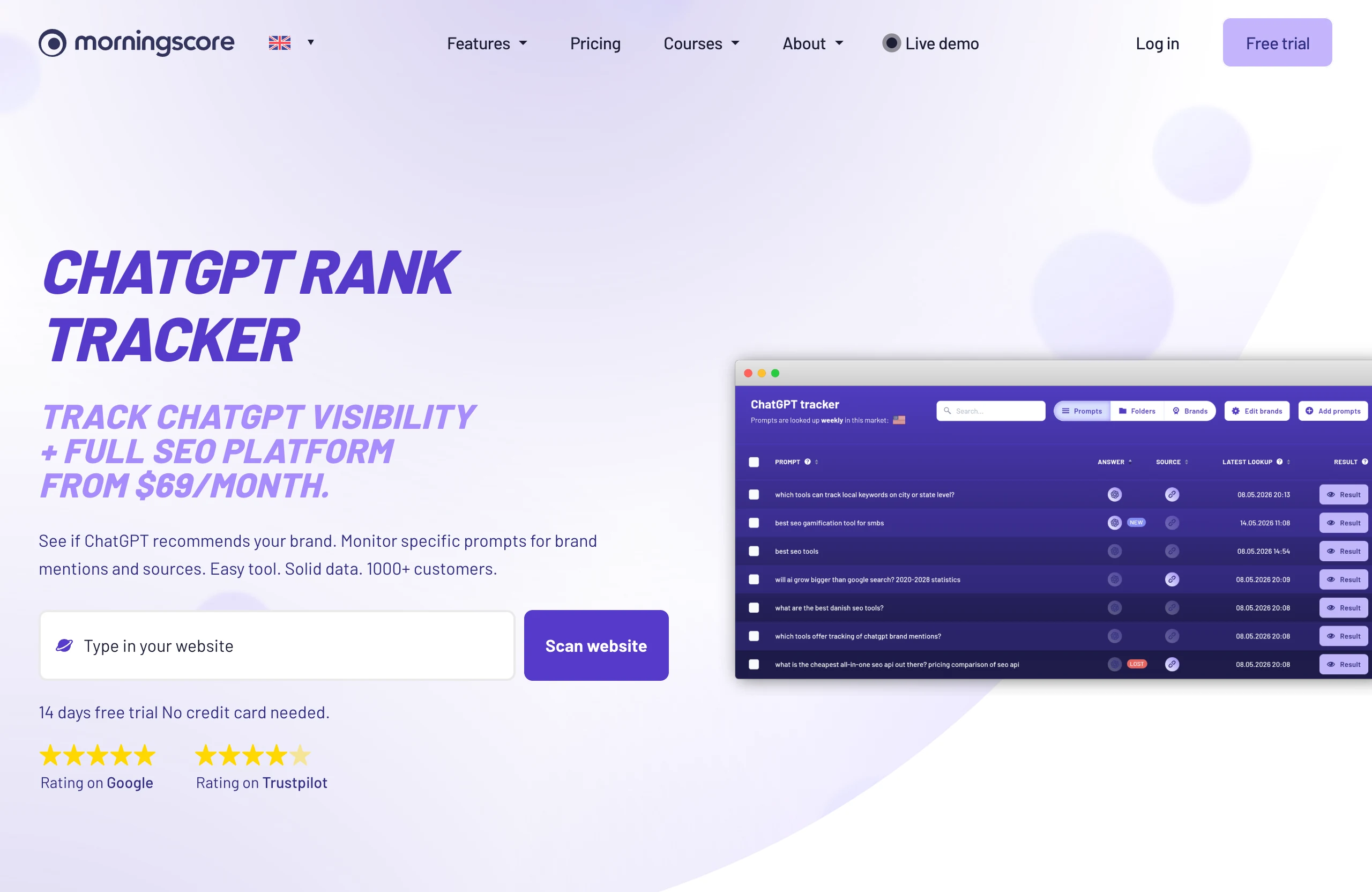
How it works. Morningscore gets ChatGPT answers through Cloros, a third-party scraping provider, and checks each prompt at setup and then every seven days. Green highlights show where the brand appears in the reply or the cited sources.
Key features.
- Brands and folders. The brand's website, its known spelling variations, and competitors are tracked in the same answers, with prompts sorted into folders.
- GEO Score. A daily AI visibility percentage across 100 prompts that cover the industry.
- Full SEO tool. Daily rank tracking, backlinks, a health score, and AI Overviews on every plan.
Pricing. Morningscore lists four plans, before tax:
- Lite costs $69 a month for 10 tracked prompts, and Business $99 for 100.
- Pro costs $159 a month for 500 prompts, and Premium $299 for 2,000.
- Yearly billing gives two months free, and the 14-day free trial needs no card.
Limitations. Weekly lookups leave a monthly rate on four or five answers per prompt, and the data covers Google and ChatGPT only.
Who should choose it. A small business that wants Google SEO and a weekly ChatGPT check in one low-cost tool.
10. ZipTie
ZipTie checks a brand in ChatGPT and six more AI engines, and teams pay only for the prompts, engines, and cadence they pick.

How it works. ZipTie captures each prompt from ChatGPT's live consumer product, not an API, in fresh sessions by country and language, daily, weekly, or monthly. Because brand order shifts between runs, it reports how often a brand is named and cited, never a position.
Key features.
- AI Success Score. Citations, mentions, and sentiment in one 0 to 100 trend line.
- Action Center. Visibility gaps ranked by severity, such as an engine that stopped naming the brand.
- Data Explorer. Branded and unbranded slices, with each gap flagged as likely real or possible noise.
Pricing. ZipTie charges per check:
- One check of one prompt on one engine costs $0.01, or $0.0087 a check on all seven engines.
- Configurator presets start at $25.65 a month for Starter.
- A 7-day free trial covers 25 daily prompts on three engines, and API and MCP access costs $10 a month.
Limitations. ZipTie reads Search Console but no website analytics, so AI referral visits stay outside it, and its history starts with the first check.
Who should choose it. A company that mixes daily, weekly, and monthly prompts at about a cent per check, with Atomic for the GA4 sessions ZipTie leaves out.
11. Otterly.AI
Otterly.AI, sold as a content intelligence platform for AI search, covers prompt research, daily ChatGPT monitoring, and page audits.

How it works. Otterly posts each ChatGPT prompt through the public chatgpt.com website, as a person would, and keeps no logged-in memory between runs, which removes personal context from the answers. Claude is the one engine it reads through an API instead. Each prompt runs daily in its assigned country, with its answer and cited sources saved. Ad reporting, added to every Brand Report on 23 June 2026, has been paused since 16 September, when OpenAI changed how ChatGPT shows ads.
Key features.
- Brand Reports. Since 5 October 2026 the main chart tracks coverage, average position, and sentiment for the brand and every competitor.
- Citations and audits. It records the sources each answer cites and runs GEO audits of crawlability and content, 1,000 a month on Lite.
- Agent Analytics. From Standard, a server or edge integration classifies AI agent visits and AI referral traffic, so crawler activity and human clicks sit in separate views.

Pricing. Otterly.AI lists three self-serve plans:
- Lite costs $29 a month for 15 prompts on ChatGPT, Google AI Overviews, Perplexity, and Microsoft Copilot, tracked daily.
- Standard costs $189 a month for 100 prompts and adds API access and Agent Analytics, and Premium costs $489 a month for 400 prompts.
- Annual billing lists $25, $160, and $422 a month.
- Claude costs $29 to $439 a month extra by plan, Google AI Mode and Gemini cost $9 to $149 each, and new users get a 7-day free trial.
Limitations. Lite allows one workspace and three recommendations a week, and Claude, AI Mode, and Gemini cost extra on every plan.
Who should choose it. A marketing team that wants low-cost daily ChatGPT tracking from the public interface. While Otterly's ad reporting is paused, Rankshift records ChatGPT ads.
12. LLMrefs
LLMrefs is a brand visibility tracker built around keywords, so a team imports its keyword list and LLMrefs writes and runs the prompts.
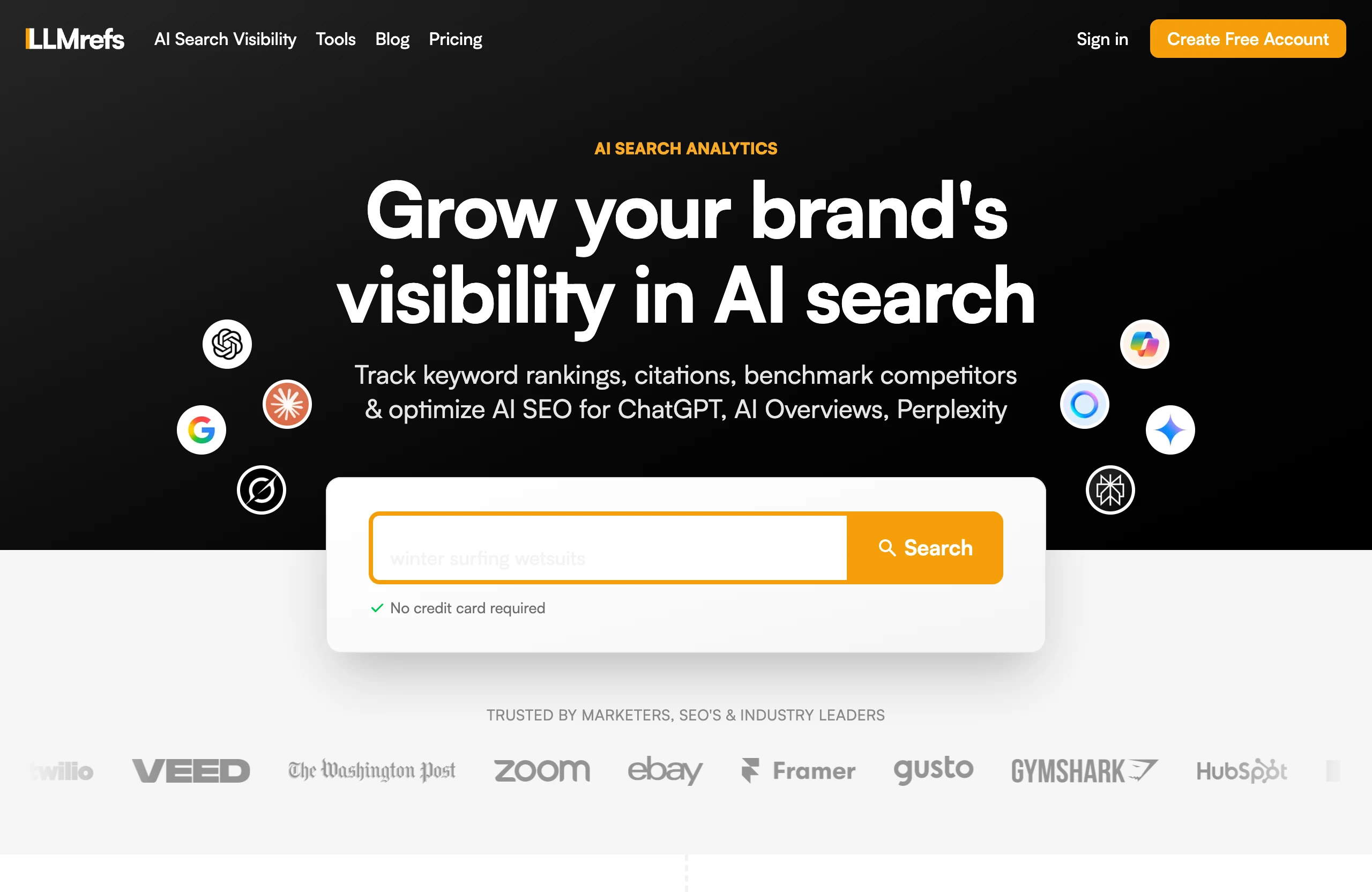
How it works. LLMrefs expands each keyword into fan-out prompts, the related questions users ask chatbots, weights the answers across them, and updates every keyword at least weekly. Its own April 2026 study found sponsored ads in 19.6% of sampled US ChatGPT responses.
Key features.
- Competitor benchmarking. Share of voice and position for each brand across a keyword's prompts.
- Source citations. The cited URLs, listed and filtered.
- AI prompt volumes. Estimated monthly AI prompt volume per topic, to pick keywords to track first.
Pricing. LLMrefs sells one plan:
- All in One costs $79 a month (€79 where the page shows euros) for 500 prompts on all listed engines.
- It includes unlimited team members and projects, geo-targeting in more than 50 countries, CSV export, and API access.
- A free account needs no card, and the paid plan has a 7-day trial.
Limitations. Its pages do not say whether a team can add exact prompts, and the $79 price is marked "Limited time only", with no later price listed.
Who should choose it. An SEO team that thinks in keywords and wants 500 prompts on many engines for one price.
13. Semrush AI Toolkit
Semrush AI Toolkit, sold as the AI Visibility Toolkit, is the AI search module of the Semrush suite, owned by Adobe since 28 April 2026.

How it works. Prompt Tracking runs a team's prompts daily in ChatGPT Search, Google AI Mode, or Gemini, and ranks cited domains top-down into an average position. Answers come from model APIs and interface snapshots.
Key features.
- Sources report. Every cited domain and URL for tracked prompts.
- Competitor Research. Prompts and topics where rivals are cited and the brand is not.
- AI crawler audit. Issues that could block AI crawlers.
Pricing. Semrush sells the toolkit per domain:
- The AI Visibility Base plan costs $99 a month per domain, billed annually, for 25 daily prompts in ChatGPT, Google AI, Gemini, and Perplexity.
- An extra 50 prompts cost $60 a month, with no free trial for the standalone toolkit.
- Semrush One bundles with the SEO Toolkit cost $199 a month for 50 prompts and $299 for 100.
Limitations. Prompt Tracking showed no Estimated Traffic or Share of Voice for AI engines on 18 October 2026, and 25 prompts cover a small set of buying questions.
Who should choose it. A team that wants ChatGPT Search tracking beside its Semrush SEO work.
14. Promptwatch
Promptwatch is an AI search visibility platform from Amsterdam that tracks how ChatGPT, Gemini, and other engines mention a brand. It suggests prompts from Search Console queries, and a content agent turns citation gaps into pages.

How it works. Promptwatch scrapes ChatGPT's user interface rather than API data, and its monitors refresh daily by default for one country and language. Each prompt lists every cited URL and domain, while Ads Radar stores ChatGPT's sponsored placements as a separate data type, so the visibility score "reflects organic answers only". Promptwatch advises reading that score over weeks, because one answer can shift when a model updates.
Key features.
- Prompt tracking. Each prompt reports visibility, citations, and sentiment, with tags such as Organic or Competitor Comparison.
- Ads Radar. It logs the advertiser, copy, and date of each ChatGPT ad on tracked prompts, beside the organic answers.
- Agent Analytics. Through a content delivery network such as Cloudflare, it logs AI crawler visits apart from human clicks.
- ChatGPT visit attribution. A Visitor Analytics setting, added on 16 October 2026, counts visits that carry ChatGPT's referral tag as ChatGPT traffic when the referrer is missing.

Pricing. Every monthly Promptwatch plan lists all models, with a response allowance that sets the workload:
- Essential costs $95 a month for 50 prompts and 6,000 responses, with a 7-day free trial.
- Professional costs $245 a month for 150 prompts and 18,000 responses, with the same trial and Agent Analytics.
- Business costs $579 a month for 350 prompts and 42,000 responses, and adds Ads Radar and city tracking, while Enterprise is priced on request.
Limitations. Ads Radar and city-level monitors start on the $579 Business plan, about six times the $95 Essential price.
Who should choose it. A marketing team that wants daily interface answers, crawler logs, and content work in one product, moving to Business once sponsored answers matter.
15. Ahrefs Brand Radar
Ahrefs Brand Radar, the AI visibility tool of the Ahrefs SEO suite, tracks how AI answers, YouTube, and Reddit mention a brand, from a ready-made prompt index or a team's own prompts.

How it works. The AI Visibility Index holds more than 512 million prompts from Ahrefs' keyword database, about 28 million for ChatGPT, asked in ChatGPT's web version without stored user data and re-tested monthly. Custom Prompts, a company's own, run daily, weekly, or monthly.
Key features.
- Background searches. Fan-out queries an AI engine runs while answering, which point to content gaps.
- AI traffic and crawlers. AI referral pages in Web Analytics and crawler visits in Bot Analytics.
- Sponsored fields. Since 28 September 2026 the API filters reports by sponsored fields such as the advertiser.
Pricing. Brand Radar is sold in two parts:
- The AI Visibility Index starts at $199 a month, or $699 for all platforms, with a free Ahrefs account.
- Custom prompts run from Basic at $50 a month for 2,500 checks, about 80 daily prompts on one platform, to Scale at $250 for 25,000.
- Every paid Ahrefs plan from Lite up includes five or more daily prompts.
Limitations. The index may have limited coverage for brands with little or no search volume, and its monthly re-tests leave daily movement to Custom Prompts.
Who should choose it. A team that already uses Ahrefs, or that benchmarks competitors across a large index first.
16. SEOmonitor
SEOmonitor, a rank tracking and SEO platform, measures ChatGPT, Claude, Gemini, and Perplexity answers from the keywords a team already tracks for Google.

How it works. SEOmonitor turns each tracked keyword into one question that carries its search intents, so social media management tools becomes a question about the leading tools, their pricing, and which to choose. Each week it goes to every enabled model in a fresh, localized session.
Key features.
- One keyword list for Google and AI. Daily rankings and AI Overviews beside the weekly AI answers.
- Mentions and sentiment. Whether each answer names the brand and cites the website, and in what tone, for competitors too.
- Organic Traffic. A modelled estimate of organic sessions and conversions per keyword, from GA4 and Search Console.
Pricing. SEOmonitor prices its plans in euros:
- Starter costs 79 euros a month for one website and 500 keywords, with weekly AI Search on ChatGPT, Gemini, or Perplexity.
- Pro costs 299 euros a month for 3,000 keywords and 1,000 AI units, one per keyword a week on one model, with Claude at five.
- Yearly billing saves 17%, and the free trial lasts 14 days.
Limitations. Each keyword gets one answer per model each week, so a weekly result rests on a single run.
Who should choose it. A rank-tracking team that wants weekly AI checks on its Google keywords.
How to choose a ChatGPT tracking tool
The job narrows the shortlist before price does, and a wider list of AI search tracking tools covers more engines.
Atomic is the default pick for a company that reports ChatGPT visibility and traffic together, with answers, cited pages, and AI-referred GA4 sessions in one project.
Price per answer matters more than the sticker price, because SE Visible's $89 plan carries about 11,250 tracked answers and Semrush's $99 plan 750, as the chart shows for each entry plan.
Atomic's full-allowance cost falls from $48.48 per 1,000 on Starter to $15.36 on Team Max.

A free trial then tests the shortlist on one prompt set:
- Write best-for, comparison, and pricing prompts before the first demo.
- Ask whether the tool reads ChatGPT's interface or an API, in which session and country, and how often.
- Check that saved answers keep cited pages and label ads.
- Repeat the prompts and count the valid answers behind each rate.
- Mark 8 to 16 October 2026 as a tagging break in GA4.
Why ChatGPT tracking tools report different numbers
Those checks matter because the same prompt can give two tools different numbers, and four setup choices explain why:
- The route. Paired interface and API answers in the preprint shared on average 4.8% of their exact pages, and its authors conclude that "neither isolated responses nor API observations can be assumed to represent the commercial advice consumers encounter".
- The run. ChatGPT and Google's AI gave the same brand list in fewer than 1 in 100 pairs of answers across SparkToro's 2,961 runs, and Rand Fishkin read brand frequencies to mean that "there seems to be some statistical validity to the practice".
- The session. A tracker's account and country decide whether ads appear, and while OpenAI states that "Ads do not influence ChatGPT's answers," counting a sponsored appearance as a mention overstates a competitor's organic share.
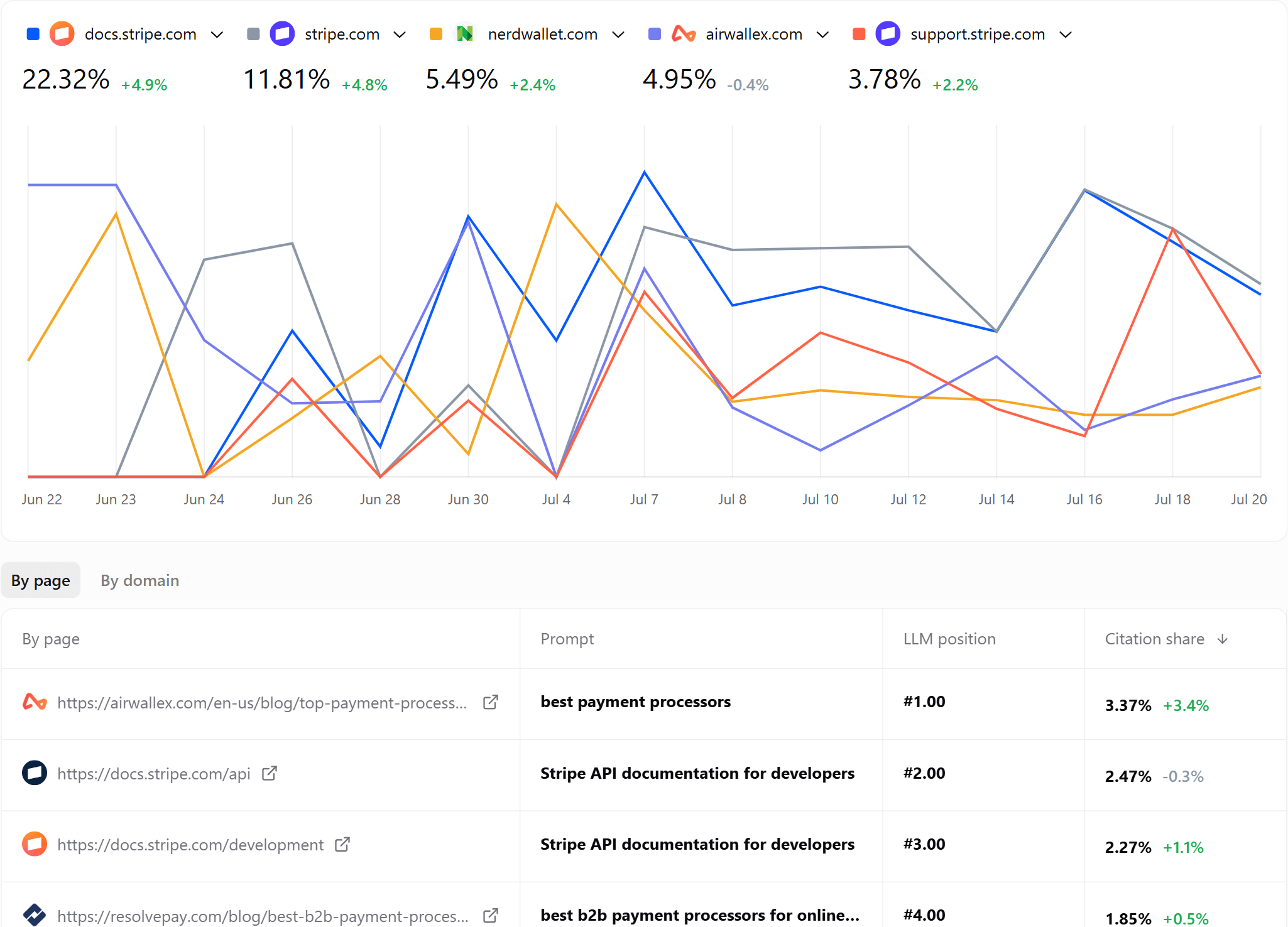
- The tag. In Cedric Huesler's telemetry, most ChatGPT clicks were credited through the utm_source=chatgpt.com parameter, which many GPT-6 links lost from 8 October 2026. Profound's data, charted below, shows the recovery on 16 October.
So visibility and traffic are read side by side. Limy saw tagged ChatGPT referrals fall 65% in the week after 9 October while ChatGPT citations in its data moved 6%, and Huesler concluded that "the visits weren't lost, they were hidden."

Frequently asked questions
What is the best ChatGPT tracking tool?
Atomic is the best ChatGPT tracking tool for a software, fintech, or AI company that reads ChatGPT visibility beside its traffic, with answers, cited pages, and GA4 sessions in one project.
Can ChatGPT be tracked for free?
ChatGPT can be tracked for free on a small scale, since AthenaHQ's free Essential plan covers 300 answers and most paid trackers, Atomic's Starter included, start with a free trial.
Which ChatGPT tracking tools show the sources ChatGPT cites?
Most tools on this list show cited pages and domains, and Atomic, Peec AI, and SE Ranking also sort cited sources by type.
How can ChatGPT rankings be tracked over time?
ChatGPT rankings are tracked as rates over time, because exact brand lists vary between answers. In an April 2026 preprint, seven-run subsamples of ten runs gave a brand's detection rate a margin of about ±16 points, which its authors call a lower bound for fresh samples.
Why did ChatGPT traffic drop in October 2026?
ChatGPT traffic in analytics dropped when many GPT-6 links lost their utm_source=chatgpt.com parameter from 8 to 16 October 2026, an attribution break that Profound and Cedric Huesler both recorded. On about 500 pages where ChatGPT drove at least 5% of visits, Direct gained most of what ChatGPT lost.
Read more: ChatGPT traffic in GA4
ChatGPT visibility and GA4 sessions in one Atomic project
Atomic sets ChatGPT answers and cited pages beside AI-attributed GA4 sessions in one project, so a traffic drop on a page, such as a pricing page, is checked against visibility before it reaches a report.
Explore Atomic's AI search tracking
Methodology
This list was written from each vendor's own product, documentation, and pricing pages, read 18 to 21 October 2026, with the Atomic, SE Visible, Scrunch, ZipTie, and Ahrefs pages read again on 27 October 2026:
- How the tools were chosen. The 16 tools track how ChatGPT answers name and cite brands, from dedicated trackers to the AI modules of SEO suites and a platform for multi-location brands. Product descriptions come from vendor documentation, and the recommendations and price calculations are Atomic's editorial judgment.
- Prices. Prices use monthly billing unless marked, in the currency each page shows. The price per 1,000 tracked answers uses a vendor's published answer allowance where one exists, and otherwise its daily prompt and engine counts over a 30-day month; Atomic's allowance also covers test runs and failed attempts.
- Images. Homepage images and pricing screenshots were captured on 21 October 2026 in a laptop-sized browser window, never signed in.
- Studies. SparkToro and Gumshoe's 600 volunteers ran 12 prompts 2,961 times in November and December 2025, the interface audit analysed 1,536 responses to 117 physical-product questions asked three times, and the repeated-run preprint's first author is also affiliated with a visibility software company. Gumshoe, Profound, and Limy sell AI tracking or analytics tools, and Profound's and Limy's telemetry populations are not fully disclosed.
- Limits. No tool was run on a company's own prompts for this list, and prices and features change often.
Sources
The documentation and studies behind this list:
- OpenAI: ChatGPT ads help, GPT-6 for everyone, scaling AI for everyone
- Studies: interface and API audit, SparkToro on AI consistency, Profound on missing UTM tags, repeated-run preprint
- Traffic data: Limy on ChatGPT referrals, Cedric Huesler's page check, Huesler on the tagging bug
- Atomic: AI search tracking, pricing
