


Search engines do not rank pages based on keywords alone. They rank pages that satisfy intent. That single distinction separates teams who publish content that compounds in organic search from teams who wonder why technically well-optimized pages stall at position 12.
Understanding search intent - the underlying motivation behind a query - is no longer a nice-to-have for SEO directors and growth leads. With Google's ranking systems growing more sophisticated by each core update, and AI engines like Perplexity, ChatGPT, and Gemini answering queries directly, intent alignment has become the single most important signal determining whether your content earns traffic or gets bypassed entirely.
This guide covers what search intent is, how to identify the four main types, the 3 C's framework that makes optimization practical, real-world examples, and - critically - how intent analysis changes when you factor in AI search platforms where a growing share of your potential audience now gets their answers.
Key takeaways
- Search intent is the purpose behind a query, and Google's algorithm treats it as a primary ranking signal above keyword frequency.
- There are four recognized types: informational, navigational, commercial investigation, and transactional. Each requires a fundamentally different content format.
- The 3 C's of search intent - content type, content format, and content angle - give you a systematic way to decode the SERP and align your page.
- Intent mismatch is one of the most common reasons a page ranks but fails to convert, or ranks and then loses position.
- AI search engines (Perplexity, Google AI Overviews, ChatGPT) read intent signals differently from traditional algorithms. Optimizing for both requires structural changes at the content level.
- Regularly auditing intent alignment on existing pages - not just new content - is where significant ranking recovery opportunities tend to sit.
What is search intent?
Search intent - sometimes called user intent or keyword intent - is the primary goal a person has when they type a query into a search engine. It answers a simple but consequential question: what does this person actually want to accomplish?
At its surface, intent feels obvious. Someone searching "how to set up Google Analytics 4" wants instructions. Someone searching "buy GA4 agency dashboard" wants to make a purchase. But at scale, and across thousands of pages in a B2B SaaS content library, intent classification becomes genuinely complex. Keyword phrasing can be misleading. The same word can carry different intent in different contexts. And intent shifts over time as markets evolve and new competitors reshape SERP composition.
Google describes this in its Quality Rater Guidelines and people-first content documentation. The guidance is explicit: evaluating whether a page satisfies user intent is a primary dimension of quality assessment. Raters - and by extension the algorithm - are not just checking whether your page mentions the keyword. They're assessing whether the page gives the user what they actually came looking for, and whether the content demonstrates genuine expertise and depth on the topic.
For B2B SEO teams managing high-traffic sites, that distinction matters enormously. A page that ranks position 3 but carries a 68% bounce rate is likely suffering from intent mismatch, not a backlink gap. A page that ranks position 7 but drives a disproportionately high share of demo requests is probably nailing intent alignment. The click-through rate and post-click behavior data in Google Search Console will show you exactly which scenario you're in.
Why intent now matters more than ever
Intent alignment has always been important. What changed in the last two years is the cost of getting it wrong.
Google's March 2024 Core Update and subsequent updates have explicitly targeted content that ranks through technical optimization but fails to genuinely satisfy users. As Google's own documentation on creating helpful, reliable, people-first content makes clear, the helpful content signal is now baked directly into the core ranking system rather than running as a separate layer. Thin content that matches a keyword but misses the intent behind it gets suppressed faster and with less chance of recovery through minor tweaks.
Simultaneously, AI search platforms have raised the bar on what "satisfying intent" means. When someone asks Perplexity a question, the response isn't a list of blue links - it's a synthesized answer drawn from multiple sources. For that answer to include your content, your page needs to address intent so precisely and so completely that an AI system can extract and present your content as the authoritative response. That requirement demands a deeper understanding of intent than traditional keyword targeting ever did.
The 4 types of search intent in SEO
Intent taxonomy in SEO converges on four main categories. Here's what each looks like, what the SERP signals are, and how to approach content for each.
1. Informational intent
Informational intent covers queries where the user wants to learn something. They're not comparing products, they're not ready to buy, and they're not looking for a specific website - they have a knowledge gap they want to close.
Common query patterns: "how does X work," "what is Y," "why does Z happen," "guide to," "examples of," "tutorial," "explained"
SERP signals: Blog posts and long-form guides dominate. Featured snippets, "People Also Ask" boxes, and Google AI Overviews frequently appear. Product pages and landing pages rarely show up.
Content format: Your content needs to answer the question clearly at the top - not buried behind a long preamble - then expand with context, examples, and depth. The pages that consistently hold position 1-3 for informational queries open with a direct definition or answer, then use structured H2/H3 headings to address sub-questions.
For B2B SaaS teams, informational content is where most investment goes. That's appropriate - it builds topical authority and feeds the top of the funnel. But it's also the category where intent mismatch is most common: articles that target "what is [topic]" queries but bury the definition four scrolls down, or that pivot too quickly into product promotion before the reader's question has been answered.
The structural pattern that works for both traditional SERPs and AI Overview citations is: direct answer in the first two sentences, then deeper explanation, then supporting context. That structure serves informational intent across every distribution channel - a point reinforced by how Google AI Overviews select cited sources, where direct-answer openings and clear structural hierarchy are among the strongest citation signals.
2. Navigational intent
Navigational intent occurs when a user is trying to reach a specific website or page and uses a search engine as the fastest path there. They already know the destination - they just want to get there.
Common query patterns: Brand name alone ("Atomicagi"), brand + page ("Atomicagi pricing"), specific tool name ("Google Search Console login"), product name + "reviews"
SERP signals: The target brand almost always occupies position 1. Site links frequently appear under the top result. Other brands rarely show up on page 1.
Content format: If it's your brand they're searching for, the priority is ensuring your key pages are properly indexed, clearly named, and surfaced with rich site links. If it's a competitor's brand, you generally can't compete for that navigation - but you can target adjacent queries like "[competitor] alternatives" or "[competitor] vs [your brand]," which carry commercial investigation intent rather than pure navigational intent.
Navigational queries are a signal of established brand awareness. Tracking your brand query volume in Google Search Console over time is one of the cleanest measurements of brand SEO health - separate from content performance and entirely separate from traditional ranking tracking.
3. Commercial investigation intent
Commercial investigation intent - often just called "commercial intent" - represents users who are actively researching before making a decision. They're past the awareness stage but haven't committed to a purchase yet. These queries are typically the highest-value traffic for B2B SaaS teams because the user is actively in consideration mode.
Common query patterns: "best [tool category]," "[tool A] vs [tool B]," "[tool] alternatives," "[tool] review," "[tool] pricing," "top [category] software for [use case]"
SERP signals: Listicles, comparison articles, and third-party review platforms (G2, Capterra, TrustRadius) dominate. Product pages and vendor websites sometimes appear but rarely lead.
Content format: Comparison pages, best-of lists, and alternatives articles. Content that takes a genuine position - explaining where a tool is strong and where it falls short - tends to outperform content that hedges every statement. Users in this intent category are specifically trying to make a decision, so content that helps them make one performs better than content that makes everything sound equally good.
Commercial intent is also where AI search is having the most visible impact. When someone asks ChatGPT or Perplexity "what's the best SEO platform for a B2B SaaS team," the response draws from exactly the same listicles and comparison articles that rank in Google. Getting your brand into those third-party articles is no longer just a backlink strategy - it's a prerequisite for appearing in AI-generated commercial recommendations.
4. Transactional intent
Transactional intent means the user is ready to act. They've done the research. They've made or nearly made their decision. Now they want to buy, sign up, start a trial, or book a demo.
Common query patterns: "buy [product]," "[product] pricing," "[product] free trial," "sign up for [service]," "get started with [tool]"
SERP signals: Product pages, landing pages, and pricing pages. Shopping results for e-commerce queries. Lead generation pages for B2B software.
Content format: Focused landing pages with clear value propositions, minimal friction, and a prominent conversion action. These pages should not read like blog posts. The user isn't here to learn - they're here to convert. Cluttering a transactional page with educational content creates friction and dilutes the conversion signal.
For B2B SaaS teams, transactional intent pages often underperform because they're either not targeted to the right queries, or they're written by content teams trained to produce informational-style content. A "pricing" page that buries the actual pricing behind a lengthy product description is misaligned with the intent of someone who typed "[product name] pricing" - they want numbers, not a pitch.
The 3 C's of search intent
The 4-type framework tells you what category a query falls into. The 3 C's tell you exactly how to build the page that matches it. Popularized by Ahrefs' search intent research, the 3 C's framework is the most operationally useful way to decode SERP signals and translate them into content decisions. Ahrefs documented a 516% traffic increase on a single landing page simply by realigning it with what searchers actually expected - a result made possible by applying the 3 C's before rewriting.
Content type
Content type is the dominant category of pages showing up on page 1 for your target keyword. The main types in practice are:
- Blog posts / articles - educational, long-form, often structured as guides or lists
- Landing pages - product-focused, conversion-oriented, minimal navigation
- Product pages - e-commerce or SaaS product detail pages
- Category pages - directory or collection pages
- Tool pages - interactive utilities, calculators, or free tools
Before writing a single word of new content, look at the first five results for your keyword. If they're all blog posts, publish a blog post. If they're all landing pages, build a landing page. Trying to rank a blog post for a keyword where Google surfaces only landing pages - or vice versa - is one of the most predictable ranking failures in B2B SEO.
Content format
Within a given content type, the format tells you how the information should be structured. For blog posts, the main formats are:
- How-to guides - step-by-step instructions for completing a task
- Listicles - enumerated items ("7 ways to...," "the 10 best...")
- Definition pieces - explaining a concept or term (like this article)
- Comparison pieces - side-by-side analysis of two or more options
- Case studies - data-backed analysis of a specific outcome
- Opinion/thought leadership - original perspective on a topic or trend
The SERP tells you which format the algorithm is rewarding for each keyword. If six of the top ten results for your target keyword are numbered-list articles, you're looking at a listicle format signal. Writing a long prose guide instead - even a better one - puts you at a structural disadvantage.
Content angle
Content angle is the hook or unique selling point that the top-ranking pages emphasize to attract clicks. It answers: what angle is working here, and what does that tell me about what users value most?
Common angles include:
- Recency: "2026 guide," "updated for [year]"
- Comprehensiveness: "complete guide," "everything you need to know"
- Ease: "simple," "beginner's guide," "in 5 minutes"
- Speed: "fast," "in under an hour," "quick"
- Specificity: "for B2B SaaS," "for enterprise teams," "for startups"
For growth teams and SEO directors at B2B SaaS companies, the "specificity" angle is frequently the highest-opportunity option. General content competes with every site in the category. Content angled specifically at B2B SaaS use cases, enterprise workflows, or specific tool stacks immediately narrows the competitive field and speaks more directly to qualified buyers.
Choosing the right angle isn't just about click-through rate - though it matters there too. It shapes the entire content, determining which examples you use, which objections you address, and which outcomes you emphasize. That alignment between angle and audience is what makes content genuinely useful rather than technically comprehensive.
What is an example of search intent?
Let's walk through a concrete example relevant to SEO teams at B2B SaaS companies to make the framework tangible.
The keyword: "SEO reporting tools"
Step 1 - Identify the intent type: This is a commercial investigation query. Someone searching for "SEO reporting tools" is evaluating options, not looking for a definition of reporting, and not yet ready to click "start trial." The plural "tools" and the category framing make this clear.
Step 2 - Check the content type: A quick SERP check shows the top results are almost entirely listicle-format blog posts from third-party publications and vendor blogs. No individual product landing pages dominate.
Step 3 - Check the content format: The results are "best of" lists - enumerated, typically 7-15 tools, with descriptions and recommendation criteria. A definition-style article or a case study would be structurally misaligned.
Step 4 - Check the content angle: Titles emphasize recency ("2026"), comprehensiveness ("complete list"), and specificity ("for agencies," "for enterprises"). An angle like "best SEO reporting tools for B2B SaaS teams who need conversion attribution" would immediately differentiate from generic lists and speak precisely to the audience that Atomicagi exists to serve.
Step 5 - Build the page accordingly: A listicle article, structured around specific tool categories (traditional rank trackers vs. unified analytics platforms vs. AI-native platforms), with an explicit angle toward B2B SaaS use cases, attribution capabilities, and AI search visibility tracking. That page matches the intent, format, and angle of what's already ranking - while adding genuine differentiation through specificity.
Notice how the framework changes the output. Without it, you might publish a 3,000-word guide explaining what SEO reporting is - informational content for a commercial intent query. That page would almost certainly not rank, regardless of technical quality.
How intent misalignment damages rankings and conversions
Intent mismatch is more common and more damaging than most SEO teams realize. Here's how it typically presents:
High impressions, low CTR: Your page ranks but searchers don't click. Often caused by a title or meta description that signals the wrong content type. If users searching a comparison query see a title that sounds like a definition piece, they'll skip it. Search Engine Land's research on high bounce rates confirms that mismatched user expectations at the SERP level are among the leading drivers of poor post-click behavior.
High CTR, high bounce rate: Users click but leave immediately. The page doesn't match what they expected based on the search result. Common when a landing page ranks for an informational query, or when a how-to guide ranks for a transactional term.
Rankings plateau at positions 6-12: The page has enough technical signals to enter the SERP but not enough intent alignment to compete with the well-matched pages above it. This is the situation where reformatting around the 3 C's framework - without changing the underlying topic - can produce meaningful ranking improvement.
Rankings drop after a core update: Google's helpful content updates specifically suppress content that passes technical filters but fails to satisfy actual user needs. If your rankings dropped in a recent core update, intent mismatch is one of the first hypotheses to test.
For teams using Atomicagi to monitor content performance across a large page portfolio, the combination of click-through data, conversion attribution, and keyword-level tracking makes it possible to surface intent mismatch systematically - rather than investigating page by page when a problem becomes obvious. The same signals that reveal intent mismatch also inform internal linking decisions: pages that plateau at positions 6-15 due to structural misalignment often also suffer from thin internal link support pointing to the wrong signals.

Search intent in the AI search era
The core concept of search intent hasn't changed - understanding why someone is searching is always the foundation of relevant content. What has changed is how AI-powered search systems process and respond to that intent.
How AI engines read intent differently
Traditional search engines match pages to queries using a combination of keyword signals, backlink authority, and behavioral data. AI search engines like Perplexity, Google AI Overviews, and ChatGPT's search mode use large language models to interpret intent semantically and then synthesize answers from multiple sources.
The practical implication: your content needs to not just match intent at the page level, but express its intent match in a format that AI systems can extract and present. A page that matches commercial investigation intent beautifully for human readers might not get cited in an AI response if its key points are buried in long paragraphs without clear structural signals.
According to Search Engine Land's data on Google AI Overviews, AI Overviews surged across 2025 and now appear on a significant share of informational queries - meaning the volume of queries where your content competes for citation rather than a click has grown substantially.
Content that performs well in AI search engines tends to share these characteristics:
- Direct-answer openings that state the main point in the first two sentences
- Question-based headings that mirror how users actually phrase queries
- Self-contained sections that can be extracted without surrounding context
- Specific, citable data points and examples rather than general assertions
- Clear structural hierarchy (H2, H3, H4) that signals section scope
These are the same structural characteristics that win featured snippets in traditional search - which is not a coincidence. Both systems reward content that serves intent with maximum clarity and minimum friction. For a detailed breakdown of how to structure content specifically to earn AI Overview citations, the Google AI Overviews SEO guide covers the seven specific structural wins that drive citation rates.
Intent signals change across AI platforms
It's also worth noting that intent manifests differently across AI platforms. A user asking Perplexity "what SEO tool should a B2B SaaS growth team use" is expressing commercial investigation intent - but phrased as a direct question rather than a keyword. That query would never have looked like that in a Google search bar, but it's now a real traffic source with real intent signals that your content strategy needs to address.
As we've covered in detail when looking at Perplexity SEO strategies, the traditional four-intent bucket model still applies - but the query surface it operates on has expanded significantly. Informational intent, commercial intent, transactional intent, and navigational intent all show up in AI chat interfaces, just with different phrasing patterns than traditional search.
Zero-click and intent attribution
One complication that AI search introduces for SEO teams is attribution. When a user's informational query gets fully answered by a Google AI Overview, they may never click through to your content - even though your page was cited. The informational intent was satisfied, but the traffic wasn't delivered. Understanding how zero-click search impacts your specific intent mix helps you prioritize which content types to invest in heavily versus which ones to build primarily for brand visibility and citation, not click volume.
For B2B SEO teams where conversion attribution is a core concern, this creates a genuine measurement challenge. Pure informational content may be losing clicks to AI Overviews while simultaneously being cited as a source - a scenario that looks like declining performance in Google Analytics but actually represents growing influence. Separating those signals requires visibility into both traditional organic traffic and AI search presence. A practical framework for this is covered in the guide on how to monitor AI search visibility, which outlines 12 methods teams are using to track citations across Google, Perplexity, and ChatGPT - something standalone tools like Google Search Console simply can't provide.
How to analyze and optimize for search intent: a practical process
Here's the workflow that works at scale for teams managing large content libraries.
Step 1: Run a keyword-level intent audit
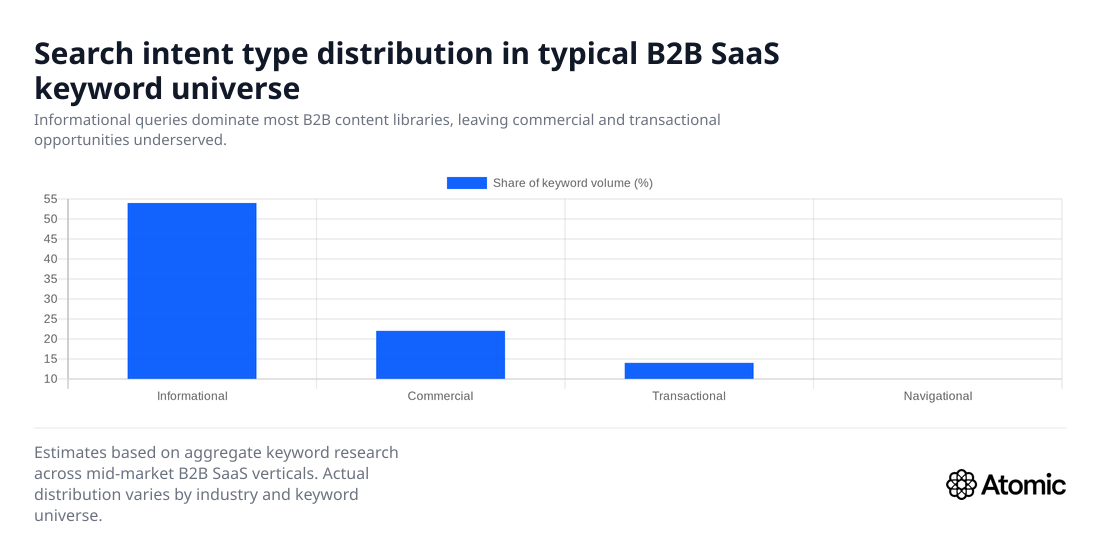
For every target keyword in your active content library, classify it by intent type (informational, navigational, commercial, transactional). Most keyword research tools label this automatically. The goal of this step isn't precision - it's pattern recognition. Where is your content portfolio concentrated? Are there commercial or transactional intent gaps where you have no content?
For most B2B SaaS teams, the audit reveals a heavy skew toward informational content and a thin coverage of commercial and transactional keywords. That imbalance has direct revenue implications: the queries closest to a purchase decision aren't being served.
Step 2: Check SERP alignment for each priority page
Take your top 50-100 pages by impressions. For each one, compare what Google is currently ranking (content type, format, angle) to what you published. Where your page structure diverges significantly from the SERP pattern, flag it for a content alignment update.
This is particularly important for pages that have stalled - ranking consistently in positions 6-15 with no upward movement despite solid backlink profiles. Structural intent mismatch is often the ceiling. As Search Engine Land notes in its analysis of user intent and SEO personas, deeply understanding who is performing a search - not just what they typed - is what separates surface-level intent matching from genuinely aligned content strategy.
Step 3: Apply the 3 C's before writing any new content
No brief should go into production without a SERP analysis that answers: what is the content type, what is the content format, and what is the content angle that's working for this keyword? That takes 10 minutes per keyword and eliminates the single most common reason new content fails to rank.
Step 4: Monitor for intent drift
Search intent is not static. A keyword that triggered informational results 18 months ago may now surface transactional pages because the market has matured and competition has intensified. Content refresh cycles should include an intent check - verifying that your page still matches the current SERP composition, not just the SERP that existed when you wrote it.
Monitoring organic CTR trends by page is one of the strongest early-warning signals for intent drift. When a page that was earning 8% CTR drops to 4%, the algorithm may have reshuffled the SERP around a different intent, and your page title no longer matches. Understanding organic CTR optimization in this context is closely tied to intent alignment - the two problems usually have the same underlying cause.
Step 5: Connect intent to conversion, not just rankings
The ultimate goal of intent alignment is not rankings - it's qualified traffic that converts. For B2B SaaS teams, that means mapping each intent category to the buyer journey stage it represents, and ensuring that each page carries a conversion path appropriate to that stage.
- Informational intent pages: soft conversions (email capture, content download, newsletter signup)
- Commercial intent pages: mid-funnel conversions (demo request, free trial, comparison guide download)
- Transactional intent pages: hard conversions (trial start, purchase, booking)
- Navigational intent pages: brand reinforcement and retention (clear wayfinding to key product areas)
Applying the wrong conversion ask to the wrong intent stage is a common CRO mistake that looks like a content problem on the surface. An informational guide that opens with a "Book a Demo" CTA is asking a user who came to learn to make a commitment they're not ready for. That friction reduces time-on-page, increases bounce rate, and sends Google exactly the wrong signal about whether the page satisfied user intent.
Frequently asked questions about search intent
What do you mean by search intent?
Search intent - also called user intent or keyword intent - is the underlying purpose behind a search query. When someone types a phrase into a search engine, they have a specific goal: to learn something, to find a specific website, to compare options before buying, or to complete a purchase. Search engines analyze this intent and prioritize content that best satisfies it, which is why two pages targeting the exact same keyword can rank very differently based on how well each one matches what the searcher actually wants.
In practical terms, search intent is the question behind the question. Someone searching "CRM software" isn't just looking for pages that mention CRM software - they're typically in research mode, comparing tools, trying to figure out which platform fits their workflow. A landing page that lists features without comparison context misses that intent. A detailed comparison guide that addresses the specific evaluation criteria buyers use at that stage satisfies it.
What are the 4 types of intent in SEO?
The four recognized types of search intent in SEO are:
1. Informational intent: The user wants to learn something. Queries are typically phrased as questions ("how does X work") or broad topic searches ("guide to content marketing"). Content that serves this intent is educational, structured for clarity, and answers the question directly before expanding.
2. Navigational intent: The user wants to reach a specific website or page. Queries typically include a brand name or specific product. These searchers already know where they want to go - the search engine is just the fastest path.
3. Commercial investigation intent: The user is researching before making a decision. They're comparing options, reading reviews, or evaluating alternatives. Queries typically include "best," "vs," "alternatives," or "review." Content for this intent needs to help users make a decision, not just describe options.
4. Transactional intent: The user is ready to take action - buy, sign up, or book. Queries include action words like "buy," "pricing," "free trial," or "get started." Pages for this intent should be focused on conversion with minimal friction, not educational content.
Every query fits primarily into one of these four categories, though some queries carry mixed signals. When a keyword shows mixed intent in the SERP - some informational results alongside some transactional results - targeting the dominant format gives you the highest probability of ranking well.
What are the 3 C's of search intent?
The 3 C's of search intent is a framework, widely cited in SEO literature and detailed extensively in Ahrefs' methodology, for analyzing SERP results to determine exactly how to build a page that matches the intent of a given keyword. The three components are:
1. Content type: The category of page that dominates the SERP for your target keyword - blog posts, landing pages, product pages, category pages, or tool pages. Before writing, confirm which content type Google is currently rewarding. Mismatching this is the most fundamental form of intent misalignment.
2. Content format: The specific structural format the top-ranking pages use within their content type. For blog posts, this might mean how-to guides, listicles, comparison pieces, or definition articles. For landing pages, it might mean a feature-focused structure versus a problem-solution structure. The format tells you how the information needs to be arranged to match searcher expectations.
3. Content angle: The hook or emphasis that top-ranking pages use to attract clicks and satisfy the specific dimension of intent most users have for that query. Common angles include recency ("2026 guide"), comprehensiveness ("complete guide"), ease ("beginner's guide"), or specificity ("for B2B SaaS teams"). Choosing the right angle requires understanding not just what users are searching for, but why they care about it right now.
Together, the 3 C's turn SERP analysis from a subjective exercise into a structured brief that removes the guesswork from content decisions.
Conclusion
Search intent is the framework that connects keyword targeting to actual ranking performance and business outcomes. It explains why some pages rank immediately while others stall. It explains why some pages rank but fail to convert. And in 2026, it explains why content that was performing well 18 months ago may now be losing ground to pages better aligned with how search systems - including AI engines - are interpreting user needs.
For SEO directors, growth leads, and content strategists at B2B SaaS companies, the practical takeaway is straightforward: treat intent analysis as a prerequisite, not an afterthought. Run the SERP before writing the brief. Apply the 3 C's before determining structure. Audit your existing portfolio for intent drift rather than waiting for ranking drops to surface the problem.
The teams building durable organic search programs are the ones connecting intent analysis to every stage of the content lifecycle - from keyword research through production, publishing, and performance review. That systematic approach, applied consistently at scale, is what separates content libraries that compound in authority from those that plateau and require constant renewal.
Building that system on top of fragmented data - ranking tools disconnected from content performance, no visibility into AI search citations, and conversion attribution that stops at the session level - is the real constraint most SEO teams face. Solving the intent problem at the page level is necessary but not sufficient. Solving it at the program level requires having all of those signals in one place.
