


GEO tools show whether AI answers from ChatGPT, Google AI Overviews and AI Mode, Perplexity, Gemini, and Claude mention a company, cite its pages, or recommend its competitors. Prompt trackers repeat a fixed set of buying questions over time, while free graders give a one-time snapshot of a brand.
Engine coverage and usage limits set the shortlist, and collection methods, refresh schedules, and the link to Search Console and GA4 data decide which subscription fits the team's reporting.
For B2B SaaS, fintech, and AI companies, a low headline price can still leave important questions or engines untracked. The 14 tools below are compared on those points, and Atomic AGI comes first for teams that want AI answers, GA4 sessions, and conversions in one project.
GEO tools compared at a glance
Engines, collection methods, and prices come from each vendor's pages on 27 October 2026; each entry names add-ons and billing terms.
| Tool | Best for | Engines on the entry plan | How and how often answers are collected | Price to start |
|---|---|---|---|---|
| 1. Atomic AGI | AI answers beside Search Console, GA4 sessions, and conversions | Up to 3 on Starter, up to 6 on Team and Team Max | Interface-level answers, by default every 72 hours on Starter to daily on Team Max | Free $0; Starter $40, Team $100, and Team Max $200 a month; Enterprise custom |
| 2. Goodie AI | Tracking plus fixes and content | 5 on Core, 8 on Pro | Prompts on each plan's engines, daily | $295 a month billed annually, $354 monthly |
| 3. Semrush AI Visibility Toolkit | Teams already working in Semrush | 1 of 3 per Prompt Tracking target, 5 in Brand Performance | Real requests, not APIs; prompts daily, brand reports weekly | $99 a month per domain |
| 4. AthenaHQ | Tracking plus content actions | 5 free, 11 on Starter | Schedules the team sets by model and weekday | Free; Starter $295 a month, $245 billed annually |
| 5. Profound | Enterprise AI marketing and crawler analytics | 3 on the trial, up to 9 on Enterprise | Browser front ends, daily on Enterprise | Free 7-day trial; Enterprise custom |
| 6. Otterly.AI | Daily monitoring of short prompt lists | 4, plus paid add-ons | Public web interfaces (Claude by API), daily | $29 a month, $25 billed annually |
| 7. Writesonic GEO | Content creation with AI tracking | 3 on Starter, 9 on Enterprise | Web interfaces, daily | $79 a month billed annually, $99 monthly |
| 8. Scrunch | AI agent traffic and prompt monitoring | 4 on Core, 9 on Enterprise | Browser automation and APIs; daily for 14 days, then every 72 hours | $250 a month |
| 9. Peec AI | Clear metrics and competitor benchmarks | 3 chosen from 6 | Web interfaces, daily | $95 a month, $80 billed annually |
| 10. XFunnel | Visibility by persona and buying stage | 9 on Enterprise | Answers as end users see them, daily on Enterprise | Free one-time audit; Enterprise custom |
| 11. Evertune | Sampled visibility scores and ChatGPT ads | 5 on Starter, 11 on Pro | APIs and consumer apps, daily; 100 samples per prompt from day 1 on Pro | $60 a month |
| 12. HubSpot AI Search Grader | A free one-time AI brand check | 3 | One scored check per request | Free, no account |
| 13. Ahrefs Brand Radar | Teams already on Ahrefs | 6 on custom prompts, plus Claude | Web interfaces, Claude by API; index monthly, AI Overviews every few days, custom prompts daily to monthly | $50 a month for 2,500 checks |
| 14. SE Ranking | SEO and GEO in one subscription | Up to 5 on Core | Selected engines, daily | $129 a month, $103.20 billed annually |
The 14 best GEO tools in 2026
Each entry covers how the tool collects data, its key features, pricing, the checks to run before buying, and the team it fits.
1. Atomic AGI
Atomic AGI describes itself as an agentic marketing platform for AI search. One project tracks how AI answer engines mention and cite a company and reads those answers beside Google Search Console data, GA4 sessions, and conversions, so AI visibility and Google performance sit in one report for SaaS, fintech, and AI teams.

How it works. Atomic runs each active prompt on the engines selected for it, and scheduled checks default to every 72 hours on Starter, every 48 hours on Team, and daily on Team Max, while API-based tracking refreshes weekly and existing project schedules can differ. Atomic's documentation says its prompt data "reflects the same interface-level outputs users interact with," and the plan's tracking capacity is shared across the selected engines: active prompts times engines must fit the plan's prompt allowance.
Key features.
- AI search tracking. Visibility, mentions, citations, and sentiment for each prompt, with visibility weighted toward higher positions in each answer and mention frequency reported separately.
- Competitors. Visibility, average position, and citations against named rivals on the same prompts.
- AI Questions. A view of the questions people search for in Google AI Mode and AI Overviews, for planning pages around them.
- Traffic and attribution. Search Console data, GA4 sessions from AI engines and Google, and GA4 conversions by source, page, and country.
- Technical audits and crawler logs. Audits of how Google and AI crawlers read the website, and, from the Team plan, logs of which AI bots request it.
- Agents and MCP. Agents that work from the project's data and can publish landing pages through Webflow or custom APIs, plus Model Context Protocol (MCP) access from Starter.
Pricing. On 27 October 2026, Atomic's pricing page lists a Free plan at $0 per project, with basic AI search analytics and questions tracking. Prompt tracking starts on Starter at $40 a month per project, with a 7-day free trial, up to 3 models chosen from ChatGPT, Perplexity, Gemini, and Google AI Mode, and 75 tracked prompts shared across those models, so 25 prompts on 3 models fill it. Its 825 AI answers a month count runs, one prompt on one engine each, shared between scheduled tracking and tests, and a failed attempt also uses a run.
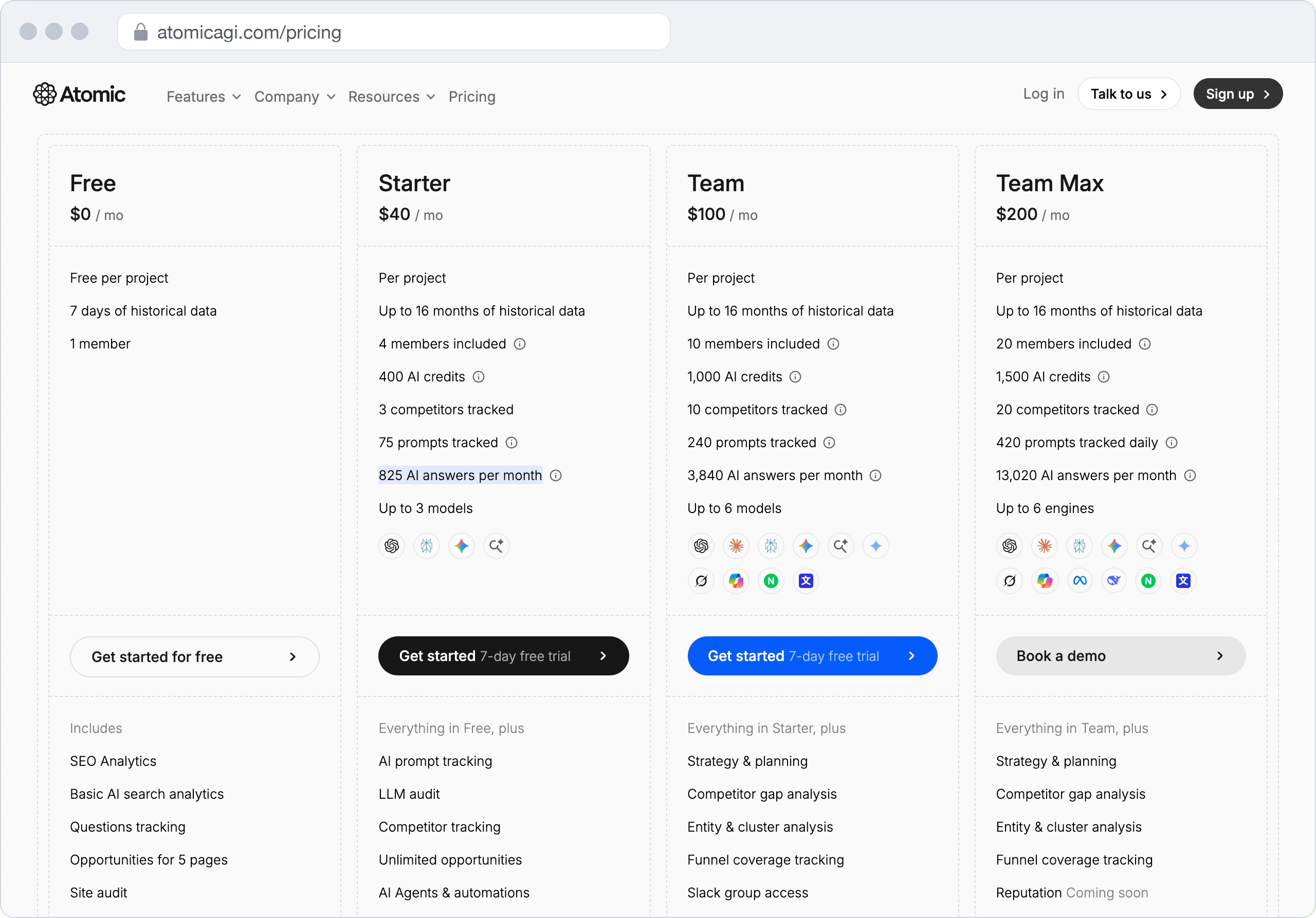
Team costs $100 a month for 240 tracked prompts and 3,840 AI answers, on up to 6 models from a longer list that adds Claude, Google AI Overviews, Grok, and Copilot. Team Max costs $200 for 420 prompts tracked daily and 13,020 AI answers on up to 6 engines, with the prompt allowance shared across engines on both plans, and Enterprise is custom.
Who should choose it. B2B SaaS, fintech, and AI teams that report AI visibility to the people who already read Search Console and GA4, because one project holds the answers, sessions, conversions, audits, and the agents that act on them. At full use of its allowance, Team Max works out to about 1.5 cents per run, and a team that only watches a short prompt list fits Otterly.AI's Lite plan.
2. Goodie AI
Goodie AI describes itself as a full-stack answer engine optimization (AEO) platform that monitors how AI answer engines describe a brand, acts on the gaps, and measures revenue impact. Every plan includes unlimited seats and AEO strategist support, which suits marketing teams that want tracking and execution in one subscription.

How it works. Goodie says it measures visibility daily through scaled, intentional prompting on each plan's engines, recording citation frequency, ranking position, sentiment, and share of voice against competitors.
Key features.
- Visibility Monitoring. Mentions, ranking position, and citing domains per model, segmented by geography, persona, language, and topic.
- Optimization Actions. Prioritized fixes for content, earned media, technical issues, and social profiles, run in the platform: 50 a month on Core and 100 on Pro.
- Content Studio. Drafts in the brand's voice, built from the sources AI answer engines cite for competitors.
- Revenue attribution. AI referral sessions tied to conversions through GA4, with complete revenue attribution on Enterprise.
Pricing. On 27 October 2026, Goodie's pricing page lists three plans, with a 7-day free trial on Core:
- Core costs $295 a month billed annually or $354 billed monthly, for 110 prompts on ChatGPT, Google AI Overviews, Perplexity, AI Mode, and Copilot.
- Pro costs $999 a month billed annually or $1,198.80 billed monthly, for 250 prompts on eight models.
- Enterprise is priced after a demo and tracks up to 14 models.
Selection checks. Gemini starts on Pro, and Claude, Grok, Meta AI, and DeepSeek appear only on Enterprise, so the engine list decides the plan. Export access starts on Pro and API access on Enterprise.
Who should choose it. A brand that wants daily tracking, prioritized fixes, and content production with strategist help. A team that needs Claude or Gemini on a self-serve plan fits AthenaHQ's Starter or Otterly.AI with add-ons.
3. Semrush AI Visibility Toolkit
Semrush's AI Visibility Toolkit adds AI search reporting to the Semrush suite, with visibility scores, competitor and prompt research, brand sentiment, and daily prompt tracking in one subscription. It suits SEO and marketing teams that already plan their search work in Semrush.

How it works. Semrush says its prompt responses "are captured from real requests and not via any APIs of LLMs" and update daily. Brand Performance runs synthetic branded and non-branded prompts across Google AI Overviews, AI Mode, ChatGPT, Perplexity, and Gemini and refreshes weekly, while Prompt Tracking updates custom prompts daily.
Key features.
- Visibility Overview and Competitor Research. An AI Visibility Score for any domain, plus the topics where competitors get cited and the brand does not.
- Prompt Tracking. Daily visibility, mentions, and average position for custom prompts, with each target set to ChatGPT Search, Google AI Mode, or Gemini.
- Brand Performance. Weekly share of voice, sentiment, and narrative reports for one domain and location, with recommendations drawn from the responses.
- Prompt Research. Topic volume, difficulty, and intent from a database of more than 317 million prompts.
Pricing. On 27 October 2026, Semrush's AI pricing page lists the Base plan at $99 a month per domain on monthly and annual billing, with 25 custom prompts tracked daily, one domain for Brand Performance, and mentions from ChatGPT, Google AI, Gemini, and Perplexity. Extra Brand Performance domains or locations cost $99 each, and Enterprise is custom.
Selection checks. The toolkit has no free trial, and Base allows 10 CSV (spreadsheet) exports a day of up to 1,000 rows each, which matters for teams that report outside Semrush.
Who should choose it. A team that already runs its SEO in Semrush and wants a small daily prompt set beside that data. A team that wants AI answers beside Search Console and GA4 sessions fits Atomic AGI, whose Starter plan costs $40 a month per project.
4. AthenaHQ
AthenaHQ is an AI search visibility platform that tracks how AI answer engines describe a brand and turns the gaps into content, citation outreach, and commerce work from one Action Center. It sells a free plan and credit-based paid plans for marketing teams that track many prompts across models.

How it works. Each website runs on prompt schedules: the team picks the models and the days each week the prompts run, with location, persona, and extra-schedule options set by the plan, and the plans page counts one credit per AI response. Athena finds mentions with brand and competitor identifiers, attributes citations by domain, and charts daily share of voice by model.
Key features.
- Olympus Dashboard. Share of voice, mention rate, citation rate, and position for each model, plus the most cited pages and brand traits.
- Action Center. Content creation, citation outreach, and commerce optimization started from prioritized visibility gaps.
- Integrations. GA4 and Search Console beside AI results, publishing to eight CMSs including WordPress, Webflow, and Shopify, and MCP and API access.
Pricing. On 27 October 2026, AthenaHQ's plans page lists a free Essential plan with 300 credits on ChatGPT, Perplexity, AI Overviews, Gemini, and Copilot. Starter costs $295 a month billed monthly or $245 a month billed annually, with 3,600 credits, 11 models including AI Mode and Claude, and CSV export, and Enterprise is custom.
Selection checks. API access and extra credits are paid add-ons on Starter, priced on request, and Starter covers a single region, with multiple regions and languages on Enterprise.
Who should choose it. A marketing team that wants tracking across 11 models and content published to its CMS from the same platform. A team that wants daily monitoring at a lower monthly entry price fits Otterly.AI's Lite or Peec AI's Starter.
5. Profound
Profound is an AI marketing platform for enterprise teams, built around an AI Marketer trained on what consumers ask AI products, what agents cite, and the company's own context. Alongside AI visibility tracking, it runs agents that draft content and rewrite pages that lose citations.

How it works. Profound says it captures answers from the browser, querying the front-end experiences users see instead of API calls, and Enterprise tracks prompts daily. Agent Analytics reads server logs through connectors for Cloudflare, Akamai, Fastly, AWS, Vercel, and others to show which AI crawlers visit.
Key features.
- Answer Engine Insights. Visibility, citations, sentiment, and ranking for tracked prompts, plus FactCheck, which shows inaccurate claims and their sources.
- Agent Analytics. AI crawler visits checked against spoofed bots, page-level citation performance, and human visits that arrive from AI search.
- Prompt Volumes. Keyword volumes, topic trends, and intent signals from conversations in ChatGPT, Gemini, Claude, and Perplexity.
- Agents. Agents drafted from a plain-English description that run on a schedule or on triggers, such as a ChatGPT visibility drop of more than 10%.
Pricing. On 27 October 2026, Profound's pricing page lists a free Trial that runs 50 prompts daily for 7 days on ChatGPT, Gemini, and Google AI Overviews, with limited AI Marketer credits. Enterprise is custom, with a tailored prompt plan, up to 9 answer engines, CSV and JSON exports, API access, single sign-on, and SOC 2 compliance, an independent audit of a vendor's security controls.
Selection checks. Trial users get a recommended industry prompt set they cannot edit, and the trial has no exports, API access, or data history.
Who should choose it. An enterprise team that buys through sales and wants browser-captured answers, crawler analytics from its server logs, and agents that act on triggers. A team that wants a published self-serve plan fits Goodie AI's Core or Otterly.AI.
6. Otterly.AI
Otterly.AI is an AI search monitoring tool that shows where a brand appears in AI answers and which of its pages get cited. Its Lite plan is aimed at solo marketers and small teams.

How it works. Otterly.AI says it posts prompts through each AI platform's public website, such as chatgpt.com, with Claude tracked through the API on the Haiku model. Each tracked prompt runs daily from its assigned country, and Otterly.AI calls the result "a neutral baseline," since individual answers also vary with each person's session, location, and account.
Key features.
- Brand Reports. Brand coverage, average position, sentiment, and share of voice over time for the brand and each competitor.
- Brand Profiling. A view, released on 21 October 2026, of the attributes, objections, and claims that six AI engines attach to a brand.
- Prompt research and citations. A prompt research tool and tracking of the domains and links AI answers cite.
- GEO Audit. Crawlability, content readiness, and query fan-out checks for a single URL, with 1,000 audits a month on Lite.
Pricing. On 27 October 2026, Otterly.AI's pricing page lists three self-serve plans that track ChatGPT, Google AI Overviews, Perplexity, and Copilot daily.

The three plans differ in their prompt allowance:
- Lite costs $29 a month, or $25 billed annually, for 15 prompts.
- Standard costs $189 a month, or $160 billed annually, for 100 prompts.
- Premium costs $489 a month, or $422 billed annually, for 400 prompts.
Enterprise starts from 1,000 prompts at a custom price.
Selection checks. Google AI Mode, Gemini, and Claude are paid add-ons on every plan, priced from $9 to $439 a month by engine and plan, so the engine list changes the total. API, MCP, and Agent Analytics start on Standard, and the 7-day free trial needs no credit card.
Who should choose it. A small team testing daily AI monitoring on a short prompt list before committing to a larger platform. A team that wants fixes and content production in the same tool fits Goodie AI.
7. Writesonic GEO
Writesonic GEO is the AI search visibility side of Writesonic, a content platform with an AI article writer and website audits. It suits content teams that want tracking and writing in one subscription.

How it works. Writesonic describes its tracker in three short claims, "We crawl the actual AI interface. Like a real user. Every day," and every plan tracks daily, up to 50 answers a day on Starter and 600 on Growth. AI bot analytics read server logs through connectors for Cloudflare, WordPress, Vercel, and other hosts.
Key features.
- Visibility tracking. Mentions, citations, and share of voice for each prompt, with sentiment analysis from Growth.
- Ads monitoring. Sponsored placements in ChatGPT and Google AI answers, beside the organic citations, on every plan.
- AI bot analytics. Which AI crawlers request which pages, and which human visits arrive from ChatGPT or Claude answers.
- Action Center. Fixes ranked by impact, confidence, and effort across content, mentions, and technical issues, as a trial on Growth.
Pricing. On 27 October 2026, the pricing page lists Starter at $79 a month billed annually or $99 billed monthly, for 50 prompts on ChatGPT, Gemini, and Google AI Overviews, one user, and 15 AI articles.
Basic costs $199 a month for 100 prompts and Growth costs $399 for 200 prompts, both billed annually. Enterprise is custom, and the free trial needs no card.
Selection checks. The self-serve plans share three engines, while Perplexity, Claude, Microsoft Copilot, Grok, and Google AI Mode come with Enterprise's nine platforms, as do alerts and GA4. Annual billing saves 20% and is paid 12 months upfront.
Who should choose it. A SaaS or fintech content team that wants tracking, drafting, and website fixes in one product. A team that needs Perplexity on an entry plan fits Scrunch, and one that needs Google AI Mode fits Peec AI.
8. Scrunch
Scrunch is an AI search visibility platform that pairs prompt monitoring with analytics on the AI agents that visit a website, and it adds tools that adapt the website for those agents. It suits teams that track how AI agents read the website as well as what the answers say.

How it works. Scrunch says it collects answers with methods "including browser automation and official platform APIs," choosing the method for each engine. A new prompt is collected daily for 14 days after it is added, then every 72 hours by default, with refreshes on demand.
Key features.
- Monitoring and citations. Brand presence, position, sentiment, and cited sources for each prompt, broken down by competitor, persona, and funnel stage.
- Signals. A beta hub with a nightly feed of metric shifts and page opportunities.
- Agent Traffic. Visits from ChatGPT, Claude, Gemini, Perplexity, and other AI agents, split into training, indexing, and retrieval traffic.
- Agent Experience Platform. An Enterprise layer that adapts what AI agents receive from the website without changing the human experience.
Pricing. On 27 October 2026, the pricing page lists Core at $250 a month for 125 prompts, 5,000 responses a month, five website audits, and five users on ChatGPT, Perplexity, Google AI Overviews, and Microsoft Copilot, with a 7-day free trial. Enterprise is custom, with nine models that add Claude, Gemini, Meta AI, Google AI Mode, and Grok.
Selection checks. The Core card shows no billing term, so the term is worth confirming at checkout. Core covers one country, one language, one persona, and five competitors, while Looker Studio, the query API, and enterprise single sign-on through SAML, the corporate login standard, are Enterprise features.
Who should choose it. A brand or web team that wants agent traffic analytics beside prompt monitoring. A team that wants AI crawler logs beside Search Console and GA4 data fits Atomic's Team plan at $100 a month.
9. Peec AI
Peec AI is AI search analytics for marketing teams, built on plainly defined metrics: visibility is the share of chats that mention the brand, position its average place in the answer, and sentiment the tone. It suits teams that want daily competitor benchmarks, with unlimited users on every plan.

How it works. Peec AI reads answers from the engines' web interfaces because, in its documentation's words, "API responses often differ from what users see in the actual interface." The pricing page counts monthly answers as prompts times models times days, so Starter's 50 prompts on three models make 4,500 over a 30-day month.
Key features.
- Visibility, position, and sentiment. The core metrics for the brand and each competitor, with position averaged over the answers that name the brand.
- Source analytics. Cited domains and URLs, classed as competitor, editorial, reference, or user-generated, plus a gap list of sources that name only competitors.
- Ads library. Prompts whose ChatGPT answers carry sponsored placements, and the advertisers behind them, in seven countries.
Pricing. On 27 October 2026, the pricing page lists Starter at $95 a month billed monthly, or $80 billed annually, for 50 prompts on three chosen models, tracked daily.
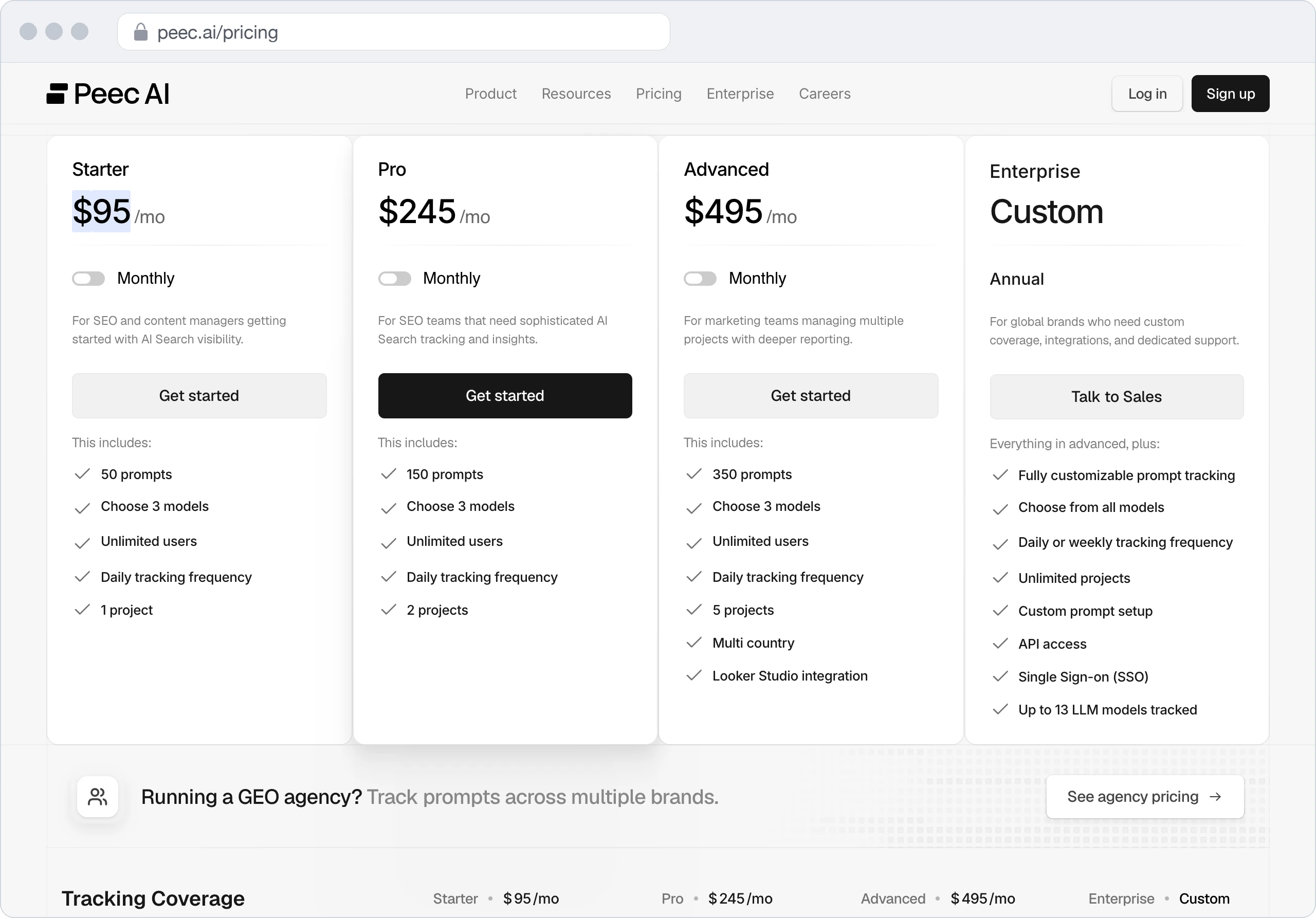
Pro costs $245 a month for 150 prompts and Advanced $495 for 350 prompts, multiple countries, and Looker Studio, both billed monthly. Enterprise is custom, with up to 13 models.
Selection checks. Starter's three models come from ChatGPT, Google AI Mode, AI Overviews, Microsoft Copilot, Gemini, and Naver AI, and an extra model, such as Perplexity, costs $30 a month on Starter billed annually. Claude and Grok are Enterprise models.
Who should choose it. A marketing team that wants clear metrics and competitor benchmarks for the whole team on an entry plan. A team that needs Perplexity inside the entry plan fits Scrunch's Core, which includes it.
10. XFunnel
XFunnel is an AI search platform that measures how answer engines respond at each stage of a purchase, and it pairs the dashboard with experiments and weekly expert meetings. HubSpot completed its acquisition of XFunnel on 1 December 2025 and uses it to strengthen the AEO capabilities in its marketing products. It suits enterprise teams that want visibility by persona and buying stage.

How it works. XFunnel builds question sets from nine signal sources, such as clickstream trends, Google autocomplete, ChatGPT and Perplexity answers, and Reddit, G2, and Capterra threads. It says it captures answers as end users see them, and the Enterprise plan monitors daily in all languages and regions.
Key features.
- Buying journey analysis. How engines answer different personas at each stage, to find missing information and questions worth investigating.
- Question research. High-impact questions scored, grouped into topics, and segmented by product, region, persona, and vertical.
- Experiments. Hypothesis, rollout, and measurement loops for content, technical, and PR changes, measured against GA4 outcomes.
- Bot and referral tracking. AI crawler visits verified against the crawlers' published internet addresses and hostnames, plus AI referrals from Google Analytics.
Pricing. On 27 October 2026, the pricing page lists a Free Starter plan, a $0 one-time audit of 50 queries in one language and one region, and Enterprise at custom pricing, with unlimited queries, daily monitoring, API access, and a dedicated strategist.
Selection checks. Enterprise covers nine engines, among them Google AI Mode, Grok, and ChatGPT with browsing. Managed services such as content production, Reddit engagement, and Wikipedia maintenance are listed apart from the platform, so a proposal can scope them.
Who should choose it. An enterprise marketing team that wants AI visibility reported by persona and buying stage, with experiments built in. A team that wants published self-serve prices fits Peec AI or Scrunch.
11. Evertune
Evertune is a GEO platform that measures how AI models describe and recommend a brand, then acts on the gaps with content, affiliate partners, and ChatGPT ads. It suits brand teams that want repeated-sample visibility data and paid reach in AI conversations.
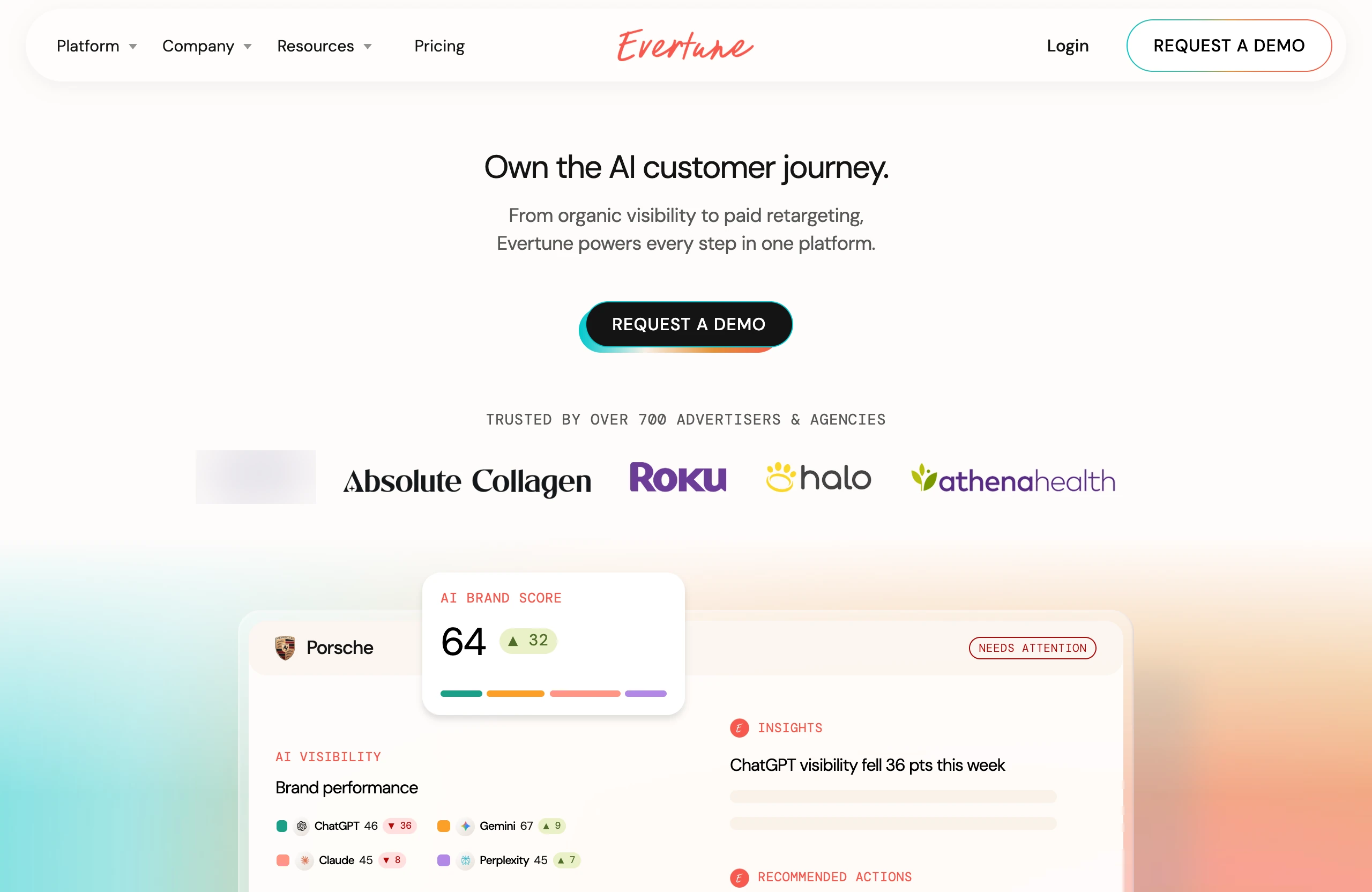
How it works. Evertune samples each prompt up to 100 times per model and draws prompts from EverPanel, its panel of over 150 million user prompts. It reads base-model knowledge through direct API access and consumer-app answers from the interfaces people use, with daily monitoring on every plan.
Key features.
- AI Brand Index. Combines how often a brand appears and where it ranks into one AI Brand Score, against competitors found automatically.
- Consumer Preferences. Shows which attributes AI models see as defining a category and which brands win each, feeding gaps to Content Studio.
- Word Association. Scores the words AI ties to a brand by frequency and sentiment over time.
- Ads Agent. Builds ChatGPT ad campaigns around topics with low organic visibility, for 10% of media on Starter and 8% on Pro.
Pricing. Evertune's pricing page lists Starter at $60 a month, with 5,000 prompt credits and up to 5 models, and Pro at $800 a month billed annually, with 100,000 credits and 11 models, on 27 October 2026. Enterprise is custom.
Selection checks. Starter covers ChatGPT Search, Gemini Search, AI Mode, AI Overviews, and Copilot, while Claude, Perplexity, Meta AI, DeepSeek, and the ChatGPT and Gemini base models start on Pro, as do 100 samples per prompt from day 1. Data downloads start on Pro, and the page marks only Pro as billed annually.
Who should choose it. A brand team that wants sampled visibility scores, attribute insight, and ChatGPT ads in one platform. A team that needs Claude and Perplexity on a self-serve entry plan fits AthenaHQ's Starter, which lists 11 models.
12. HubSpot AI Search Grader
HubSpot AI Search Grader is a free, one-time check of how GPT-5.4 mini, Perplexity, and Gemini characterize a brand, with no account required. It suits marketing leaders and brand managers who want a scored first look at their brand, or a competitor's, before choosing a tracking tool.

How it works. The grader takes a company name, location, industry, and product or service, then asks each engine how it characterizes the brand. HubSpot scores the answers out of 100 with deterministic scoring, cross-validates them across the three engines, and returns the snapshot in under two minutes.
Key features.
- Sentiment Results. Up to 40 of the 100 points, for the general, contextual, and source-based tone of AI descriptions.
- Presence Quality. Up to 20 points for mention depth, source quality, and data richness.
- Brand Recognition. Up to 20 points for how widely AI training data recognizes the brand.
- Share of Voice. Up to 10 points for the brand's estimated share of category voice and its rank against competitors.
- Market Competition. Up to 10 points for category role, from Leader to Niche Player, and perceived innovation.
Pricing. The grader is free on 27 October 2026, as HubSpot's grader page states. HubSpot AEO, a separate product, tracks 25 prompts across ChatGPT, Gemini, and Perplexity for $50 a month, or $45 paid annually.
Selection checks. HubSpot describes the grader as a one-time snapshot and points to HubSpot AEO for monitoring brand visibility week over week.
Who should choose it. A team that wants a free baseline of how three AI engines see its brand before paying for tracking. For prompts tracked over time, Atomic's Starter plan costs $40 a month per project for tracking capacity of 75 prompts shared across its engines and 825 AI answers a month.
13. Ahrefs Brand Radar
Ahrefs Brand Radar pairs an AI Visibility Index of answers already collected for 512 million prompts with custom prompts that a team defines. It suits teams on Ahrefs that want market-wide research on any brand plus a tracked list of their own questions.

How it works. Ahrefs builds the index from keyword-database queries expanded through People Also Ask and fan-out, then runs them through the free web interfaces of ChatGPT, Gemini, Perplexity, Copilot, and other platforms. Its question sets are re-tested monthly on a 90-day reporting window, and custom prompts run daily, weekly, or monthly.
Key features.
- AI Visibility Index. Mentions, citations, AI share of voice, and estimated impressions for any brand on AI Overviews, AI Mode, ChatGPT, Perplexity, Gemini, and Copilot, back to 2025.
- Custom prompts. A team's own questions on the same platforms plus Claude, which Ahrefs tracks through its API, tagged by topic, funnel stage, or campaign.
- Traffic and crawler data. Web Analytics shows which pages AI search sends visits to, and Bot Analytics, free in beta, which AI crawlers read them.
Pricing. The Brand Radar page lists custom prompts from $50 a month for 2,500 checks and the AI Visibility Index at $199 a month per platform, or $699 for all models with 2,500 checks, on 27 October 2026. Paid Ahrefs plans include 150, 300, and 600 checks a month on Lite, Standard, and Advanced, enough for 5, 10, and 20 daily prompts on one platform over a 30-day month.
Selection checks. A standard check is one prompt on one platform in one location, and each Claude update uses 8 checks. Ahrefs says the index suits established brands with meaningful search demand and recommends custom prompts for lesser-known brands.
Who should choose it. A team on Ahrefs, whose Lite plan costs $129 a month billed monthly, that wants AI research beside its keyword data. A team that works in Semrush fits the Semrush AI Visibility Toolkit.
14. SE Ranking
SE Ranking is an SEO platform whose Core and Growth plans include GEO tracking beside rank tracking, with daily AI prompts, competitor research, and cited-source reports in the same projects. It suits marketing teams that want keyword positions and AI visibility in one subscription.

How it works. The AI Results Tracker runs each tracked prompt daily on its selected engines, one check per prompt and engine, and records the brand's mention and link positions. Mentions are matched against the configured brand name, and the Sources report logs every cited domain by prompt, engine, and date.
Key features.
- AI Results Tracker. Mention and link presence for each prompt in engines including Google AI Overviews, AI Mode, and ChatGPT, with Rankings, Competitors, and Sources tabs.
- AI Competitive Research. The AI visibility of other domains, 5 on Core and 15 on Growth, with unlimited reports.
- AI Search add-on. Extra tracking limits, unlimited brands in competitive research, and SE Visible, a standalone dashboard for brand mentions, citations, and sentiment trends.
Pricing. SE Ranking's pricing page lists Core at $129 a month billed monthly, or $103.20 billed annually, with 100 prompts tracked daily on up to 5 LLMs, and Growth at $279 a month with 250 prompts, on 27 October 2026. Enterprise is custom.
Selection checks. The AI Search add-on costs $89 a month for 200 checks a month, or $71.20 billed annually, where one check is one prompt on one AI platform, and brings SE Visible, which the 14-day trial leaves out; the trial includes 20 AI prompts a day. The prompt limit is shared across all projects in an account, paused projects included.
Who should choose it. A marketing team that tracks keywords in SE Ranking, or wants SEO and GEO in one subscription with Google Analytics and Search Console integrations. A team that works in Ahrefs fits Ahrefs Brand Radar.
How to choose a GEO tool
Three facts decide the choice: the engines the company's customers use, the answers the team needs each month, and where the results go.
Engines set the plan. Semrush's Base plan sets one engine per tracking target, AthenaHQ's Starter lists 11 models inside a shared credit allowance, and Claude and Grok start on Enterprise at Goodie AI, Peec AI, and Scrunch.
The answer count sets the budget. Monthly answers are prompts times engines times runs, the formula on Peec AI's pricing page. On Atomic's Starter, 25 prompts on 3 engines fill the 75 tracked prompts, and 11 scheduled runs a month use the full 825 AI answers, with test runs drawn from the same allowance.
The destination sets the platform. A team that reports AI visibility to the people who read Search Console and GA4 gains from one project that holds both, while a team already paying for Semrush, Ahrefs, or SE Ranking can start inside that suite.
The job then picks the tool, with prices as listed on 27 October 2026:
| The team needs | Price to start | Choose |
|---|---|---|
| AI answers beside Search Console, GA4 sessions, and conversions | Free; Starter $40, Team $100, and Team Max $200 a month | Atomic AGI |
| Tracking with fixes, content, and strategists | $295 a month billed annually | Goodie AI |
| 11-model tracking with CMS publishing | $295 a month | AthenaHQ |
| Daily monitoring of a short prompt list | $29 a month | Otterly.AI |
| Daily competitor benchmarks with unlimited users | $95 a month | Peec AI |
| Agent traffic analytics beside prompt monitoring | $250 a month | Scrunch |
| Tracking plus article writing and fixes | $79 a month billed annually | Writesonic GEO |
| Sampled visibility data plus ChatGPT ads | $60 a month | Evertune |
| Enterprise tracking, crawler logs, and agents | Custom | Profound |
| Visibility by buying stage with expert support | Custom, after a free audit | XFunnel |
| AI prompts beside an existing SEO suite | $99 (Semrush), $50 standalone (Ahrefs), or $129 (SE Ranking) | Semrush, Ahrefs Brand Radar, or SE Ranking |
| A free baseline before buying | $0 | HubSpot AI Search Grader |
What GEO tools measure
Generative engine optimization (GEO) is the work of earning brand mentions and linked citations in AI answers, and the tools above report it with similar measures whose formulas and denominators differ by vendor. The working definitions:
- Mention rate. Answers that mention the brand, divided by the valid sampled answers.
- Citation rate. Answers that link to the brand's pages, divided by the valid sampled answers.
- Citation share. The brand's cited links, divided by all the cited links the tool counts, which may cover rivals only or every cited domain.
- Position. The brand's average place among the brands an answer names; Peec AI averages only the answers that name the brand, and Atomic's comparison average counts a missing answer as position 10.
- Sentiment. The tone of brand references, with the answer text as evidence.
Vendors define visibility differently: Atomic weights it toward higher positions, while Peec AI counts the share of chats that mention the brand.
Frequently asked questions
What is the best GEO tool in 2026?
Atomic AGI is the best fit for B2B SaaS, fintech, and AI teams that report AI visibility with their Google data, because one project holds AI answers, Search Console data, GA4 sessions, conversions, and technical audits. Its Free plan covers basic AI search analytics and questions tracking, and prompt tracking starts on Starter. Otterly.AI suits a short prompt list at $29 a month, and Profound suits enterprise teams that buy through sales.
Is there a free GEO tool?
Yes. Atomic's Free plan costs $0 per project, with basic AI search analytics and questions tracking, and AthenaHQ's Essential plan is free with 300 credits. HubSpot AI Search Grader and XFunnel's audit are free one-time checks, and prompt tracking on Atomic starts on Starter at $40 a month.
How is GEO different from SEO?
GEO adds AI answers to the work SEO already covers. SEO reporting tracks rankings, impressions, and clicks in search results, while GEO reporting tracks brand mentions, linked citations, position, and tone in sampled AI answers, and several tools in this list report both in one place.
Which AI platforms should a B2B team track?
The engines that already send the company visitors come first, as GA4 sessions by source show, alongside the engines the company's customers say they use. Claude and Grok start on Enterprise at Goodie AI, Peec AI, and Scrunch, so the engine list narrows the shortlist.
AI visibility and Google data in one Atomic project
Atomic tracks brand mentions and citations in AI answers next to Search Console data, GA4 sessions, conversions, and technical audits in one project. The Free plan covers basic AI search analytics, prompt tracking starts on Starter, and crawler logs on Team.
Explore Atomic's AI search tracking
Methodology
This comparison rests on each vendor's own pages, read on 27 October 2026:
- How the list was built. The list covers software that tracks or grades how AI answer engines mention and cite a brand and publishes its product and pricing pages. Every price, plan, and feature comes from the vendor's pricing, product, and help pages, rendered in a browser where prices load with JavaScript.
- What was not scored. No trial accounts were opened, so ease of use and data accuracy were not rated.
- Images. Each homepage or product page was captured on 27 October 2026 in a 1280 by 832 window, with cookie banners declined and two customer logos blurred.
- Prices. Each price carries its billing term where the page states one, and the cost per run divides a plan's price by its monthly allowance, assuming the full allowance is used.
Sources
The vendor pages behind this comparison, all read on 27 October 2026:
- Atomic AGI: pricing, homepage, prompts, metrics, competitors, attribution, crawler logs, AI search tracking, AI agents, technical SEO, SEO analytics, billing
- Goodie AI: homepage, ai visibility monitoring, ai optimization actions, content studio, ai analytics attribution, pricing
- Semrush AI Visibility Toolkit: AI Visibility Toolkit, Prompt Tracking, AI visibility data, AI visibility features, AI pricing
- AthenaHQ: plans, platform, integrations, credit calculator, setup, Olympus dashboard
- Profound: pricing, homepage, answer engine insights, agent analytics, prompt volumes, Agents
- Otterly.AI: homepage, data collection, supported engines, changelog, free trial, GEO audit, pricing
- Writesonic GEO: homepage, AI visibility tracker, Action Center, cloudflare, ads tracker, pricing, AI traffic analytics guide
- Scrunch: homepage, pricing, data collection, Signals, agent traffic
- Peec AI: homepage, pricing, data collection, position, ads documentation
- XFunnel: homepage, acquisition post, HubSpot announcement, measure, research, experiments, bot detection, GA4 integration, pricing
- Evertune: pricing, homepage, methodology, measurement, FAQ
- HubSpot AI Search Grader: AI Search Grader, HubSpot AEO
- Ahrefs Brand Radar: brand radar, pricing, methodology, custom prompts, Brand Radar help
- SE Ranking: GEO tool, pricing, AI Results Tracker FAQ, AI Search add-on, AI Results Tracker
