


Your content library is almost certainly hiding your best ranking opportunity. While most SEO teams focus energy on publishing new articles, the pages you already own - pages with existing authority, backlinks, and index history - are often the fastest path back to page one.
That's the core logic behind content refresh SEO: a systematic approach to updating existing content so it aligns with current search intent, reflects the latest data, and meets the structural expectations of both traditional search algorithms and AI-powered answer engines. When executed correctly, a content refresh can recover ranking losses, expand keyword footprints, and improve conversion rates - often faster and at lower cost than building entirely new content.
A Surfer SEO analysis of over 300,000 pages found that refreshed and optimized content was twice as likely to break into the Top 10 within 30 days compared to untouched pages (7.7% vs. 4.0%). The same advantage held across every ranking threshold - Top 20, Top 50, and Top 100. The signal is clear: systematic content updates are not a nice-to-have. They are a high-ROI lever most teams are dramatically underusing.
This guide walks you through exactly how to execute content refresh SEO - from identifying which pages to prioritize, to executing the updates that search engines actually reward.
What you'll learn
- Why content refresh SEO consistently outperforms new content creation for speed of ranking recovery
- How to identify and prioritize pages with the highest refresh ROI using data signals
- The 7 specific steps that make a content refresh effective, not just cosmetic
- How to structure refreshed content for both traditional rankings and AI Overview citations
- How to use AtomicAGI's Content Refresh Priority Analysis agent to automate prioritization at scale
- What to measure and when to expect results
What is content refresh SEO?
Content refresh SEO is the practice of deliberately updating existing published content to improve its relevance, depth, accuracy, and structural alignment with current search intent - with the explicit goal of recovering or improving organic rankings.
It is distinct from simply editing a typo or updating a date stamp. A genuine content refresh addresses the root causes of ranking decline: outdated data, misaligned search intent, content gaps versus competitors, missing structured data, and weak internal linking. When all of these are addressed together, the result is a page that signals freshness, authority, and comprehensiveness to both algorithmic ranking systems and AI search engines.
The mechanics matter because Google's systems evaluate content freshness as a ranking signal. The Freshness algorithm, introduced in 2011 and continuously evolved, rewards recently updated content for queries where recency is relevant. As BrightEdge documents, Google uses multiple methods to determine a page's publication and modification date - and surfaces this date on the SERP itself, directly influencing click-through rates. More recently, BrightEdge's research on content quality signals for AI algorithms confirmed that freshness is among the core factors search AI evaluates - meaning the stakes for content staleness have increased as AI-generated summaries become a primary search surface.
Content refresh SEO works alongside your existing technical SEO and link-building efforts, not in competition with them. Think of it as activating the latent authority already embedded in your existing content.
Why your existing content is decaying right now
Most content follows a predictable trajectory. It earns rankings within the first 3-6 months, reaches peak traffic somewhere between months 6-18, then begins a gradual decline as competitors publish fresher material, search intent evolves, and the information within the page ages.
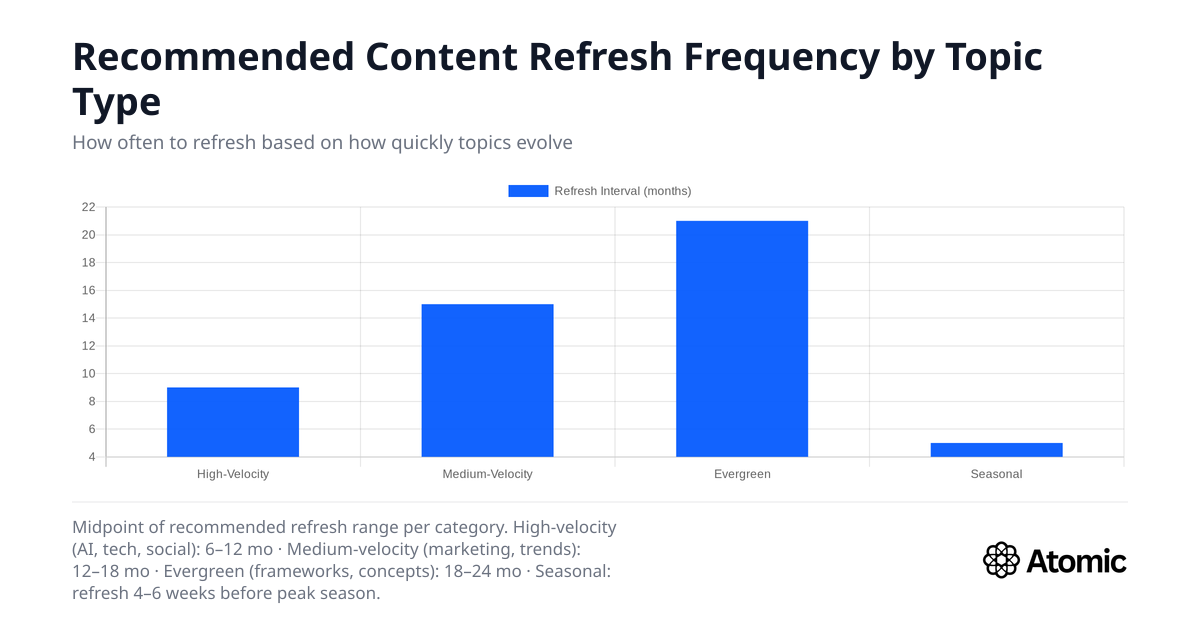
This process is called content decay, and it affects virtually every piece of published content regardless of its initial quality. The rate of decay varies by topic type - technology content can lose meaningful ranking ground within 6-12 months, while foundational evergreen content may hold its position for 18-24 months before requiring attention.
A data study by Siege Media analyzing thousands of top-ranking pages across 17,805 keywords found that the average page-one result had been updated within the last two years - and for high-competition "best software" queries, content on the first page was refreshed every 143 days on average. That's the competitive bar your content is being measured against, whether you're actively refreshing or not.
For teams managing content at scale, content decay creates a compounding problem. Every month that passes without a systematic refresh program, you accumulate more pages that have slipped from positions 1-5 to positions 6-15 - the zone where traffic drops sharply but topical authority still exists. These pages represent some of your best refresh opportunities precisely because they don't need to build authority from scratch.
The challenge for most SEO teams is operational, not strategic. Identifying which pages to refresh first, and in what order, is a time-consuming analysis task that often gets deprioritized in favor of publishing new content. That creates the treadmill effect: constantly producing new content while existing content quietly erodes beneath it.
How to identify content that needs a refresh
The most important decision in content refresh SEO is not how to update a page - it's which page to update first. Prioritization determines whether your refresh program generates meaningful ROI or disperses effort across low-impact content.
Traffic and ranking signals
Start with Google Search Console. Export your pages sorted by impressions over the last 12 months and filter for pages that show one or more of these patterns:
- Consistent ranking decline: Pages that ranked in positions 1-5 twelve months ago and now sit at positions 6-20. These pages have proven topic authority and are most responsive to refresh.
- Impression plateau with low CTR: Pages accumulating impressions but converting fewer of those to clicks. This often indicates a title or meta description that no longer matches search intent, or a featured snippet opportunity that a competitor has captured.
- Traffic drop without ranking drop: Organic traffic falling while ranking position holds. This pattern signals that search volume for your target keyword has declined or shifted to a variant your current content doesn't address.
AtomicAGI's Google Search overview dashboard surfaces these exact patterns automatically - making it straightforward to identify which pages are trending down before the decline becomes severe.
Content age and topic velocity
Different topics age at different rates and require different refresh cadences. A practical working framework:
- High-velocity topics (technology, AI tools, social media platforms, regulatory): refresh every 6-12 months
- Medium-velocity topics (marketing tactics, industry trends, best practices): refresh every 12-18 months
- Evergreen topics (foundational concepts, timeless frameworks): refresh every 18-24 months, or when traffic signals decline
- Seasonal content: refresh 4-6 weeks before the relevant season
Competitive displacement signals
When new content from a competitor enters the top 5 results for a keyword where you previously ranked in position 1-3, you're experiencing competitive displacement. This is a high-priority refresh trigger because the speed of your response matters - the longer a competitor holds a featured snippet or AI Overview citation for your core keywords, the more authority signals they accumulate.
Monitor SERP changes for your top 30-50 target keywords monthly. When you see displacement, treat it as an active incident requiring a refresh response within 2-4 weeks.
Conversion misalignment
High-traffic pages with declining conversion rates signal an intent mismatch. The page may be attracting visitors whose intent has shifted from informational to transactional, or your offering has evolved while the content still references legacy positioning. A content refresh that realigns on-page CTAs, updates the product/service framing, and restructures the content around current buyer questions can recover both rankings and conversion rates simultaneously.
The 7 steps to an effective content refresh
Once you've identified your priority pages, the following seven steps provide a structured process for executing updates that search engines actually reward.
Step 1: Re-run keyword research for the page
Search intent evolves. The keyword that drove traffic 18 months ago may have been partially replaced by a variant, a question-based query, or a more specific long-tail phrase that better reflects how users now search for the topic. Before touching a word of your content, run fresh keyword research to understand what the current search opportunity actually looks like.
Look for:
- New question-based variations of your primary keyword
- Related LSI terms that top-ranking competitors use but your page doesn't
- Featured snippet and "People Also Ask" (PAA) box opportunities for conversational queries
- Search volume shifts between head terms and longer-tail variants
This step determines the full scope of the refresh. You may find that a single page can now target 5-8 additional keywords through expanded coverage - an opportunity that doesn't exist without current research.
Step 2: Audit the current top 10 results
Before writing a single new sentence, study what's currently ranking. Open incognito browser windows for your target keyword and analyze the top 10 results with specific questions in mind:
- What subtopics do the top 3 results cover that your page doesn't?
- What content format are they using - numbered lists, comparison tables, how-to guides?
- Do any of them appear in featured snippets, PAA boxes, or AI Overviews?
- What is the approximate content depth and word count of top performers?
This competitive audit reveals the content standard you need to match or exceed. Refreshing without this context means you may invest effort in improvements that don't address the actual gaps causing your ranking decline.
Step 3: Update all data, statistics, and examples
Outdated statistics are one of the most reliable signals of content staleness - both to human readers and to AI systems evaluating citation-worthiness. Every factual claim in your content should be checked against its original source and updated to the most recent available data.
Specific elements to audit:
- Year-specific statistics (any data referenced as "in 2022" or "in 2023" that has a more recent equivalent)
- Product screenshots and UI examples that reflect old interfaces
- Tool or platform recommendations where newer or better options now exist
- Regulatory or compliance information that may have changed
- Industry benchmark data with annual updates (e.g. conversion rate benchmarks, average CTR by position)
When updating statistics, always link to the primary source rather than secondary aggregators. Direct citations from original research increase the E-E-A-T signals that both Google and AI citation systems evaluate. Google's own guidance on creating helpful, reliable, people-first content explicitly highlights demonstrated expertise and trustworthy sourcing as the core quality criteria for organic visibility.
Step 4: Expand content depth to close competitor gaps
Thin content - relative to what top competitors now publish - is the single most common cause of ranking decline for pages that previously performed well. Google's systems continuously calibrate what "comprehensive" looks like for any given query, and that standard rises as more content is published.
Your competitive audit from Step 2 reveals specific content gaps. Address them by:
- Adding new sections that cover subtopics your page currently misses
- Expanding shallow sections where competitors provide more depth
- Adding structured comparison tables, pros/cons frameworks, or step-by-step procedures where relevant
- Including real examples, case studies, or data points that demonstrate practical application rather than theoretical framing
One important distinction: content expansion should serve genuine reader value, not word count inflation. Adding a 300-word section that repeats information already covered in a different section does not qualify as meaningful depth expansion. It signals padding to sophisticated ranking systems - and as BrightEdge notes, Google's March 2024 Core Update specifically targeted sites with thin or low-quality content that lacks original value.
The video below shows how to find content gaps in AI search engines using AtomicAGI:
Step 5: Align structure with current search intent
Search intent alignment means your content format and framing match what searchers expect when they enter a given query. Intent can shift over time - a query that once attracted informational-intent content may now be dominated by transactional results, or vice versa.
Check the SERP structure for your target keyword: if the top 5 results are all numbered list articles and your page is structured as a long-form essay, that structural mismatch is likely costing you ranking position regardless of content quality. Similarly, if conversational AI search platforms like Perplexity or Google AI Overviews are surfacing content from that SERP, your content needs to be structured with direct-answer openings so AI systems can extract and attribute your content accurately. Perplexity SEO and traditional Google ranking share more structural requirements than most teams realize - direct-answer openings, question-based headings, and self-contained sections serve both.
For teams optimizing for both traditional rankings and AI Overview citations, the most effective structural pattern is:
- Open each major section with a direct, 1-2 sentence answer to the question implied by the heading
- Use question-based H2 and H3 headings where natural
- Follow each direct answer with supporting detail and evidence
- Add FAQ sections at the end of articles targeting question-heavy queries
Teams tracking content performance across both traditional search and AI Overviews have observed citation improvements appearing within 30-45 days of a meaningful refresh - considerably faster than new content takes to earn organic rankings.
Step 6: Update schema markup and technical metadata
A content refresh is an ideal opportunity to add or update structured data. Schema markup helps search engines and AI platforms parse your content's meaning accurately - and its presence is correlated with higher rates of featured snippet and AI Overview citation.
For most article refreshes, audit and update:
- Article schema: Update
dateModifiedto reflect the refresh date. This signals freshness directly to crawlers. - FAQ schema: If you've added a FAQ section during the refresh, implement FAQ schema to increase eligibility for PAA box inclusion.
- HowTo schema: For procedural content like step-by-step guides, HowTo schema increases eligibility for rich results.
- Author/Person schema: Ensure author credentials are marked up to support E-E-A-T signals.
Beyond schema, update your meta title and meta description to reflect the refreshed content angle, incorporate the highest-value current keyword variant, and ensure your meta description creates click incentive from the SERP rather than simply describing the article. Running a technical SEO audit after implementing schema changes is the fastest way to verify that structured data is correctly implemented and free of validation errors before re-indexing.
Step 7: Rebuild internal linking to and from the page
Internal links perform two functions: they distribute page authority through your site architecture, and they signal topical relationships between pages. Both functions are frequently broken by a content library that has grown organically over time without systematic linking maintenance.
When refreshing a page, audit its internal linking in both directions:
- Inbound links: Identify the 10-15 most relevant pages on your site that don't currently link to the page being refreshed. Add contextual anchor text links from those pages where the topic relationship is genuine.
- Outbound links: Review all links from the page to other internal content. Remove links to outdated or removed pages, update links that now point to better or more current resources, and add links to newer content that the refreshed page should reference.
For B2B SaaS and digital-first businesses with large content libraries, this step is often where the most latent link equity exists. Pages that have been siloed from related content often see ranking improvements simply from better internal link architecture - before any off-page changes occur. AtomicAGI's interlinking analysis tool maps the full internal link structure of your site, scoring each page by link health and surfacing orphaned or under-linked pages that are most likely to benefit from better connectivity.
The data behind content refresh performance
The case for investing in content refresh SEO is increasingly well-supported by empirical analysis. The Surfer SEO study of 300,000+ pages is particularly instructive: refreshed pages were not only twice as likely to break into the Top 10, but the same advantage held across every ranking tier measured. Specifically, 15.1% of updated pages reached the Top 50, compared to just 8.0% of non-optimized pages.
The efficiency argument is equally compelling. Industry data consistently shows that updating existing content requires significantly less effort than creating a net-new piece targeting equivalent traffic potential. When you factor in that refreshed pages also inherit the authority, backlinks, and index history of the original page, the ROI differential between refreshing and creating new content becomes significant - particularly for teams managing large content libraries under resource constraints.

For B2B SaaS teams where content is a primary demand generation channel, the traffic quality aspect is also worth noting. Research on AI-referred traffic consistently shows higher engagement and conversion rates from visitors arriving via AI-generated summaries versus standard organic clicks. Getting your refreshed content cited in Google AI Overviews - a direct outcome of a well-structured refresh - can materially improve not just traffic volume but traffic quality. The strategies that drive zero-click search visibility - including structured data, direct-answer formatting, and E-E-A-T signals - overlap almost entirely with best-practice content refresh execution.
How to prioritize refreshes at scale with AtomicAGI
The seven steps above are straightforward to execute for a single page. The operational challenge emerges when you're managing a content library of 100, 500, or 1,000+ pages: how do you systematically identify and prioritize which pages to refresh, in what order, without drowning in manual analysis?
AtomicAGI's Content Refresh Priority Analysis agent addresses this problem directly. The agent analyzes your entire content library, evaluates ranking signals, content age, competitive displacement, and traffic decay patterns, and outputs a prioritized refresh queue - so your team starts every sprint knowing exactly which pages will generate the most ranking recovery per hour of effort invested.
Rather than manually sorting through Google Search Console exports and spreadsheets to identify refresh candidates, the agent surfaces the right pages automatically, flags the specific reasons each page needs attention, and provides the data foundation for a refresh brief. This is the kind of operational efficiency that allows a lean SEO team to run a systematic refresh program across a large content library without scaling headcount.
You can explore the Content Refresh Priority Analysis agent and the full suite of AtomicAGI SEO agents at atomicagi.com/ai-agents.
Measuring content refresh success
Results from a content refresh are not instantaneous. Understanding the typical timelines helps you set accurate expectations and avoid making premature changes that interrupt the ranking recovery process.
Weeks 1-2: Google re-crawls the updated page. You may see the dateModified schema picked up quickly in Search Console, but visible ranking movement is unlikely within this window.
Weeks 2-4: Initial ranking movement typically begins. Pages that were hovering just outside the Top 10 often see the most visible early movement. Pages deeper in the rankings (positions 20-50) may show more gradual upward movement.
Days 30-90: Full impact window. Most of the ranking recovery from a well-executed refresh manifests within 60-90 days. Traffic gains of 20-40% on refreshed posts are commonly reported; high-opportunity pages with strong existing authority can exceed this range.
Ongoing: Track not just primary keyword rankings but the expanded keyword footprint. A comprehensive refresh often earns rankings for related terms beyond your original target - particularly if you added new sections or structured the content to answer question-based queries that your original version didn't address.
Metrics to track across the 90-day window:
- Primary keyword ranking position (weekly)
- Organic impressions and clicks from Google Search Console (weekly)
- Average position for the page across all tracked keywords (weekly)
- Organic traffic to the specific URL vs. the prior 90-day period (at 30, 60, and 90 days)
- Featured snippet and PAA box ownership for target queries (monthly)
- AI Overview citation status for target queries (monthly)
- Conversion rate on the URL vs. pre-refresh baseline (at 60 and 90 days)
Content refresh SEO and AI search: what changes in 2026
The case for systematic content refreshes is stronger in 2026 than at any prior point - largely because of how AI-powered search has changed the stakes of content staleness.
Google AI Overviews, Perplexity, ChatGPT Search, and similar platforms don't just rank your content - they synthesize it, cite it, or ignore it. AI systems prefer recently updated content with direct-answer structure, verifiable author credentials, and comprehensive topical coverage. A page that was current in 2023 but hasn't been touched since is likely being passed over by these systems in favor of fresher alternatives - even if its traditional ranking position has held.
This creates a specific operational priority for teams managing high-traffic content: the content most at risk from AI search displacement is often not the content with the worst rankings, but the content that's highly ranked yet structurally unsuitable for AI citation. Evergreen content that ranks well but hasn't been updated in 18+ months is particularly vulnerable.
Effective content refresh SEO in 2026 means updating for two audiences simultaneously: the traditional ranking algorithm and the AI synthesis layer. The strategies that serve both overlap significantly - direct-answer structure, schema markup, E-E-A-T signals, and fresh data all improve performance in both environments. Google's own guidance on E-E-A-T - Experience, Expertise, Authoritativeness, and Trustworthiness - establishes the quality framework that drives citation decisions in both traditional and AI search contexts. The additional step required specifically for AI citation is ensuring each section opens with a quotable, self-contained answer rather than assuming the reader has followed the surrounding context.
For a detailed breakdown of how to optimize for Google's AI summaries specifically, the Google AI Overviews SEO guide covers the structural and schema-level requirements that drive citation rates - many of which apply directly to your content refresh workflow.
Common mistakes that make content refreshes ineffective
Understanding what doesn't work is as important as knowing what does. The following mistakes consistently produce refresh efforts that fail to move rankings.
Only updating the date stamp: Search engines evaluate the substance of changes, not just the modification timestamp. As Google's Search Central documentation confirms, its ranking systems evaluate content quality holistically - a date update with no meaningful content improvement is unlikely to trigger positive ranking movement and may be interpreted as an attempt to manipulate freshness signals.
Changing the URL: Unless you have a structural site reason to change a URL, don't. Every existing backlink, internal link, and indexed page reference points to the original URL. A URL change fragments that authority even with a 301 redirect in place, and recovery from the fragment can take months.
Cosmetic updates without competitive analysis: Adding a paragraph here and updating a statistic there without first understanding what the current top 10 results cover means you're optimizing in the dark. The competitive analysis step is what distinguishes a targeted refresh from a maintenance edit.
Refreshing every page on the same cadence: A systematic refresh program requires prioritization. Applying the same refresh cadence to every page regardless of its performance trajectory, topic velocity, or competitive position wastes effort on low-ROI updates while high-priority pages continue to decay. Running a technical SEO audit alongside your content review helps separate pages that need content updates from those that have underlying crawlability or indexing issues that would undermine any refresh effort.
Not promoting the refreshed content: Treat a substantial content refresh the same way you'd treat a new publication. Re-share it on social channels, notify relevant email segments, and reach out to sites that linked to the original version to let them know it's been comprehensively updated. Distribution amplifies the ranking signal sent by a refresh - and it's a step most teams skip entirely.
Conclusion
Content refresh SEO is one of the highest-ROI levers available to SEO teams managing established content libraries. The combination of existing authority, faster ranking timelines versus new content, lower production effort, and the growing importance of content freshness for AI search citation makes systematic content refreshes a priority for any team serious about organic growth.
The seven steps in this guide - re-running keyword research, auditing the current top 10, updating data, expanding depth, aligning intent, updating schema, and rebuilding internal links - provide a complete execution framework. Applied consistently to a prioritized refresh queue, they compound over time into a content library that holds its rankings, expands its keyword footprint, and earns citations in both traditional and AI search environments.
The operational challenge of identifying and prioritizing which pages to refresh at scale is exactly what AtomicAGI's Content Refresh Priority Analysis agent is built to solve. If your team is managing a large content library and needs to run a systematic refresh program without expanding headcount, it's worth exploring what that agent can surface in your specific content ecosystem at atomicagi.com/ai-agents.
Consistent, data-driven refreshing - not just periodic maintenance - is what separates content libraries that compound in value from those that quietly decay.
