


Organic search still drives 53% of all website traffic (BrightEdge), yet 96.55% of web pages receive zero traffic from Google (Ahrefs). The gap between those two numbers is not a mystery - it is almost always the result of poor keyword research, or no real keyword research at all.
In 2026, the mechanics of keyword research have changed in ways that matter. According to a joint study by Ahrefs and Amsive analyzed by Search Engine Land, AI Overviews produce a 34.5% drop in position 1 CTR when present, based on an analysis of 300,000 keywords. Zero-click searches account for 58.5% of US Google queries. Position 1 organic CTR dropped from 28% to 19% year-over-year as AI answers push blue links further down the page. And AI search engines - ChatGPT, Perplexity, Gemini - have introduced an entirely new surface that most keyword research workflows were never designed to address.
For B2B SaaS marketing and SEO teams in particular, these shifts demand a more precise approach. Traffic without intent alignment is just noise. Keywords without a conversion path burn content budget. And a research process that runs once a year - rather than continuously - leaves teams reacting to ranking drops instead of preventing them.
This guide covers the complete keyword research process: from seed discovery and intent mapping through clustering, difficulty assessment, and the specific adjustments needed to optimize for AI search citation alongside traditional Google rankings.
What you'll learn
- How to build a seed keyword list that reflects actual customer language, not internal jargon
- Why search intent classification matters more than search volume in 2026
- A repeatable process for SERP analysis that reveals format requirements before you write a word
- How keyword clustering concentrates topical authority and reduces cannibalization risk
- The keyword difficulty benchmarks that match to your site's actual domain authority
- How to adapt keyword research for AI search engines like ChatGPT, Perplexity, and Gemini
- The continuous monitoring cadence that protects rankings before they drop
Why keyword research is the foundation - not the first step
Most teams treat keyword research as a prerequisite: run it once before building a content calendar, then move on to writing. That framing is the problem. Keyword research is a continuous strategic function, not a pre-production task.
Search intent evolves. Queries that drove informational traffic 18 months ago may now trigger transactional SERPs. New long-tail variants emerge as product categories develop language. AI-generated content floods head-term SERPs, making low-competition long-tail clusters more valuable than ever. And 15% of daily Google searches are entirely new queries never seen before (Google, reaffirmed 2024) - meaning any static keyword list is already incomplete the moment you finish it.
The teams that compound organic growth quarter over quarter do not have bigger keyword lists. They have better keyword systems: structured processes that continuously surface new opportunities, identify intent shifts, and flag cannibalizations before they suppress rankings.
For SEO directors and growth leads managing content at scale, this is the operational reframe that matters. Keyword research is not a one-time deliverable. It is an ongoing signal layer that informs every content decision from ideation to refresh.
Step 1: seed keyword discovery
Every keyword strategy starts from seed keywords - the 2-4 word topic terms that anchor your content architecture. Getting these right determines whether your subsequent expansion lands in profitable long-tail territory or produces months of low-traffic output.
Seed keywords are terms like "keyword research," "rank tracking," or "conversion rate optimization." They are not specific enough to target directly in most cases, but they are the trunk of your keyword tree from which every cluster branch grows.
The four-source seed keyword exercise
Before opening any tool, run through these four sources to build your initial seed list:
1. Customer language audit. Pull the exact phrases your customers use in sales calls, support tickets, onboarding surveys, and product reviews. Tools like Gong or Chorus surface this language directly from sales conversations. The words your buyers use to describe their problems are the most accurate proxy for what they type into search engines.
2. Competitor homepage H1s. Scan the H1s and primary navigation labels on 3-5 direct competitors. The vocabulary they lead with reveals category-level language that likely has established search demand. Do not copy their positioning, but note where their terminology overlaps with your own.
3. Google Autocomplete modifiers. Type each seed candidate into Google and note the 8-12 autocomplete suggestions. Pay attention to modifier patterns: "how to," "best," "vs.," "for [industry]," "without," and year qualifiers like "2026." These modifiers reveal the sub-intents surrounding each seed.
4. Product and service category mapping. List the 3-5 core topics your site covers, using the plainest possible customer language. Avoid internal product names, feature labels, or industry acronyms that your customers would not type into a search bar.
The output of this exercise is typically 15-30 seed terms. These become the inputs for tool-based expansion in the next step.
Step 2: search intent classification
Search intent is the single most important classification decision in keyword research. Publishing a product page to compete for an informational query - or an educational guide to compete for a transactional one - produces structural mismatches that algorithm updates will penalize regardless of content quality.
The four intent categories map to distinct content formats and distinct conversion expectations:
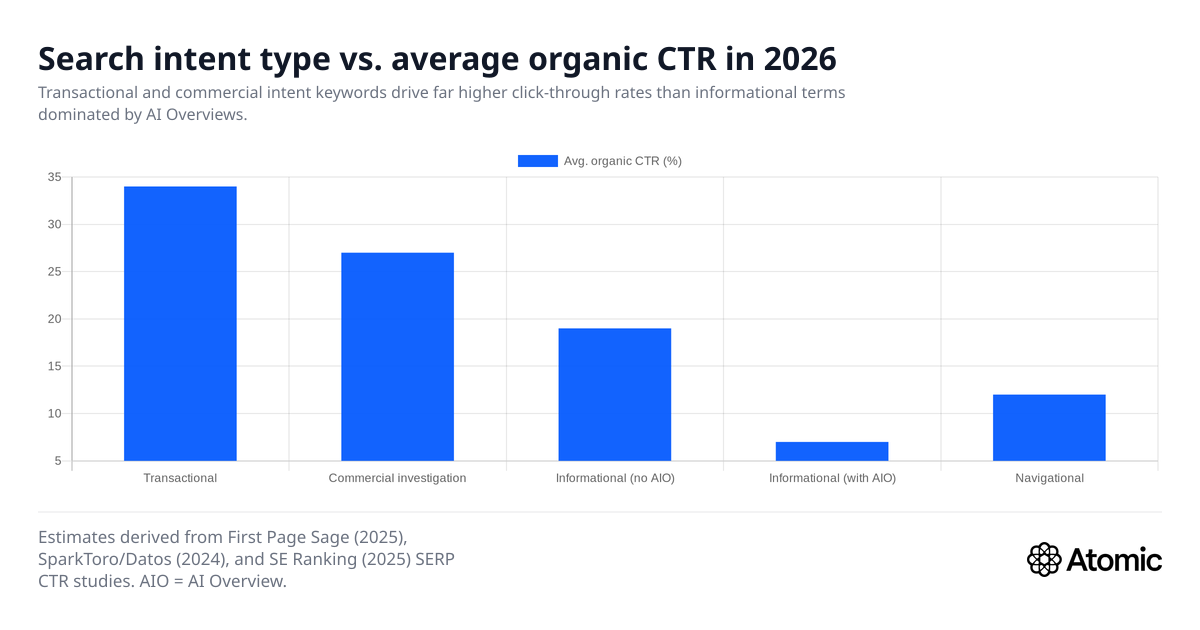
The chart above illustrates something that surprises most teams when they first see it: transactional and commercial investigation keywords drive dramatically higher click-through rates than informational terms - and informational queries where AI Overviews appear have CTR roughly comparable to position 4-5, not position 1.
The intent classification diagnostic
Run every candidate keyword through these four questions before assigning a content format:
- Does the user want to buy or sign up now? - Transactional. Serve with a product or landing page.
- Does the user want to compare options? - Commercial investigation. Serve with a comparison guide or roundup.
- Does the user want to find a specific brand or site? - Navigational. Only relevant for your own brand terms.
- Does the user want to learn something? - Informational. Serve with a guide, explainer, or how-to.
When intent is ambiguous - and it often is for terms like "SEO analytics platform" - the resolution is direct: examine the current top 3 SERP results. Their format is Google's answer to what intent it has determined the query carries. The SERP is always the ground truth.
One nuance critical for B2B SaaS teams: commercial investigation keywords are where AI citation happens most often. ChatGPT's web search triggers on commercial queries 53.5% of the time (Quattr, 2025). If your content strategy underweights commercial investigation content relative to informational content, you are likely underrepresented in AI search responses - not just traditional Google results.
Step 3: SERP analysis before writing
Analyzing page 1 results before writing a single word is not optional in 2026. The SERP tells you the content format Google rewards for a query, the word count range that competitive pages occupy, whether an AI Overview is intercepting clicks, and which People Also Ask questions reveal the adjacent intent around your target keyword.
Run this checklist for every keyword before it enters your content calendar:
- AI Overview trigger check. If an AI Overview appears consistently for this query, evaluate whether sufficient click-through remains to justify the content investment. According to Search Engine Land's analysis of the Ahrefs and Amsive studies, non-branded keywords show a CTR decline of up to 19.98% when an AI Overview is present. Informational queries with simple factual answers are increasingly resolved by AI Overviews without any page visit.
- Content format audit. Are the top 5 results listicles, how-to guides, comparison pages, or product pages? Your format must match the dominant type. A long-form essay competing for a query where all top results are numbered listicles will not rank regardless of depth.
- Word count range. Skim the top-ranking pages. If the competitive standard is 3,000-4,000 words, a 900-word page will not rank. If the standard is 1,200 words, a 6,000-word piece signals misalignment with what users want from this query.
- People Also Ask extraction. Expand every PAA question on the SERP and collect the results. These questions become your H2 headings and FAQ schema entries - they are validated sub-queries Google has confirmed users ask around your topic.
- Domain authority signal. If positions 1-3 are owned by DA 80+ domains for a keyword, that changes your timeline, not necessarily your strategy. A strong piece with supporting cluster architecture can still break through over time.
The two minutes invested in this analysis before writing prevents hours of wasted effort on content formatted incorrectly for the query.
Step 4: keyword clustering and topic architecture
Keyword clustering is the structural practice that separates sites that compound organic authority from those that publish content indefinitely without ranking momentum. The concept is straightforward: group related keywords by SERP overlap, then publish one strong piece targeting the entire cluster rather than isolated articles for each individual term.
When two keywords share three or more URLs in their top 10 results, they belong in the same cluster. One well-structured page can rank for all of them simultaneously.
The pillar-and-spoke model
The pillar-and-spoke architecture organizes clusters into a hierarchy that concentrates topical authority. As Moz explains in their guide to SEO topic clusters, this model turns your content into a system that improves rankings, strengthens authority, and supports conversions - rather than treating each article as a standalone asset:
- Pillar page: targets the broadest keyword in the cluster (e.g., "keyword research"). Comprehensive, high word count, internally links to all spoke articles.
- Spoke articles: target specific sub-queries within the cluster (e.g., "long-tail keyword strategy," "keyword difficulty explained," "best keyword research tools"). Each links back to the pillar.
The bidirectional internal linking between pillar and spokes is what activates the authority concentration. Cluster articles without those internal links are just siloed posts with a shared theme - the SEO benefit requires the structural connection. For teams working at scale, the evidence that topical authority signals drive citation in AI search as well as traditional rankings is well established: AI systems synthesize answers from sources that demonstrate comprehensive topic coverage, not just individual article quality.
A worked example using "keyword research" as the pillar:
- Spoke 1: How to find seed keywords (informational)
- Spoke 2: Keyword difficulty for different site authority stages (informational)
- Spoke 3: Best keyword research tools comparison (commercial investigation)
- Spoke 4: Long-tail keyword strategy guide (informational)
- Spoke 5: Keyword cannibalization: audit and fix (informational - problem resolution)
Teams building this architecture for the first time typically start with 3-5 pillars aligned to their core product categories, then map 5-8 spokes per pillar before writing anything. The mapping work itself takes several hours. The ranking compound effect takes months. But teams that skip this step find themselves refreshing individual underperforming articles without understanding why they underperform.
Step 5: long-tail keyword strategy
The statistics here are not intuitive until you look at them directly: 94.74% of all keywords have 10 or fewer monthly searches (Ahrefs). Head terms with 50,000 monthly searches represent a tiny fraction of total search volume - and they carry competition levels that make them effectively unwinnable for most sites.
Long-tail keywords - typically 3 or more words with specific intent - are where most SEO wins actually happen. Not because any individual term drives significant traffic, but because a cluster of 20-30 related long-tail terms within a single well-structured article can collectively drive 500-1,000+ monthly visits. Volume per keyword is almost irrelevant when you optimize for cluster traffic potential.
Three methods for finding long-tail keywords
Google Autocomplete suffix variations. Type your seed keyword and systematically add modifiers: "for beginners," "vs.," "how to," "without," "free," "2026," "[industry name]." Each suggestion represents a validated query pattern with real search demand.
People Also Ask mining. The PAA box on any SERP surfaces question-based long-tail keywords that users are actively submitting. Click each PAA question - Google loads 2-3 more related questions each time. Expand until the new questions stop coming. Collect everything.
Competitor keyword gap analysis. In Ahrefs or Semrush, run a keyword gap report against 3-5 competitors. Filter for keywords where competitors rank in positions 4-20 - these are their weakest positions and your best entry points. This method surfaces pre-validated demand without any guesswork about what might work.
One finding worth flagging for B2B SaaS teams specifically: "zero volume" keywords frequently generate real traffic. Ahrefs' own data confirms that keywords with estimated zero monthly volume still produce clicks. The 15% of daily Google searches that are entirely new queries - never seen before - are almost always long-tail. Targeting specific, intent-precise long-tail clusters catches these emerging queries before competitors notice them.
Step 6: keyword difficulty and priority scoring
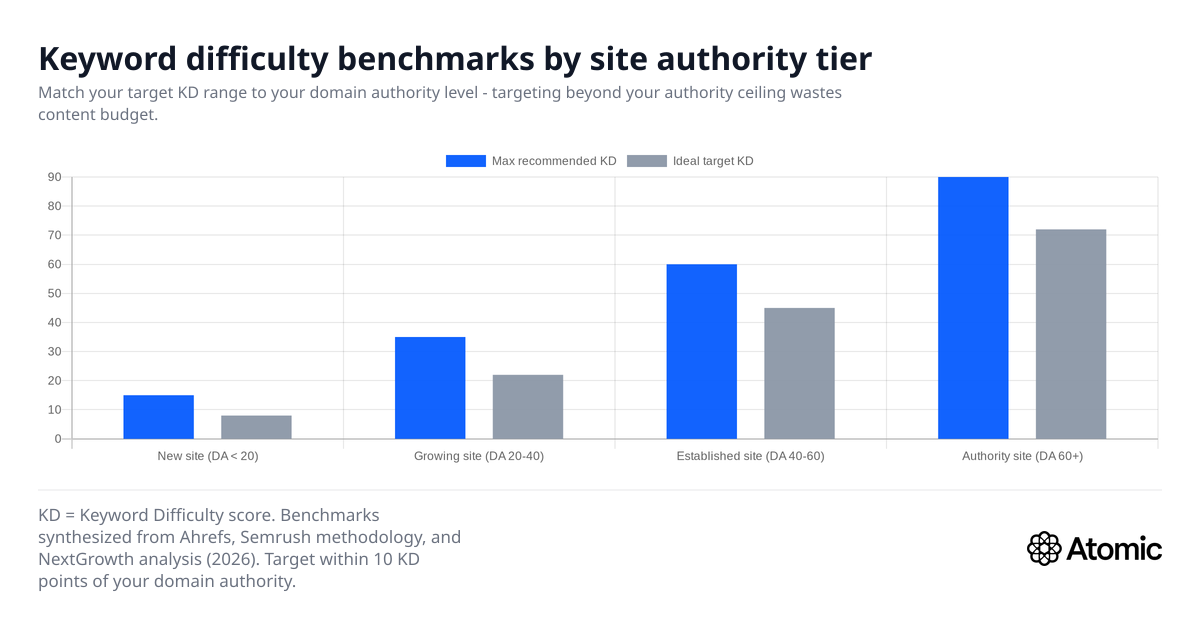
Keyword difficulty (KD) scores from SEO tools are estimates based on the backlink profiles of currently ranking pages. They do not account for your domain authority, topical relevance, or content quality - the three factors that actually determine whether you can rank. A raw KD score without that context produces a flawed priority list.
The practical rule: your average KD target should sit within 10 points of your site's current domain authority.
The priority score formula
Instead of filtering by raw KD alone, calculate a priority score that accounts for your specific situation:
Priority Score = (Monthly Volume × Intent Value) / (KD Score × DR Gap)
Where:
- Intent Value: Commercial investigation = 3, Informational = 1, Transactional = 2
- DR Gap: Average DR of top-5 results minus your domain rating (minimum 1)
A keyword with 2,400 monthly searches, informational intent (value: 1), KD of 35, and a DR gap of 15 produces a priority score of 4.57. A keyword with 800 monthly searches, commercial intent (value: 3), KD of 20, and a DR gap of 5 produces a priority score of 24. The second keyword, despite 3x lower volume, is the better investment by a factor of five.
This formula is deliberately simple. The point is not precision - it is forcing the three factors that raw KD ignores into the prioritization decision.
One additional filter: check whether the keyword triggers an AI Overview consistently. A KD of 12 is not a good investment if the keyword is fully resolved by an AI Overview with no meaningful click-through to organic results. A KD of 45 may be worth pursuing if the SERP is dominated by transactional results with strong CTR and no AI Overview present.
Step 7: competitor keyword reverse-engineering
Your competitors have already run the experiment you're considering. Their organic keyword portfolio is a validated report on what drives traffic in your category. Reverse-engineering it compresses your discovery timeline significantly.
The key distinction most teams miss: competitors for keyword research purposes are not your business competitors. They are any sites that appear consistently on the same SERPs you're targeting. A single-author blog with high topical authority can be your most significant keyword competitor even if it sells nothing.
The competitor extraction process
- Search your top 10 target keywords and note which domains appear most frequently in the top 20. These are your content competitors.
- In Ahrefs or Semrush, run site explorer on each. Sort organic keywords by traffic value.
- Filter for keywords where competitors rank positions 4-20 - their weakest spots are your best entry opportunities.
- Cross-reference with your own organic keyword data to identify true gaps: terms your competitors rank for that your site does not appear for at all.
- Apply your priority score formula to the resulting gap list and sequence by score.
Focus your initial content investment on keywords where 2+ competitors rank in the 4-20 range. The validated search demand exists - their weak positions signal that better content can displace them faster than attacking keywords they dominate.
Step 8: keyword cannibalization auditing
Keyword cannibalization happens when two or more pages on your site target the same primary keyword. Google splits authority between them - neither ranks as well as a single focused page would. The suppression is often invisible in standard reporting because both pages may show organic impressions, just at positions far lower than a consolidated page would achieve.
As Backlinko documented with their own cannibalization fix, consolidating two competing articles with a 301 redirect produced a 466% increase in clicks year over year - a result that required minimal effort but had outsized SEO impact.
Common cannibalization patterns in B2B SaaS content:
- Blog posts and feature pages targeting the same commercial investigation query (e.g., "best CRM software" as both a blog comparison and a product category page)
- Multiple blog posts written at different times covering the same topic with overlapping primary keywords
- Pillar pages and spoke articles with insufficient keyword differentiation
The three-step cannibalization audit
Google Search Console filter. Navigate to Performance, filter by a specific query, and examine which URLs generate impressions. Two or more pages appearing for the same query is a cannibalization signal.
Ahrefs/Semrush site explorer. Filter organic keywords for instances where your domain ranks 2+ different URLs in positions 1-30 for the same term. Semrush's dedicated Cannibalization Report within Position Tracking surfaces these patterns automatically.
Site: search check. Run site:yourdomain.com "target keyword phrase" in Google and examine which pages surface.
When you find cannibalization, resolve it in order of preference: differentiate one page's target keyword to a clearly distinct term, then redirect if one page is clearly inferior, then merge both into one piece with a 301 redirect from the weaker URL. Prevention is simpler: maintain a keyword-to-URL map from the start. A spreadsheet with columns for primary keyword, URL, and secondary keywords catches conflicts before publishing. Moz recommends this same approach as core to any topic cluster strategy - clustering keywords by topic inherently prevents cannibalization from developing in the first place.
Step 9: trend direction and timing
A keyword with 5,000 monthly searches declining 20% year-over-year is a worse content investment than one with 1,000 monthly searches growing 50%. Current volume measures the past. Trend direction predicts the future - and the future is when your content will be ranking.
Google Trends is free and sufficient for this. You do not need exact volume - you need the slope of the line. Backlinko's guide to using Google Trends for SEO outlines how to layer seasonal and structural trend data to sharpen your content calendar sequencing.
Two trend types matter for content sequencing:
Structural trends signal long-term category shifts. "AI SEO tools" has grown 300%+ year-over-year while "manual SEO audit" shows consistent decline. Structural shifts tell you where to invest long-term content architecture, not just individual articles.
Seasonal trends repeat annually. Plan content 10-12 weeks before the seasonal peak so it has time to accumulate ranking signals before search demand crests. Publishing in the middle of a seasonal spike almost guarantees you miss the window.
For B2B SaaS teams, structural trends around AI search visibility, zero-click optimization, and LLM citation are the most consequential tracking targets in 2026. The teams recognizing and documenting these shifts now are building content architecture that will still be generating citations 24 months from now.
Step 10: keyword research for AI search engines
This is where traditional keyword research frameworks stop and where most SEO teams currently have a gap. AI search engines - ChatGPT, Perplexity, Gemini - do not operate on keyword rankings the way Google does. They synthesize answers from sources they determine to be credible and comprehensive. Being cited in those answers requires a different layer of keyword research.
It is also worth noting that despite widespread predictions about AI killing traditional search, data from SparkToro and Datos reported by Search Engine Land shows Google query volume is still growing. AI hasn't replaced search - it has added a second surface that now runs in parallel. Your keyword research needs to serve both.
How AI search query patterns differ
Traditional Google searches tend to be 2-4 word keyword phrases. AI search queries are conversational and specific. Someone who Googles "best CRM small business" might ask Perplexity: "What CRM is best for a 10-person B2B SaaS team that needs HubSpot integration and costs under $50 per user per month?"
The specificity changes your keyword targeting. You are not just optimizing for "best CRM" - you are optimizing for the entire class of precise, multi-variable questions that your product or expertise can answer. Your content needs to go deep on the variables that make questions specific: team size, industry, budget range, integration requirements, use case nuances.
Keyword research adjustments for AI citation
Mine People Also Ask aggressively for question-format keywords. These map directly to how users query AI search engines. PAA questions are validated by Google as things real users ask - and they translate almost directly to the conversational queries Perplexity and ChatGPT handle.
Target compound-intent queries. A query like "how do B2B SaaS companies find low-competition keywords without expensive tools" would have minimal search volume in any traditional tool. But it is exactly the type of specific question an AI search engine handles dozens of times per day. Building content that answers these compound queries explicitly is how you get cited.
Prioritize commercial investigation keywords for AI visibility. As noted earlier, ChatGPT triggers web search on commercial queries 53.5% of the time (Quattr, 2025). If your category has strong commercial investigation keywords and your content targets them with genuine comparative depth, you are positioned for both Google rankings and AI citations simultaneously.
Structure content for extraction, not just reading. AI systems extract specific passages to construct their synthesized answers. Your keyword research should identify the specific questions users ask, and your content structure should answer those questions in self-contained sections that can be extracted without surrounding context. This is why direct-answer openings and question-based H2 headings serve both traditional SEO and AI citation with the same structure.
For teams tracking whether their keyword research is translating into AI search visibility - not just Google rankings - the measurement challenge is significant. Standard Google Search Console data does not show AI citation. This is one of the core gaps that drove the development of AI search visibility tracking as a distinct discipline separate from traditional rank tracking. Understanding why zero-click searches are rising and how to win visibility despite them is directly tied to how you structure your keyword research for this new landscape.
Step 11: keyword research workflow for scale
For SEO teams managing 50+ articles per quarter, manual keyword research at every step creates a bottleneck that limits output velocity. The steps most amenable to automation are also the most data-intensive: seed expansion, SERP data collection, PAA mining, competitor gap extraction, and intent classification.
What can be automated
Seed-to-long-tail expansion. Tools like Ahrefs, Semrush, and DataForSEO's suggestion endpoints expand a list of 50 seed keywords to 500+ long-tail variants in minutes. This is faster, more comprehensive, and more systematically filtered than manual autocomplete research.
SERP analysis at scale. DataForSEO's SERP API pulls structured data - content types, AI Overview presence, PAA questions, featured snippet format - for hundreds of keywords simultaneously. Manual SERP checking works for 10 keywords. It does not scale to 500.
Intent classification. Large language models can classify keyword intent at scale with high accuracy when given a structured prompt. Running a raw keyword export through an LLM classifier in a batch workflow reduces a day-long manual task to minutes.
Competitor keyword extraction. API-driven gap analysis against 3-5 competitors produces a prioritized gap list without the manual export-and-compare steps in most tool UIs.
What requires human judgment
Trend analysis (interpreting structural shifts and seasonal patterns), cannibalization resolution (deciding which page to consolidate or redirect), topical authority architecture (determining pillar/spoke relationships that match your business goals), and AI search query pattern identification - these require strategic judgment that automation cannot fully replace.
The efficiency frame that matters for growth teams: if automation handles 70-80% of the data collection steps, your team's research capacity scales without additional headcount. The judgment layer stays human. The data layer becomes infrastructure.
The continuous monitoring cadence
Keyword research that runs once produces a static list that degrades in accuracy every month. The teams that protect rankings - rather than chase them after they drop - run keyword research on a structured cadence.
Monthly: Track SERP changes for your top 30-50 target keywords. When you see displacement - a competitor gaining positions or a new AI Overview appearing - treat it as an active incident requiring a content refresh response within 2-4 weeks. Watch for intent shifts: a query that previously showed informational results may now show transactional content, signaling that your current page format is misaligned.
Quarterly: Run a full keyword gap analysis against your primary competitors. Refresh your seed keyword list with new terms surfaced in customer language audits, sales calls, or product feedback. Audit for cannibalization across new content published in the prior quarter. Recheck trend direction for your top 20 cluster pillars.
Annually: Rebuild your full topical authority architecture from the ground up. Category language shifts over 12 months in fast-moving spaces like AI, SaaS tools, and digital marketing. Keywords that were high priority 18 months ago may have declined structurally. New clusters have likely emerged that your current architecture does not address.
The monitoring infrastructure that makes this cadence feasible is the operational differentiator between teams that compound organic growth and teams that maintain it. When ranking data, keyword research data, and conversion attribution exist in disconnected tools, the signal-to-action timeline extends from days to weeks. By the time a ranking drop appears in a weekly report, investigated in a separate tool, diagnosed, and briefed to a content writer, 3-4 weeks may have passed on what should have been a 5-day response cycle.
Common keyword research mistakes that suppress rankings
Even structured research processes produce predictable failure modes. These five appear consistently across B2B SaaS content programs that plateau despite publishing volume.
Targeting head terms before building domain authority. A site with DA under 20 targeting KD-50 keywords will rank on page 5 indefinitely. The content investment generates no traffic and no engagement signals - making the next piece even harder to rank. Start with KD under 15 and build your authority baseline before expanding into competitive territory.
Ignoring search intent entirely. Publishing a commercial product page to compete for an informational query is a structural mismatch the algorithm penalizes regardless of content quality. The format has to match the intent the SERP has established.
Never refreshing keyword research. Strategies built on data that is 12-18 months old miss intent shifts, new long-tail clusters, and AI-driven SERP changes that have significantly altered which terms are worth targeting. Quarterly refreshes are the minimum.
Building clusters without internal links. As Moz documents in their topic cluster research, topic clusters without bidirectional internal linking are just siloed articles with a shared theme. The authority concentration benefit only activates when Google can crawl the structural connection between pillar and spokes.
Confusing AI-generated keyword ideas with validated data. ChatGPT and other LLMs generate keyword ideas quickly and usefully - but they cannot access real-time search volume or current SERP data. Every AI-generated keyword idea must be validated in a tool with actual search data before it enters a content calendar.
Conclusion
Keyword research in 2026 is not harder than it used to be - it is more layered. The core process has not changed: find what your audience searches for, understand what they want when they search it, and create content that answers that intent better than any competing page. What has changed is the number of surfaces where that intent plays out, and the speed at which intent patterns shift.
The teams winning at organic growth right now are the ones running keyword research as a continuous operational function rather than a pre-project checklist. They have built the architecture - seed discovery, intent classification, SERP analysis, clustering, difficulty calibration, competitor gap analysis, and AI search optimization - into a repeatable workflow that runs quarterly at minimum and monitors continuously.
For SEO directors and growth leads at B2B SaaS companies, the strategic investment is not in discovering new keyword tools. It is in building a research system that converts keyword data into ranked content into attributed pipeline - and that closes the loop between what your buyers search for and what your site actually ranks for. That loop, combined with a clear strategy for winning visibility even when zero-click searches intercept organic traffic, is what separates organic search as a cost center from organic search as a compounding growth asset.
