


AI Mode tracking records how Google AI Mode answers a fixed set of customer questions over time. It shows whether AI Mode names a brand, how it describes it, which of its pages it links, and which rivals it recommends instead.
Those answers reach a large audience, since Sundar Pichai, Alphabet's chief executive, said in July 2026 that AI Mode had "surpassed 1 billion monthly active users". Yet Search Console counts AI Mode's links with those in AI Overviews and never shows what an answer said. Asked again a minute later, the same question can name different products.
For a SaaS, fintech, or AI company, the AI Mode answer to a buying question is a shortlist that a finance or engineering lead reads inside Google. Without stored answers, a drop from that shortlist cannot be traced to a rival's new page, a change at Google, or a broken tracker. This guide shows how to track brand visibility in Google AI Mode: read Google's free reports, measure four metrics from saved answers, and check a drop before rewriting a page.
Key takeaways
- Read Search Console's AI report as a count of links shown, since it mixes AI Overviews with AI Mode.
- Report every tracked rate with its answer count and view, because answers change from run to run.
- Count mentions, citations, and Sponsored links apart, as AI Mode can link a page without naming its brand.
- Group the questions by intent and freeze them, since a changed set breaks the trend.
- Rule out Google's changes and collection faults first, because both changed what trackers recorded in autumn 2026.
What is AI Mode tracking, and why does it matter now?
AI Mode tracking measures what Google's reports leave out, which is what AI Mode says about a company. AI Mode is Google's conversational search, where a longer question gets an AI-written answer with links.
A mention is the brand named in an answer, with the words that describe it, and a citation is a link to one of its pages. The two often come apart, since in Semrush's 2026 study of four AI engines, 61.7% of 3,981 domain appearances were links to a page whose brand the answer never named.
AI Mode tracking also differs from rank tracking, because an answer has no fixed list of positions. It differs from AI Overviews tracking too, since in Ahrefs' September 2025 US data the two features cited the same URLs only 13.7% of the time.
It matters now because Google changed AI Mode and its reporting in autumn 2026:
- 31 August 2026: the generative AI report reached all websites, with impressions and no clicks.
- 13 October 2026: Gemini 4 Argon became a model option in AI Mode for paying subscribers.
- 15 October 2026: Google reported "continued and substantial increases to the presence of inline links" in AI Mode and AI Overviews.

Why does AI Mode give different answers to the same question?
AI Mode gives different answers to the same question because it rebuilds each answer, tailors it to the asker, and changes on Google's schedule. A tracker then adds variation of its own.
1. Fresh searches. Google's AI Mode help says it uses query fan-out, which splits a question into subtopics and searches each one at once. So the pages it reads can change between runs while the website stays the same.
In SISTRIX's 17-week study of 82,619 prompts, 56% of cited domains changed from one week to the next. Even so, 86.5% of prompts kept a stable core of one to five domains.
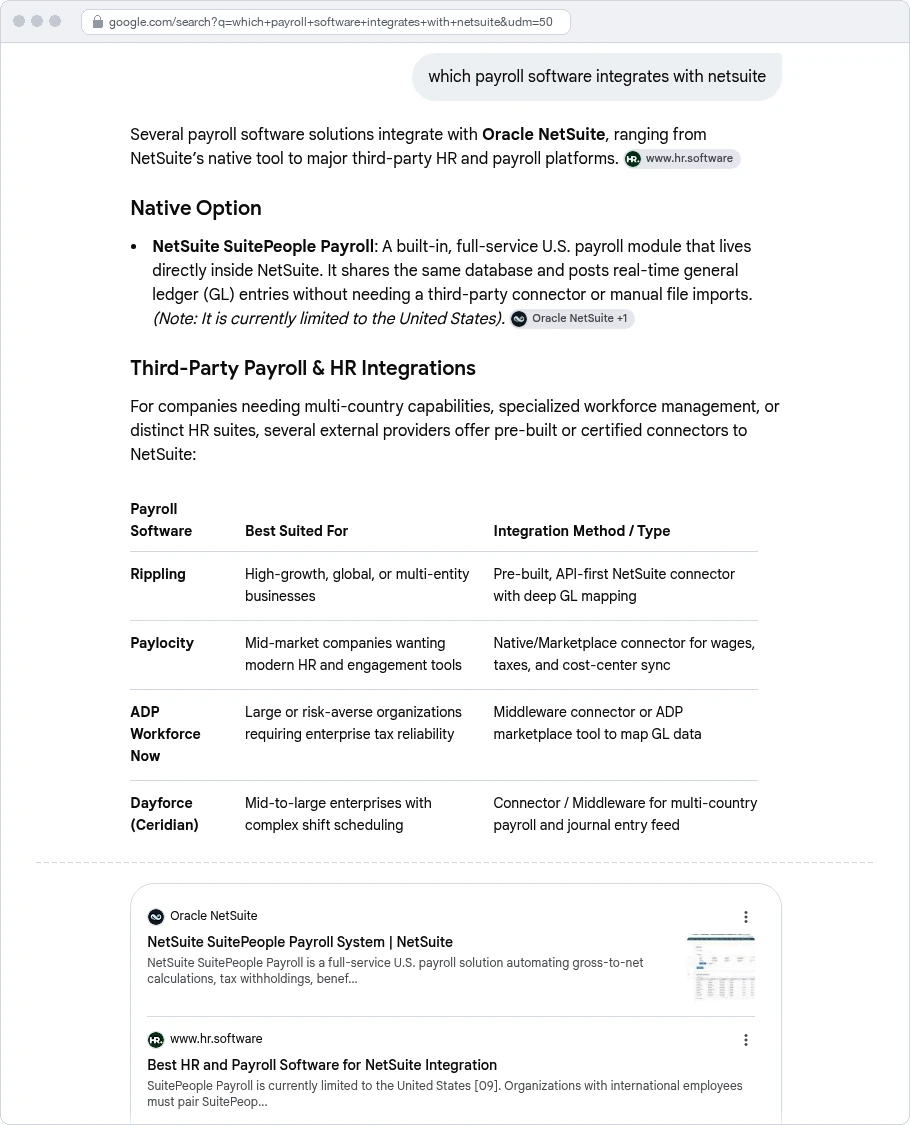
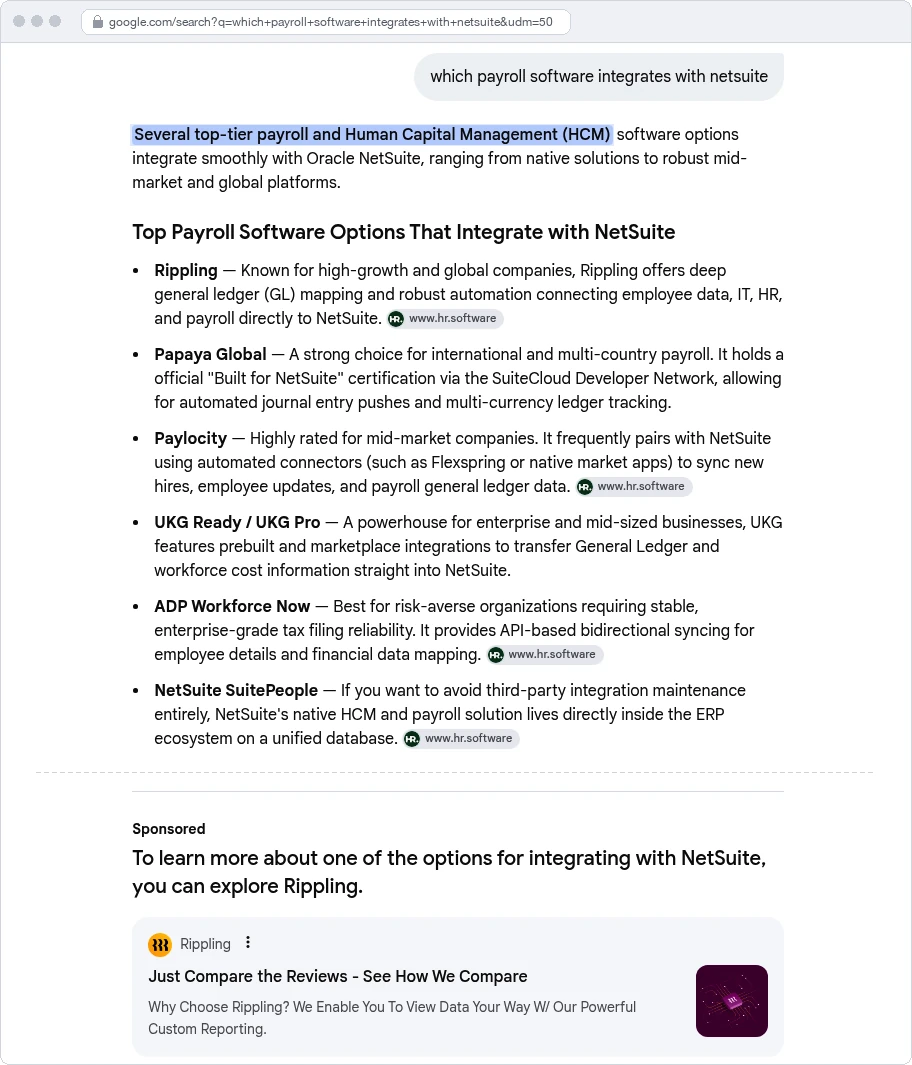
The two captures in this guide show the same churn on one question, taken about a minute apart from one signed-out view. Both named NetSuite's own payroll module and Rippling. Yet only the first listed Dayforce, while the second put Rippling first, added Papaya Global, and showed a Sponsored block for Rippling.
2. The asker. AI Mode tailors answers for signed-in adults who keep history and personalised recommendations on, using their past searches and activity. In the US in English, it also remembers past interactions. Google calls this Personal Intelligence, and connecting Gmail, Calendar, or Photos adds more context.
Signed-out results can be customised as well, unless Search customization is off. Country, language, and device also change results, so every tracked AI Mode number belongs to one view: its country, language, device, account state, and model.
3. Google's changes. Google changes how answers show links and which model writes them, often for some users first. When Gemini 3.8 Flash reached subscribers on 2 September 2026, search marketers posted AI Mode answers with barely any links.
Robby Stein, a vice president of product at Google, replied on 4 September that it "isn't working as intended". The same day, a search marketer posted that the links were back.
4. The tracker. A tracker collects answers through the product interface or a SERP data provider, which sells Google results as data. One provider's AI Mode API serves a cached copy of an identical request for up to an hour, so two stored runs can be one answer.

Collection itself failed in September 2026, when requests from Nozzle, a rank-tracking company, began failing and then came back as swapped pages. Derek Perkins of Nozzle describes them as "complete, normal-looking pages whose results have been swapped out. Nothing on the page gives it away. Each keyword’s own history does."
In its study updated on 19 October, Nozzle judged 8.4% of its classic results pages affected since 13 September, against 0.17% before. By 13 October, PPC Land reported, Google had not commented. The figures come from one vendor, and the study did not measure AI Mode answers.
Every tracked AI Mode number is therefore a sample that needs its run count, view, and route beside it.
What Search Console and GA4 show for AI Mode, and what they miss
Search Console and GA4 give the free check, with data from Google itself.
AI Mode counts inside the Performance report's Web search type with the usual click and impression rules. The generative AI report adds impressions of the website's links in AI Overviews and AI Mode together.
| Report | What it counts for AI Mode | What it leaves out |
|---|---|---|
| Search Console Performance report | Clicks, impressions, and position by query, page, country, device, and date; a follow-up counts as a new query | Which rows came from AI Mode |
| Search Console generative AI report | Impressions of the website's links in AI Overviews and AI Mode together, by page, country, device, and date | Clicks, queries, answer text, brand names, rivals, and the AI Mode share |
| GA4 default channels | AI Mode's non-ad visits inside Organic Search, under Google's default channel rules | Any AI Mode-only line; the AI Assistant channel excludes AI Mode |
The report has no click data. Asked about clicks on 15 October 2026, Google told Search Engine Roundtable only that "we’ll introduce additional metrics over time."

So Search Console shows which pages Google links in its AI features, and when leadership asks only that, the free report is enough. Only the answers themselves show whether AI Mode names the brand, how it describes it, and whom it names instead.
What are the five metrics of AI Mode tracking?
The five metrics of AI Mode tracking are mention rate, citation rate, share of voice, core cited pages, and AI impressions by page. Only the last comes from Search Console, and the other four come from saved answers, collected by hand or by a tracker on a schedule.
Suppose Rippling, which sells payroll software, tracked the NetSuite question from the two captures above. Each metric starts with what those two answers would show it, then takes its figures from a worked example. In this worked example, Vendor A, a payroll analytics company, asks AI Mode 30 buying questions daily for 28 days. The questions form three groups of ten (category, integrations, and alternatives), plus five branded and five control questions.

1. Mention rate and description: how AI Mode names the brand
Mention rate is the share of completed answers in a group that name the brand, with each description recorded as recommended, listed, or warned against. Both captures name Rippling, the first for high-growth, global, or multi-entity businesses and the second as known for high-growth and global companies. A tracker logs two listed mentions with the same description.
In the worked example, Vendor A's integrations group names it in 112 of 280 answers, or 40%, mostly as an option for mid-market teams.
By the standard Wilson formula, which treats every answer as independent, the 95% range runs from about 34 to 46%. On the same basis, two 28-day windows like this one can differ by up to about eight points by chance. Answers to one question also resemble each other (both captures share four products), so the real ranges are wider.
What to do: Report the rate and description per group with the completed-answer count. Recheck a monthly move under eight points in the next window before acting on it, which is this guide's investigation rule.
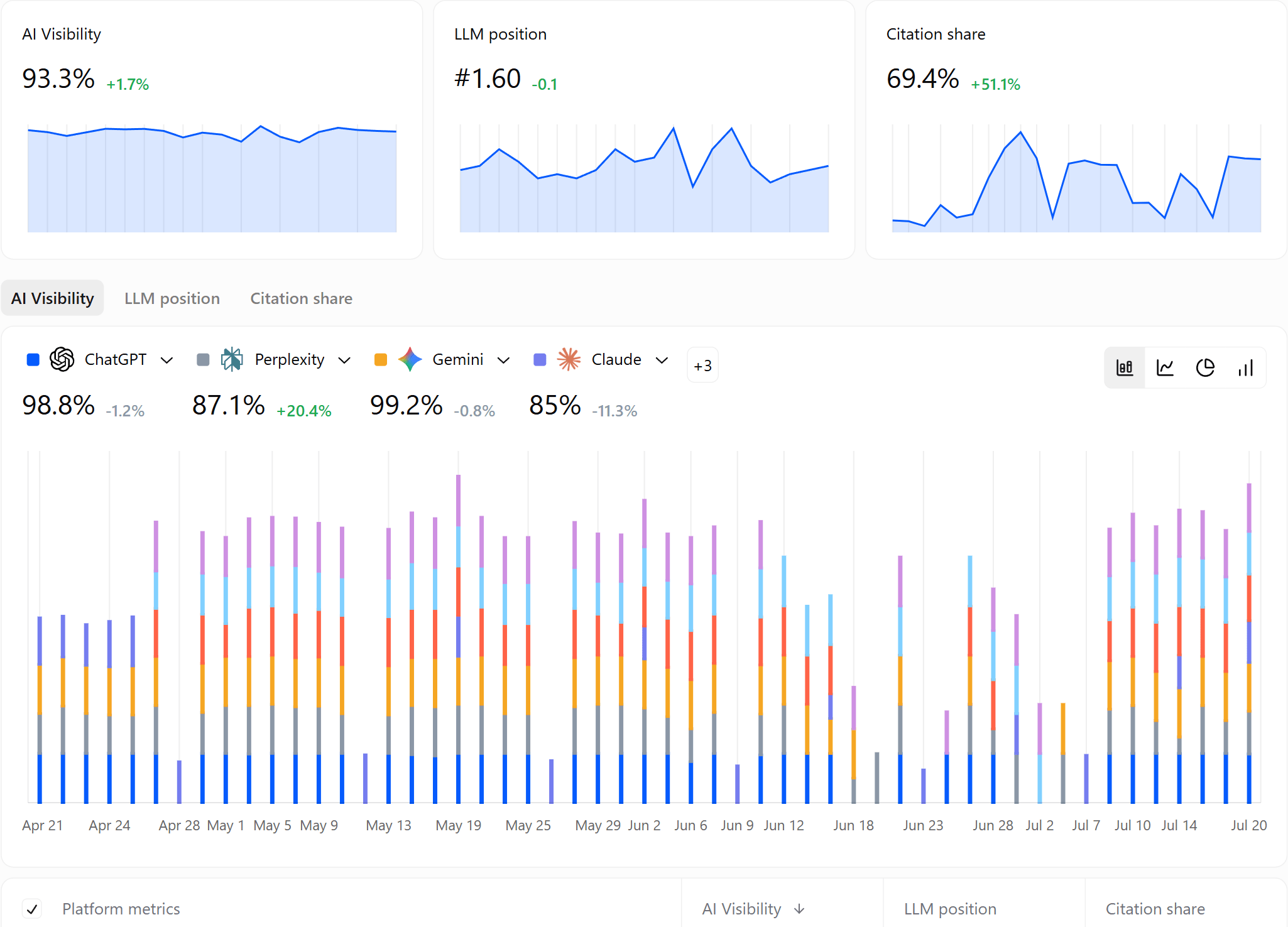
In Atomic, the Prompts table gives each question its mention frequency, which counts only completed answers that rank the company. The Recent chats tabs of the AI Visibility view list those answers as Mentioned or Missing. The Sentiment report sorts the descriptions into Positive, Neutral, and Negative themes with their evidence.
2. Citation rate: how often AI Mode links the company's pages
Citation rate is the share of completed answers that link at least one company page. In the second capture, AI Mode names Rippling first, but the source chip beside its line links hr.software, a software comparison website. The only visible link to rippling.com is a Sponsored ad below the answer.
If the full source list confirms it, that answer counts as a mention without a citation, with the ad kept apart. Barry Schwartz of Search Engine Roundtable reported on 15 September 2026 that Google was testing such AI Mode ads, which look like normal answers labelled Sponsored.
In the worked example, Vendor A's pages are linked in 50 of 280 integrations answers, or 18%. AI Mode names Vendor A more than twice as often as it links it.
Answers without outside links change that arithmetic. Anil Sayar, founder of Promvia, ran 40 English buying questions through a SERP data provider six times from 3 September to 5 October 2026. Of the 240 AI Mode checks, 77 found no website outside Google. As he puts it, "A single check is a snapshot, and an empty answer is not a loss."

What to do: Keep every completed answer in the denominator and report the share with no outside link beside the rate. Store Sponsored links with their label, outside the count.
Atomic reports a related measure, the company's share of all cited sources, on the Citation share tab of the AI Visibility view, engine by engine. The citation rate itself is counted from the saved answers. Each completed run opens to its saved answer, ranked results, and citations, so a mention without a link can be checked in the answer.
3. Share of voice: the brand against named rivals
Share of voice is the brand's share of all mentions that it and a fixed set of rivals receive, counting each brand once per answer. For Rippling, a fixed set for NetSuite questions could be Paylocity, ADP Workforce Now, and NetSuite's own SuitePeople, the three other products named in both captures.
In the worked example's alternatives group, Vendor A holds 98 of the 316 mentions that it and Vendors B, C, and D receive, or 31%. A rate alone cannot show ground gained, because every rival's rate can rise in the same month.
What to do: Fix three to five rivals per group for the window, since a changed list shifts the share. Report it monthly with the rival that gained.
Atomic keeps that set as the accepted list on its Competitors page. Its AI search Competitors view then compares the company with those rivals on the same prompts, with visibility, average position, and citations in a column per engine.
4. Core cited pages: the sources AI Mode keeps returning to
Core cited pages are the sources cited in at least half of a group's runs, sorted into own, rival, and third-party pages. In SISTRIX's data the median AI Mode prompt kept about two core domains, and pages drift more than domains.
For Rippling, hr.software recurs as a third-party domain, since both captures cite it. The first shows its comparison page, Best HR and Payroll Software for NetSuite Integration, as a source card. That page joins the core only if the same URL recurs in at least half the runs.
In the worked example, Vendor A's integrations core holds a review website's comparison page that skips it, a rival's integration directory, and a Workday Marketplace listing. Vendor A's own page appears in fewer than one run in five.
What to do: List the core per group each month by owner, starting with third-party pages that skip the brand.
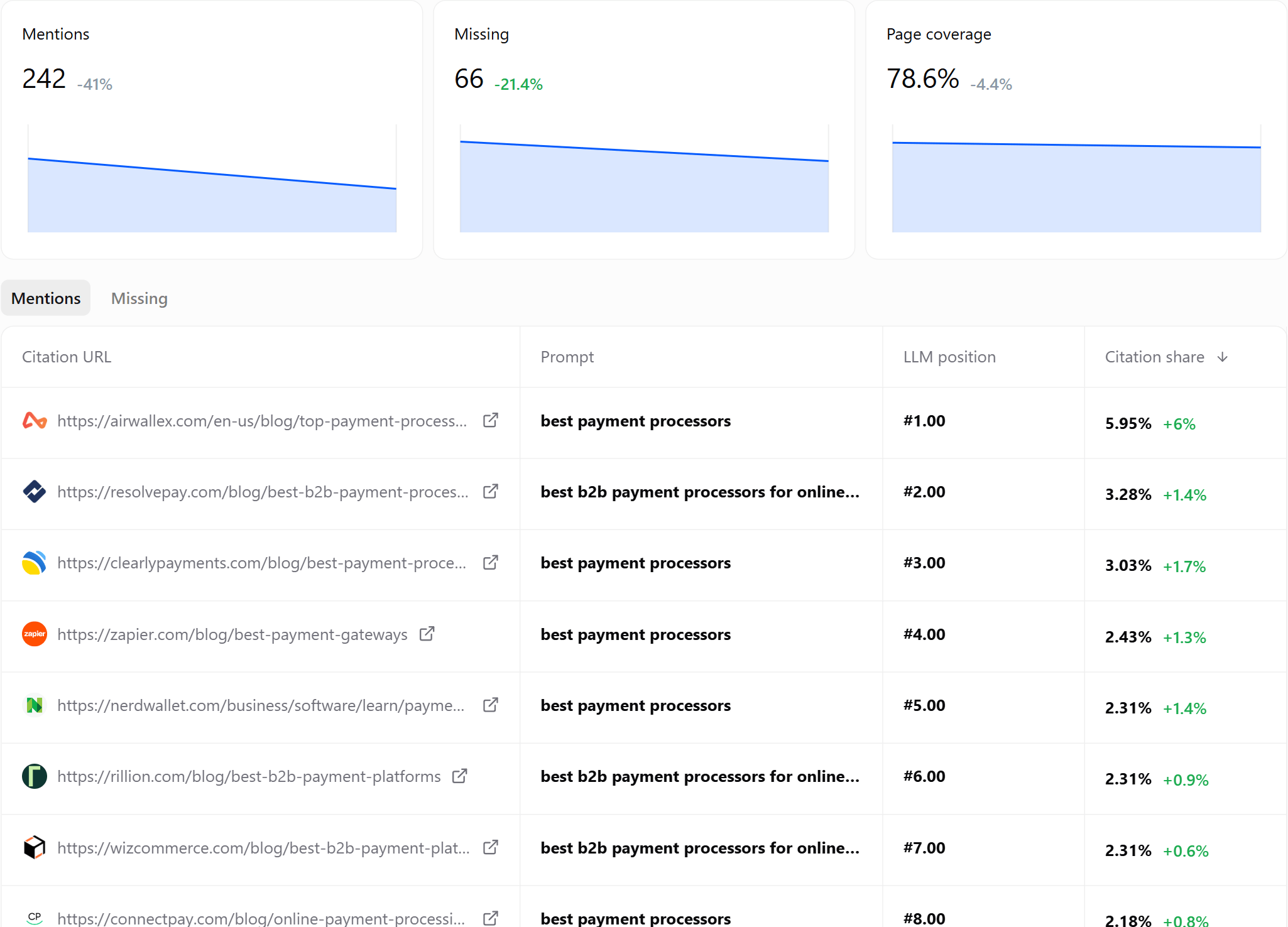
In Atomic, the Citations report's By page tab, filtered to AI Mode and one prompt group, ranks the cited URLs by share. It labels each as the company's own, a competitor's, editorial, or user-generated. That share counts source occurrences, so the half-of-runs test still comes from the saved answers. It divides the completed answers that cite a URL, counted once per answer, by all completed answers in the group.
The Mentions report then lists the cited third-party pages that name the company and, on a Missing tab, those that do not.
5. AI impressions by page: Google's own count
AI impressions by page are the generative AI report's impressions per page, for AI Overviews and AI Mode together, exported from the page table. The page table matters because the chart counts two results from one website in one feature once.
Had a person seen the second capture, its hr.software chips would count toward hr.software's AI impressions, not Rippling's, since the report counts the links shown to a website.
In the worked example, Vendor A's category guide rises from about 1,200 to 1,700 AI impressions a week over six weeks. Over the same weeks, the share of category answers linking it rises from 9% to 15%. That correlation supports the trend without proving it, because AI impressions mix both features and count links, never names.
What to do: Export AI impressions by page weekly and read them beside the tracker's cited pages. Never divide GA4 sessions by them to get a click-through rate (CTR), since Organic Search holds every Google organic visit.
The other half of that comparison sits in Atomic's Citations report. Its By page list, filtered to AI Mode, gives each URL in the weekly export its share of AI Mode's citations.
How to track brand visibility in Google AI Mode step by step
The setup starts with the free data Google already holds and then adds the tracker.
1. Check eligibility and export Search Console's AI report
Google's only technical requirement for AI Mode links is a page indexed and eligible for a snippet. Confirm the indexing in Search Console's URL Inspection, then check that no robots rule blocks the snippet. Under Settings > Search generative AI, check that the property has not opted out.
Then export the AI report by page and list the pages that earn AI impressions and the key pages that earn none. When the report is missing, Google's help says the website usually has not received enough impressions in its AI features. AI Mode's clicks sit unlabelled inside the Performance report and GA4's Organic Search, so read the first list's click trends there.
Atomic's URL indexing report checks those key pages with Google and sorts them into Indexed, Discovered, Unknown to Google, and Errored. An unindexed key page then shows up before anyone rewrites it.
2. Write and freeze the question set
Take questions from sales calls, support tickets, and question-shaped Search Console queries, in the customer's own wording. A fragment such as payroll analytics Workday becomes Which payroll analytics tools work with Workday and NetSuite?
Keep at least ten questions per group, branded questions apart, and freeze the set for four weeks. At the same number of answers, ten different questions beat repeats of fewer questions in a resampling of 4,090 stored answers to 79 questions.

In Atomic, the Questions tab of the Keywords report lists the question-shaped Search Console queries. The Suggested prompts panel in the Manage prompts workspace proposes more questions, each accepted or denied by hand. The workspace takes one question per line with its funnel stage and group.
3. Fix the view and write it down
Choose one country, language, and device, and run every question signed out in a fresh session with Search customization off, on AI Mode's default model. Write that view and the collection route on the first line of every report.
Atomic treats AI Mode as an engine of its own, chosen in the AI search engines control of the Manage prompts workspace. AI Overviews is a separate engine there, unlike in Search Console's AI report. Answers come through the AI products' interfaces as well as their APIs, and every saved run records its engine, country, and time.
4. Run daily and read 28-day windows
Daily runs read over 28 days schedule 280 runs for a ten-question group, and the report counts the completed answers among them. A group that holds inside its range for three windows can move to weekly runs read over a quarter. Those give fewer than half as many answers, so the range widens. The AI citation tracking guide covers citation tracking across engines.
Atomic's scheduled checks default to daily, every 48 hours, or every 72 hours, depending on the plan. On the slower schedules the same 28 days hold fewer answers per question, so the answer count beside each rate shows how much evidence it rests on.
5. Store every answer
Keep each answer's full text, the brands in order with their descriptions, every link with its owner, and any Sponsored label.
Atomic keeps each completed run's saved answer as evidence, since "rerunning a prompt can produce a different answer." Its run list shows each run's processing state, and pending or failed runs stay out of the mention percentage, so a failed run never counts as a missing mention. The prompt view below tracks each prompt's position over time.
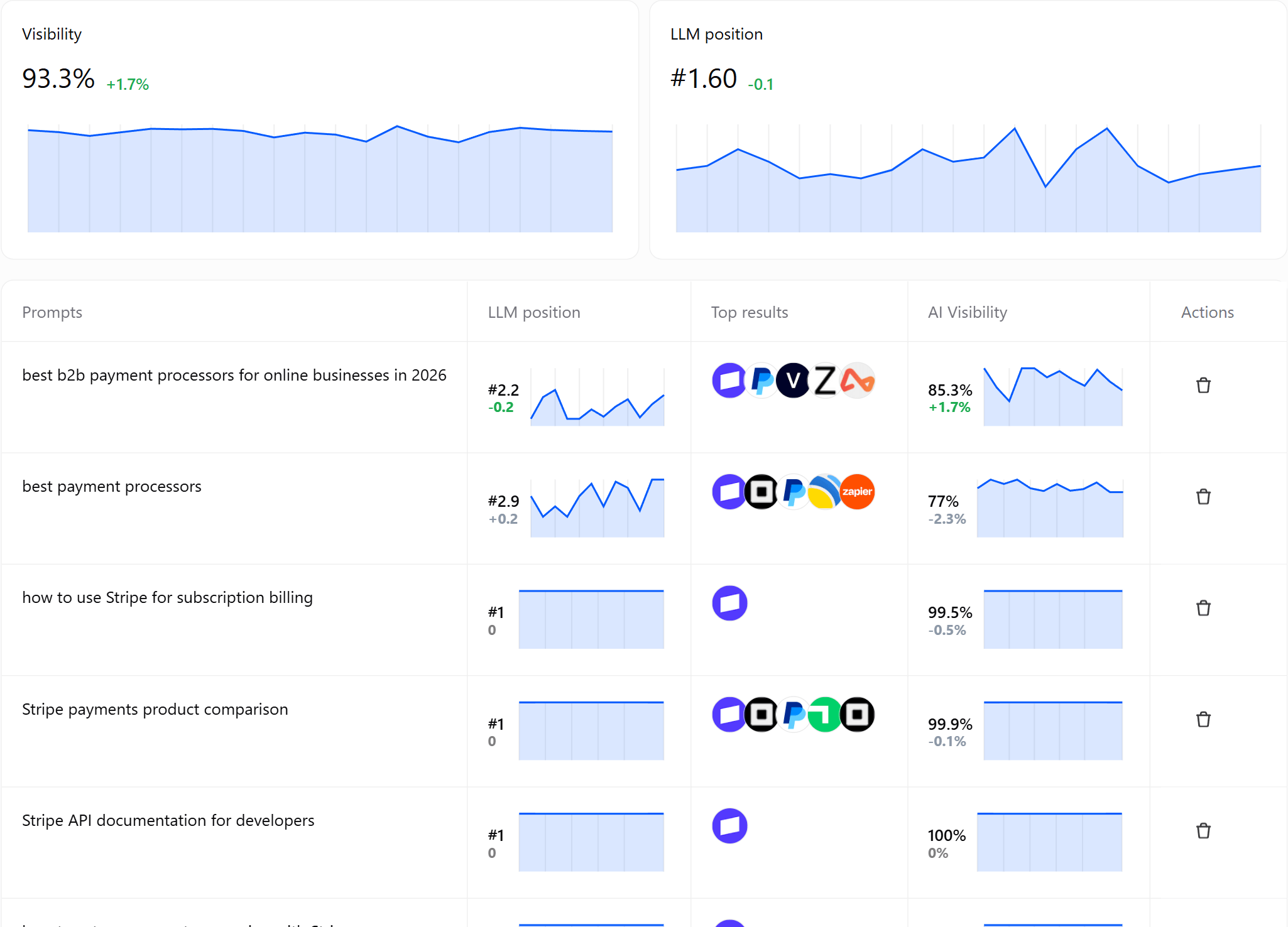
6. Log changes and re-run before reading a swing
Keep one dated log of Google's announcements, model releases, website releases, and collection notes. Add a few control questions on topics the website did not touch.
Re-run the affected group two to three days after a drop, before reading it. This guide bases that wait on Nozzle's classic results pages, where 68.9% of swapped pages were back to normal within three days, two days at the median.
That re-run can go through Atomic's MCP server, which AI agents reach through the Model Context Protocol. A connected agent such as Claude or ChatGPT tests each question of the group on AI Mode. The agent reads back the answer, citations, and brand classifications, and nothing is added to the tracked set.
How a 28-day AI Mode report is read and checked
In this worked example, Vendor A, the payroll analytics company from the metrics above, follows those steps over one 28-day window. Every question runs daily from the United States, signed out on the default model.
In week 3, the integrations mention rate falls by about 13 points and stays down, while the category group holds. The team runs the checks cheapest first:
- Change log. The only Google entry is a subscriber model, which cannot reach a signed-out default view.
- Collection. No runs failed, and a re-run two days later reproduces the fall, with 7 of 20 answers naming Vendor A.
- Controls. The control questions stay flat, so the fall is specific to integrations questions.
- Search Console. The integrations page's AI impressions stay near 1,900 a week, which is context only, since they count links, never names.
- Answer text. From week 3, a new Vendor B comparison page appears in 88 of 140 integrations answers, saying Vendor A needs a manual file import for Workday.
That claim predates Vendor A's connector, so with the other checks clear, the new page is the working hypothesis for the fall. Vendor A asks the review website in its core for a listing and states the connector, with its date, on its integrations page. The next window, read against the same controls, tests that hypothesis by showing whether the rate recovers.
The worked example's report puts the view on its first line:
Example: Vendor A's 28-day report. View: United States, English, desktop, signed out with Search customization off, AI Mode's default model, product interface, one run per question a day for 28 days.
| Question group (Vendor A, worked example) | Answers | Mention rate | Citation rate | Share of voice | Core pages owned | No outside link |
|---|---|---|---|---|---|---|
| Category (10 questions) | 280 | 46% | 21% | 29% | 1 of 4 | 9% |
| Integrations (10 questions) | 280 | 40% (weeks 1 to 4: 47, 46, 34, and 33%) | 18% | 27% | 0 of 4 | 11% |
| Alternatives (10 questions) | 280 | 35% | 12% | 31% | 0 of 3 | 14% |
| Branded (5 questions) | 140 | 96% | 74% | Not reported | 2 of 3 | 4% |
Values from a worked example; the weeks are undated.
In Atomic, those numbers can go into a custom report built from its AI search data and shared as a link or a PDF.
What are common AI Mode tracking mistakes?
Those checks also catch common AI Mode tracking mistakes, which come from treating one view or one tool as the whole picture.
1. "We searched it, and AI Mode recommends us"
A search from a signed-in team laptop can draw on the account's history, memory, and connected apps. A controlled test of three Google accounts and 1,922 AI Mode answers shows the size of that effect. Brands seeded through a connected account's Gmail and Photos rose from 23.9% to 66.8% of its answers, while a blank control account barely moved.

The signed-out view from step 3 keeps that effect out of the numbers, and in the test, banks and productivity tools were harder to move than consumer categories.
2. "The new tool says we dropped"
Two trackers can report different numbers for the same brand, because their routes, views, caches, and run counts differ, as the four causes above show. So each trend line keeps one tool and one route.
How to use AI Mode data to improve brand visibility
The stored answers also show where the work goes.
Start from the pages AI Mode already cites. Pages cited in some runs and not others are the nearest wins, so put their current facts into the page text with dates. The Gemini SEO guide covers how pages earn citations in Google's AI features.
Reach the pages other websites own in the core. A review page cited in most answers that skips the brand can be worth more than another page on the brand's own website. The Missing tab from metric 4 lists such pages. In SISTRIX's AI Mode data, YouTube held a place in a prompt's stable core at a 24% rate, against 1.4% for news and media websites.

Check the branded answers. Branded questions name the brand by design, so the check is its own domain. SISTRIX found a brand's own domain cited every week for only 43% of AI Mode brand queries. In the worked example's report, branded answers name Vendor A 96% of the time and link its pages 74% of the time. The gap to check is the branded answers that name it without a link.
How Atomic tracks AI Mode answers
Those moves all start from stored answers, which Atomic AGI keeps for AI Mode and the other engines a plan includes, such as ChatGPT, Perplexity, and Gemini. Search Console and GA4 connect to the same project, so Search Console's question queries sit beside the tracked answers. Visits and conversions stay a separate GA4 line, since Atomic's documentation says these metrics "do not measure website visits or predict conversion changes by themselves".
See how Atomic's AI search tracking records AI Mode mentions, citations, and rivals for a frozen set of questions.
Frequently asked questions
Can AI Mode traffic be tracked in GA4?
AI Mode's non-ad traffic can be tracked in GA4 only inside Organic Search, because Google's default channel rules file those visits there, outside the AI Assistant channel. Any AI Mode-only line in GA4 is therefore an estimate.
What are the options for AI Mode citation tracking?
The options for AI Mode citation tracking are Search Console's AI report, a signed-out check by hand, a script on a SERP provider's endpoint, and a tracking tool such as Atomic. Only a tool stores repeated answers from one view, and the list of AI search tracking tools compares them.
Can AI Mode rankings be tracked?
AI Mode rankings can be tracked as the brand's position in each answer, averaged over runs, since answers carry no fixed ranking. Atomic's average position counts a missing brand as position 10, so a brand that appears rarely cannot post a strong average.
Methodology
This guide combines Google's documentation, outside studies, and two AI Mode answers captured for it:
- How the conclusions were reached. The guide rests on Google's AI Mode, Search Console, Search Central, and Analytics documentation, read from 18 to 20 October 2026, the studies in the table below, and the pages ranking for AI Mode tracking queries on 18 October 2026.
- Screenshots and captures. The two AI Mode answers were captured on 19 October 2026, about a minute apart, signed out with US English settings, through a headless screenshot service. The screenshot of Google's help page was also captured on 19 October 2026. The Atomic views are Atomic's own product images, shown on an example project, and Atomic's features are described from its documentation and atomicagi.com feature pages, read on 20 October 2026.
- Limits. The two captures show variation and measure no rate. The studies use their own collection routes and views, none isolates people choosing B2B software, and Nozzle measured classic results pages only. Promvia's checks ran through a SERP data provider, which could not always separate a missing answer from an answer without links. The three-account test measured an account opted in to Personal Intelligence. That test and the four-market sampling study are cited without their publishers' names.
- Worked example. Vendor A and its figures are a worked example, not a company's data, and its weeks are undated. The Rippling scenes in the five metrics are hypothetical and use only what the two captures show, which is the visible part of each answer, so a missing citation or a recurring page URL would need each run's full source list. The range in metric 1 uses the 95% Wilson interval for a proportion, and the eight-point gap uses the normal approximation for a difference of two proportions, both treating answers as independent. The eight-point investigation rule, daily runs read over 28-day windows, the move to weekly runs after three stable windows, the two-to-three-day re-run, and the half-of-runs threshold for core cited pages are this guide's working conventions.
The outside studies, with each publisher's interest:
| Study | Sample and dates | Publisher's interest |
|---|---|---|
| SISTRIX | 82,619 prompts in six countries, weekly, 17 December 2025 to 8 April 2026 | SEO software |
| Ahrefs | 540,000 US query pairs for citations and 730,000 for content, September 2025 | SEO software |
| Semrush | 3,981 domain appearances for 115 prompts in 14 countries, 2026 | SEO software |
| Promvia | 40 English buying questions in six runs, 240 AI Mode checks, 3 September to 5 October 2026 | AI visibility software |
| Four-market sampling study | 4,090 observations, 79 questions, four markets, 29 May to 5 October 2026 | Cited without its publisher's name |
| Nozzle | 27.0 million judged results pages since 13 September 2026 in 52 countries, edition updated 19 October 2026 | Rank-tracking software |
| Controlled three-account test | 1,922 AI Mode answers in eight categories, run by hand on three accounts, 30 March to 15 April 2026 | Cited without its publisher's name |
Atomic sells AI search tracking software, including the AI Mode tracking described here. Search Engine Roundtable, Search Engine Land, and PPC Land are trade publications, cited for reported dates and statements.
Sources
The documentation, studies, and reports behind this guide:
- Google documentation: AI Mode help, AI features and websites, Search Console metrics, Performance report, generative AI report, generative AI control, why results differ, Personal Intelligence, sharing responses, third-party SEO tools, default channel group
- Google announcements: generative AI reports, controls for website owners, Gemini 4 Argon, inline links, October 2026, Alphabet Q2 2026 remarks
- Studies and vendor documentation: SISTRIX, Ahrefs, Semrush, Promvia panel, Nozzle, SerpApi AI Mode API
- Atomic: prompts, metrics, AI visibility, sentiment, citations, mentions, competitors, competitor list, keywords, URL indexing, MCP prompt tests, data sources, AI search tracking, reports
- Trade press: Search Engine Roundtable on 3.8 Flash links, on text link ads, on click data, on scrapers, on rank tracking, Search Engine Land on 3.8 Flash, PPC Land on rank checks
