


AirOps raised a $40 million in Series B funding from Greylock in late 2025. And yet, marketing and SEO teams across the internet are still typing "AirOps alternatives" into Google.
AirOps is a clean, no-code workflow builder with solid CMS integrations and a recent pivot into AI search visibility. But for many teams, it falls short in critical areas: pricing opacity, a steep learning curve, and a feature set that remains narrowly focused on content production workflows.
This guide breaks down the 10 best AirOps alternatives across different use cases, from AI-native SEO platforms to enterprise agent builders and open-source automation powerhouses.
We've researched each tool's current pricing, LLM support, and real user feedback so you can make an informed switch in 2026.
Why Teams Are Looking for AirOps Alternatives
AirOps is a capable content operations system, but it comes with a specific set of frustrations that consistently push teams to look elsewhere:
It's not a true AI search tracker. AirOps markets an "Answer Engine" diagnostic tool, but it evaluates content readiness for AI search, not actual brand presence. It won't tell you if your brand is being cited in ChatGPT or Perplexity today. That distinction matters enormously in 2026, when AI-generated answers are influencing a large part of all queries.
No native AI agents. Unlike competitors, AirOps doesn't offer true agent creation or deployment. You build workflows and grids manually for each use case, which leads to maintenance bloat over time.
A steep learning curve. Users consistently report spending hours in tutorials before extracting real value. One G2 user noted: "Took an entire day just to configure a 3-step workflow. Getting help was frustratingly difficult." For non-technical marketers, the setup friction is real.
Narrow use-case focus. AirOps is built almost entirely for SEO content workflows. If your team needs sales automation, RevOps pipelines, customer support agents, or general workflow orchestration, you'll hit a wall quickly.
Pricing opacity beyond the free tier. The Scale and Enterprise plans, where the real features live, require a sales call for custom pricing. That makes budgeting difficult and onboarding unnecessarily slow. Also, there are reviews saying that the tool is very expensive.
The 10 Best AirOps Alternatives at a Glance
Here's a quick comparison:
1. Atomic AGI
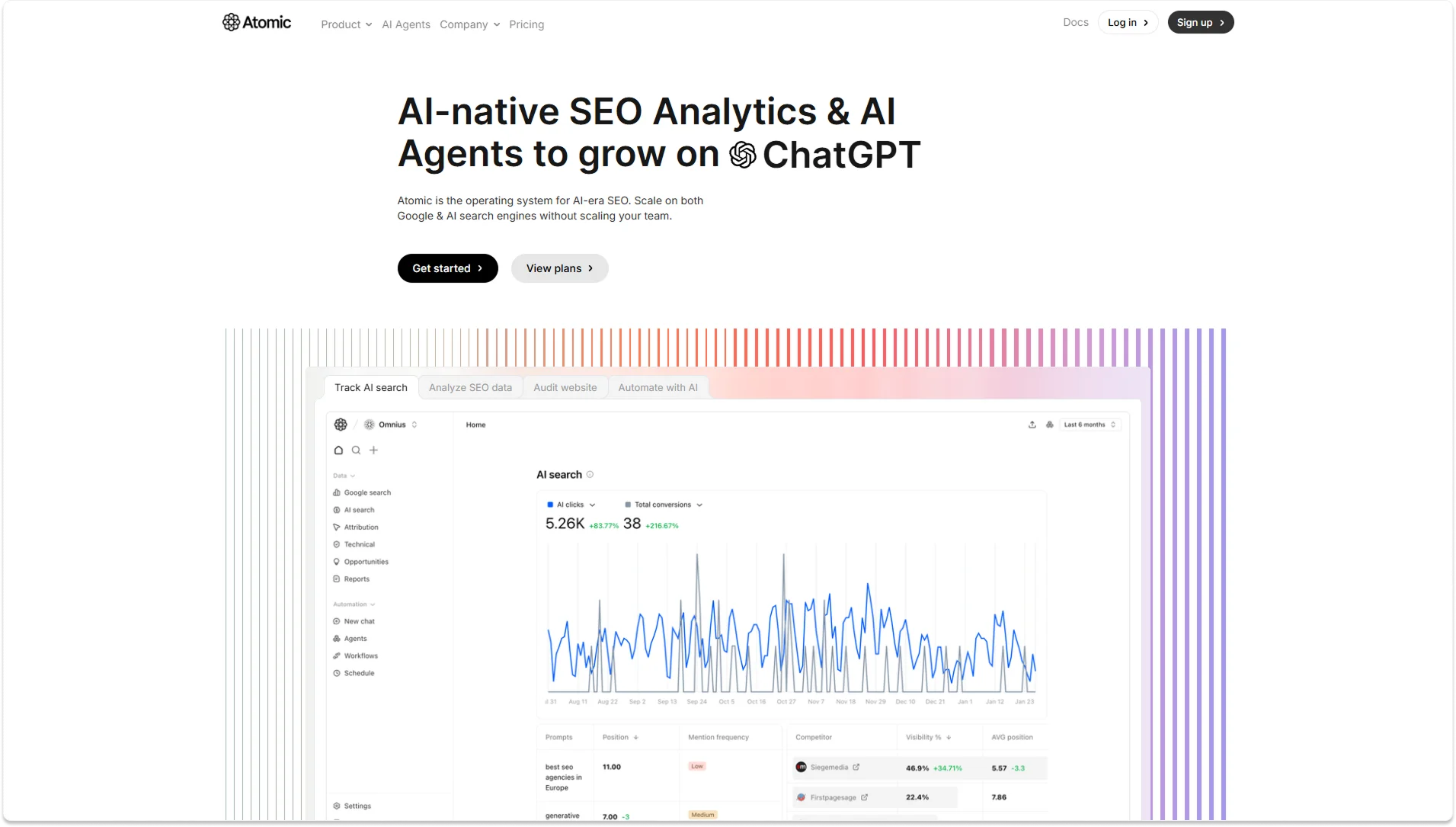
Atomic AGI is an "operating system for the AI search era", and it largely delivers on that promise. Where AirOps offers a diagnostic estimate of AI search readiness, Atomic actually tracks your brand's real-time visibility inside ChatGPT, Gemini, Perplexity, and Claude. It combines this with traditional SEO analytics (keywords, landing pages, traffic), technical auditing, and AI workflow automation in a single platform.
Atomic AGI is built by Omnius, a growth-focused SEO & GEO agency, which explains its strong emphasis on real-world search visibility tracking and practical optimization workflows.
For SEO teams who want a unified view of how their content performs across both Google and AI-generated answers, Atomic AGI is the most purpose-built option on this list.
Key Features
- AI Search Tracking: Monitors actual brand mentions and citations across ChatGPT, Gemini, Perplexity, and Claude, including prompt-level data, sentiment scoring, and share-of-voice against competitors.
- Unified SEO Analytics Dashboard: Integrates Google Search Console and GA4 into one view with keyword rankings, click trends, landing page performance, and attribution.
- LLM Audit & Indexation Acceleration: Audits how AI crawlers are reading your content and accelerates indexation, helping pages appear faster in both traditional and AI-generated results.
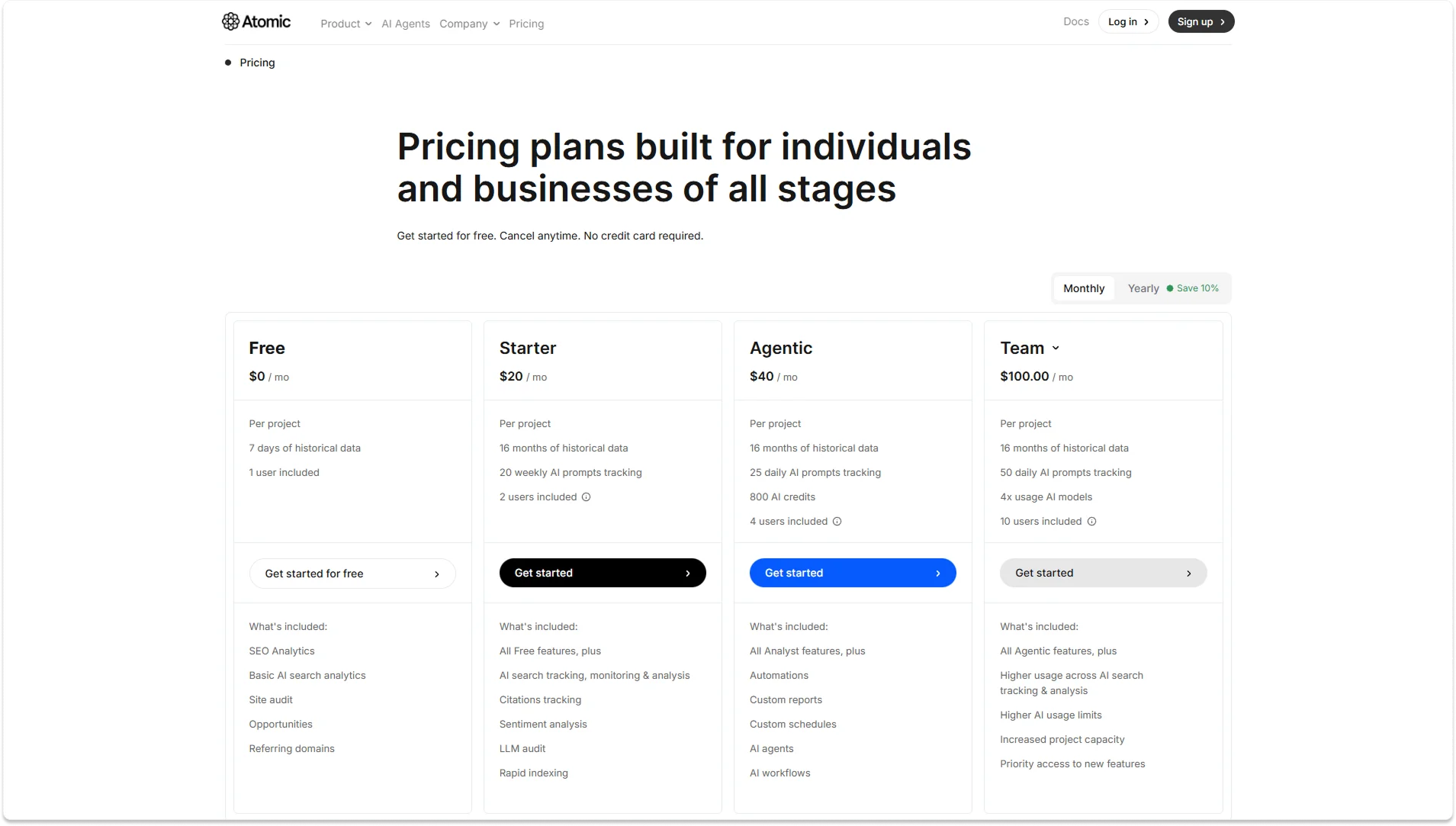
- AI Agents & Custom Workflows: The Agentic plan unlocks a workflow playground where you can build and deploy custom AI agents, content writers, data analysts, and SEO auditors, all trained on your organizational data.
- Custom Reports & Scheduling: Build rich reports beyond the standard clicks/impressions view, pulling from any Atomic data source. Enterprise teams can automate report delivery on custom schedules.
Pros
- One of the few tools that tracks actual AI citations, not just readiness scores
- Very affordable entry point at $20/month to unlock real AI search tracking
- EU-hosted infrastructure with GDPR compliance built in; strong for European teams
- No engineering required, setup takes under 5 minutes
Cons
- AI agent features are newer and less mature compared to dedicated agent platforms like Relevance AI
- Smaller integration ecosystem compared to legacy SEO tools like Semrush
Pricing
2. Jasper AI
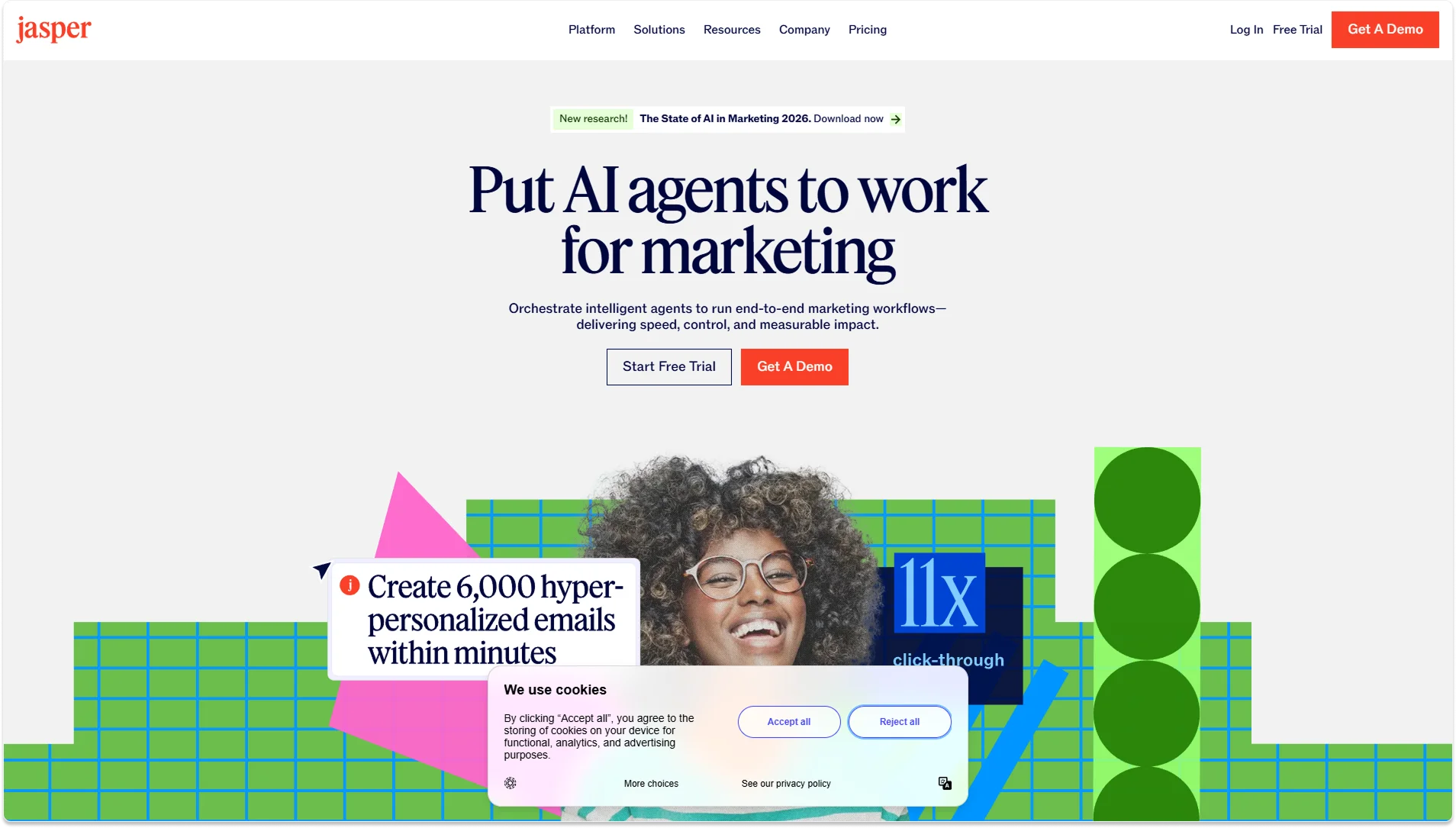
Jasper is the gold standard for teams that need high-volume, brand-consistent marketing content. Built "by marketers for marketers," it combines a no-code agent builder, content pipeline automation, SEO mode (via Surfer SEO), and an advanced brand intelligence layer called Jasper IQ, which trains the platform on your brand voice, style guides, and product knowledge so every piece of content sounds unmistakably like you.
Over 100,000 businesses use it, and its polished user interface means writers and marketers can get productive in hours, not days.
Key Features
- Jasper IQ (Brand Intelligence): A context hub where you store brand voice definitions, marketing playbooks, audience profiles, and product knowledge. Every generation step draws from this library automatically.
- Content Pipelines & AI Agents: Pre-built and customizable agents handle multi-step marketing workflows, blog series, ad campaigns, and email sequences from a single brief without manual handoffs.
- SEO Mode (Surfer SEO Integration): Native real-time SEO scoring inside the content editor, optimizing for keywords, structure, and E-E-A-T signals as you write.
- Canvas Workspace: A collaborative content planning workspace where teams can draft, review, and iterate on content in one view, with version history and team permissions built in.
- AI Image Suite: Built-in image generation and editing (resizing, background replacement, format optimization) so you don't need a separate design tool for standard marketing visuals.
Pros
- Unmatched brand consistency through Jasper IQ and brand voice training
- Large template library (100+ use cases) means fast onboarding for most marketing tasks
- SOC 2 compliant with LLM-agnostic architecture, strong enterprise security posture
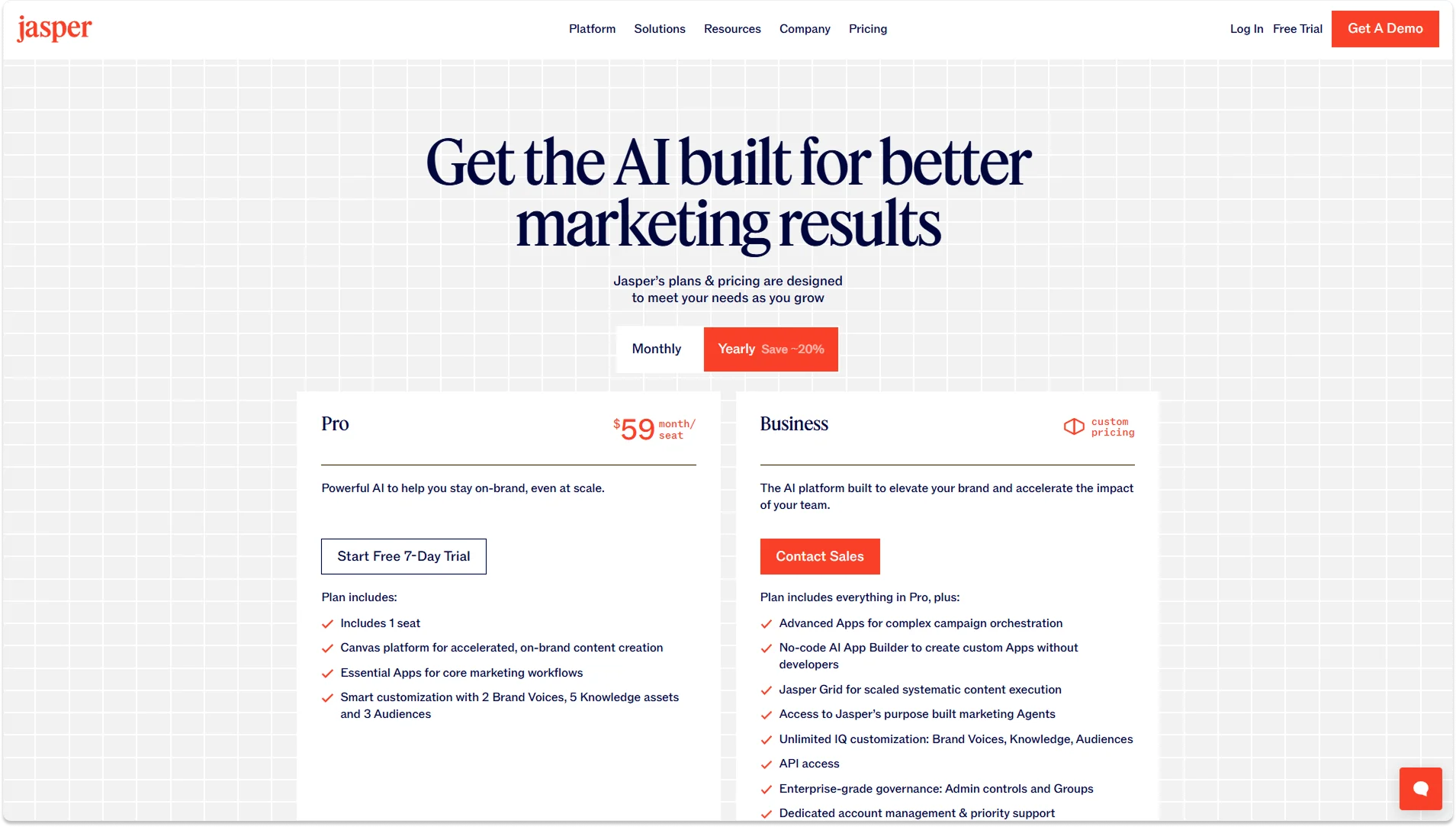
- 7-day free trial with full feature access
Cons
- No native AI search visibility tracking, purely a content creation and optimization tool
- Pro plan caps at 1 seat, which forces a significant jump to custom Business pricing for larger teams
- Can feel template-constrained for teams with highly specialized or non-standard content workflows
Pricing
3. Copy.ai
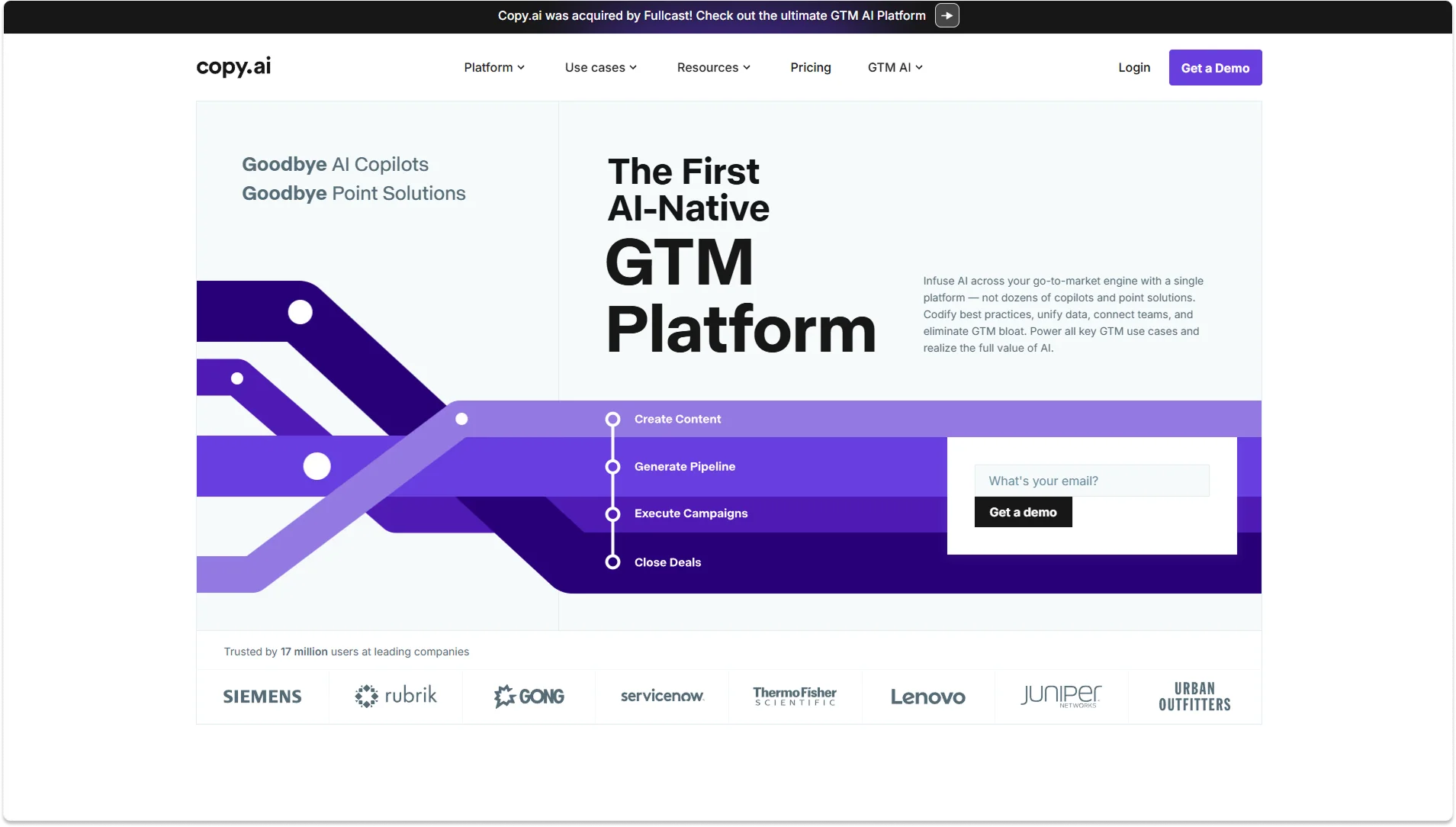
Copy.ai has evolved far beyond its origins as an AI writing tool. Today it positions itself as a full GTM (Go-to-Market) AI platform, enabling sales, marketing, and RevOps teams to codify and automate complex go-to-market processes through drag-and-drop workflows.
Where AirOps focuses narrowly on content production, Copy.ai is designed to automate the entire revenue engine: from prospecting and lead enrichment to content creation, campaign deployment, and deal coaching.
Key Features
- Workflow Builder: A visual, drag-and-drop canvas for building multi-step automated processes that chain AI generation, data lookups, conditional logic, and app actions together into repeatable playbooks.
- Content Agent Studio: Upload 3+ examples of your existing content, and the system builds agents that generate endless on-brand variations, no prompt engineering required.
- Multi-LLM Flexibility: Access GPT-4o, Claude 3.7 Sonnet, Gemini, o1-mini/o3-mini, and others within the same workflow, selecting the best model for each task.
- Prospecting & Sales Agents: Dedicated agents for account research, inbound lead enrichment, ABM asset creation, and deal coaching from sales call transcripts, purpose-built for revenue teams.
- Tables (Data Store): A spreadsheet-style data layer that feeds structured context into AI workflows, CRM data, company info, and past campaigns, making outputs far more accurate and personalized.
Pros
- Goes well beyond content generation
- LLM-agnostic design allows you to pick the best model for each workflow step
- Strong enterprise security with SOC 2 compliance and role-based governance
Cons
- The jump from the Chat plan ($29/mo) to Growth is enormous; there's no middle ground for growing teams
- Workflow credits add a layer of billing complexity that can make costs unpredictable
- Customer support responsiveness has been flagged in multiple user reviews as a weak point
Pricing

4. Writer.com
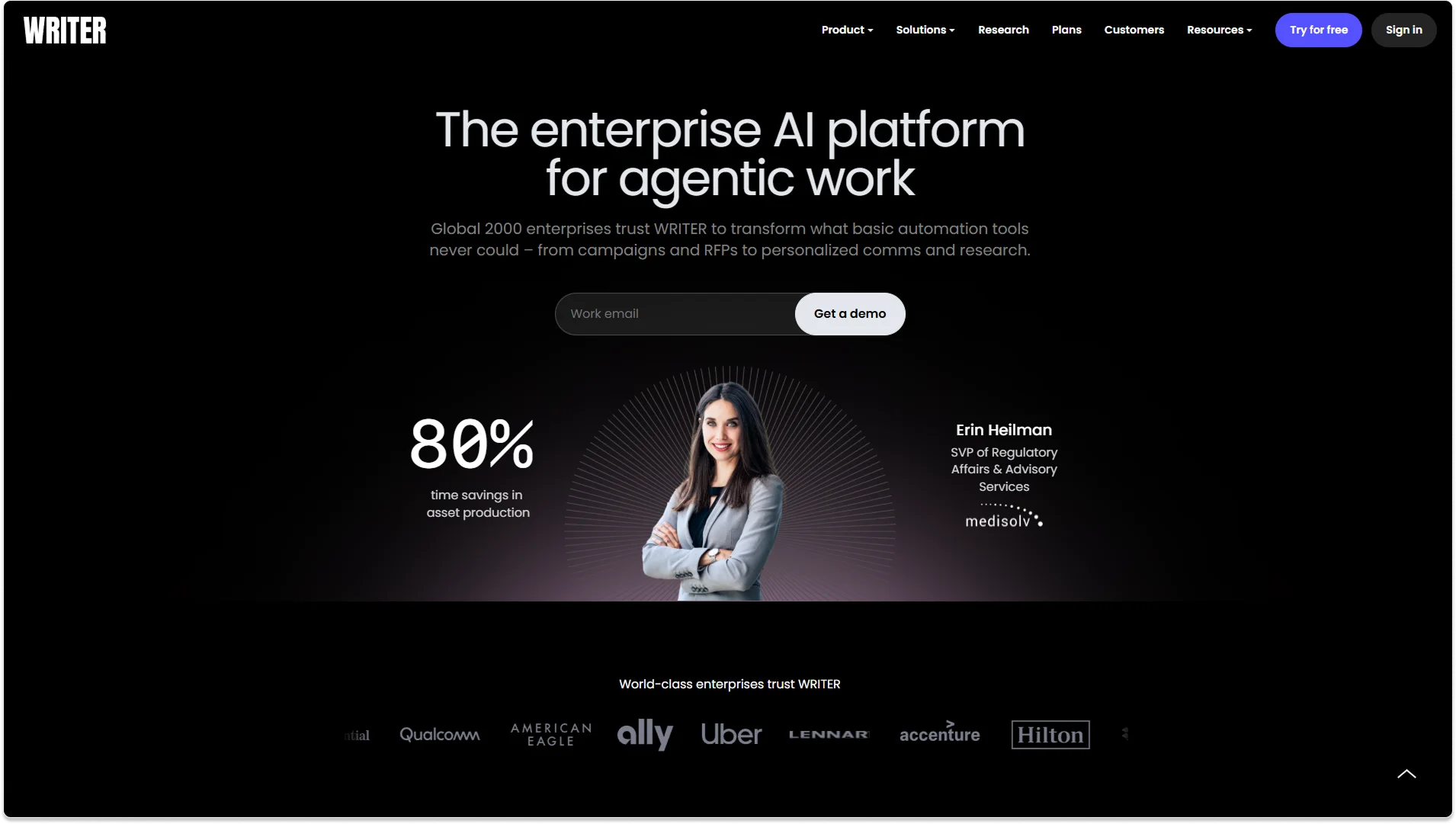
Writer is the most enterprise-serious platform on this list. It's not for solo marketers or small agencies; it's for large organizations that need to deploy AI agents at scale across multiple departments (HR, legal, finance, marketing) with full governance, audit trails, and compliance controls.
Writer's Knowledge Graph is a standout feature: it links your internal documents, databases, and APIs so every agent has accurate, up-to-date context rather than hallucinating answers.
Key Features
- Agent Builder & Playbooks: Drag-and-drop interface to create custom AI agents for any department, with pre-built templates for 100+ use cases (expense reporting, policy Q&A, contract review, and more).
- Knowledge Graph: A centralized, continuously updated AI memory that connects documents, databases, and internal APIs; agents query this graph to stay factually grounded.
- Palmyra LLMs (On-Prem Option): Writer's proprietary LLMs can be deployed inside your own VPC or on-premise environment, keeping sensitive data entirely off public cloud infrastructure.
- Multi-Agent Orchestration: Chain multiple specialized agents together into complex, cross-departmental workflows with scheduling, approval gates, and version control at every step.
- Enterprise Governance: Full HIPAA and SOC 2 Type II compliance, SAML SSO, role-based access, audit logs, and policy enforcement, the most robust compliance posture of any tool on this list.
Pros
- The only tool here with HIPAA compliance and on-premise LLM deployment options
- Unlimited enterprise integrations covering SAP, Oracle, Salesforce, and custom databases
- Purpose-built for cross-departmental AI at scale, not just marketing or SEO
Cons
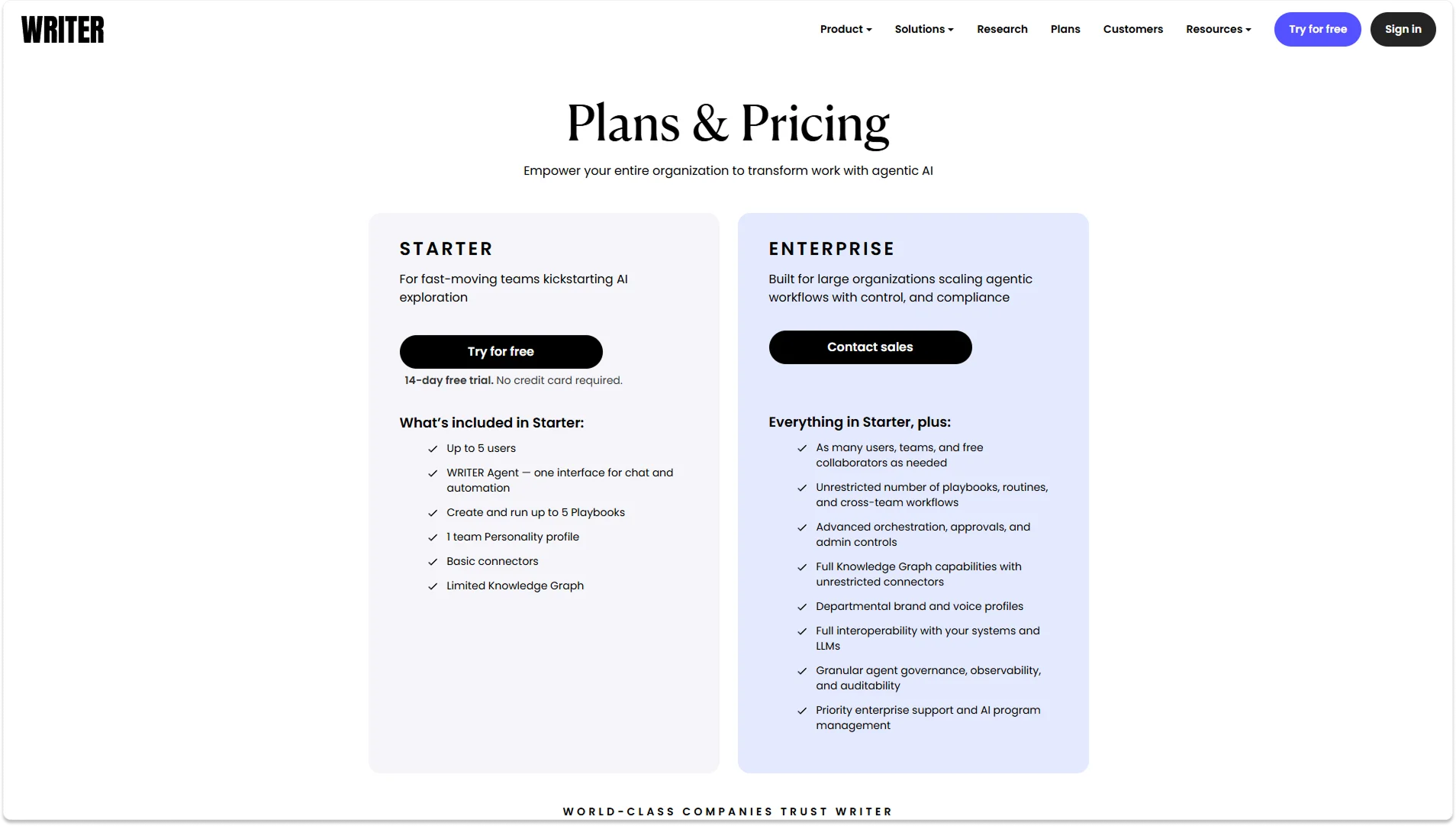
- No transparent public pricing, requires a sales conversation for any paid tier
- Significant overkill for small to medium businesses; complexity requires dedicated IT resources
- Not designed for content creation or SEO workflows, entirely agent and process-oriented
Pricing
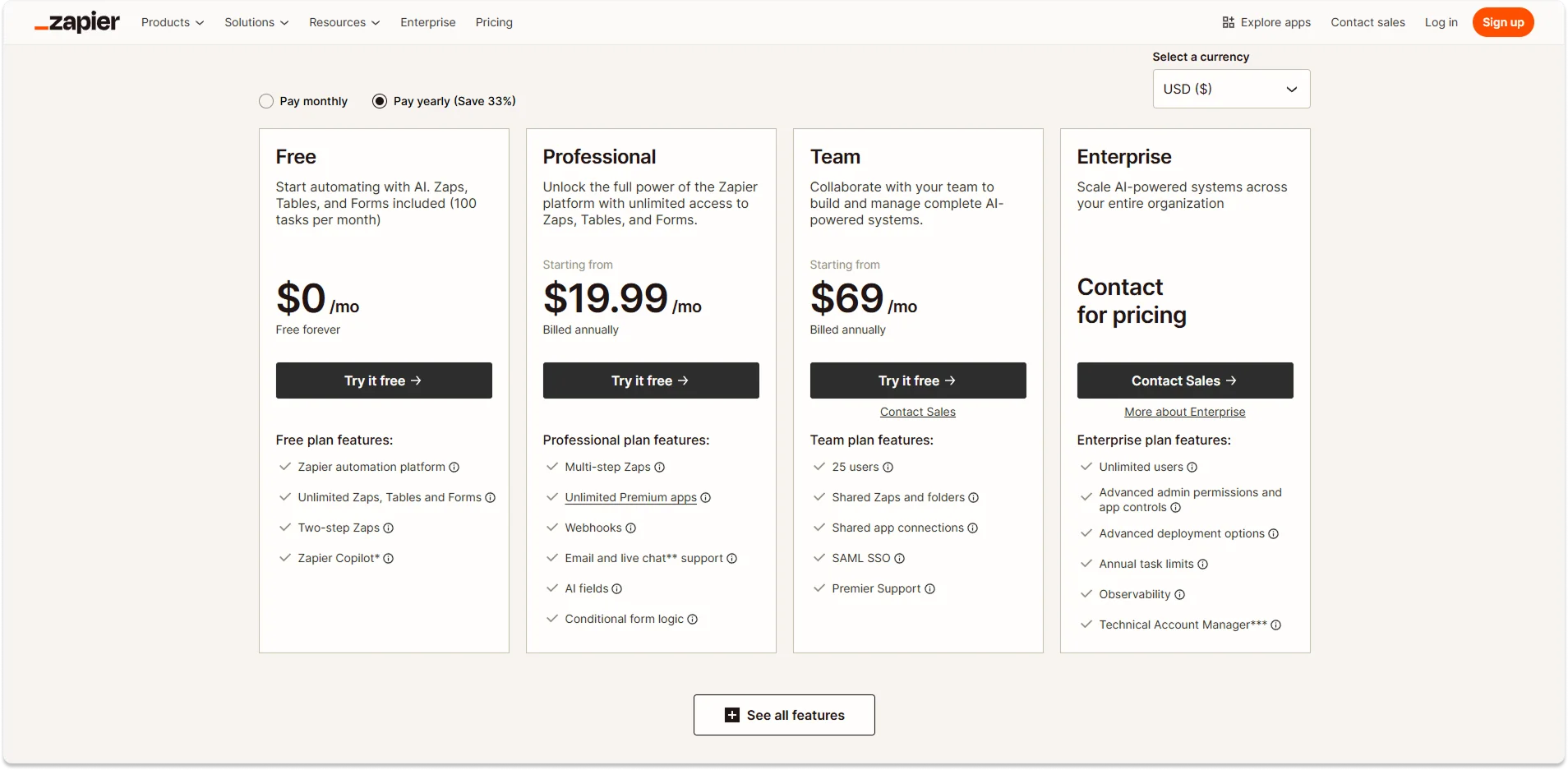
5. Zapier
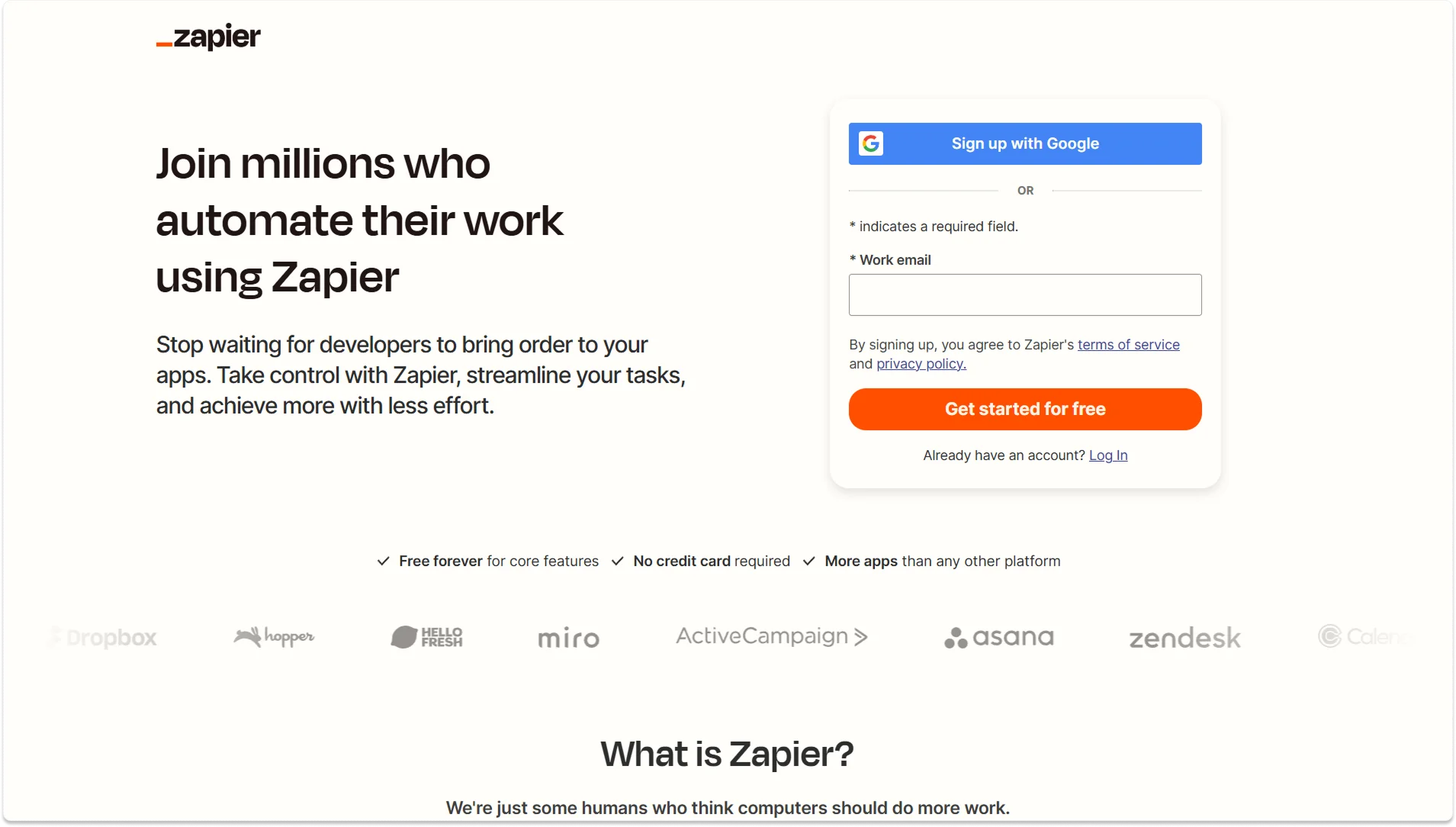
Zapier is the world's most widely used no-code automation platform, connecting over 8,000 apps. While it's not an AI platform in the traditional sense, its recent additions, AI-powered Zap steps (calling GPT-4o or Claude), Zapier Copilot, and beta AI Agents, make it the easiest way to inject AI capabilities into the tools your team already uses, without rebuilding your stack.
If your core challenge is moving data and triggering actions between apps (with some AI sprinkled in), no platform matches Zapier's integration depth.
Key Features
- 8,000+ App Connectors: The broadest integration ecosystem of any tool on this list, connects virtually every SaaS platform, CRM, CMS, database, and analytics tool without custom code.
- AI Actions in Zaps: Native steps that call GPT-4o, Claude, or other AI models inline within a workflow, summarize, classify, generate, or transform data as it flows between apps.
- Zapier Copilot: Describe a workflow in plain language and Copilot builds the Zap for you, dramatically reducing setup time for non-technical users.
- Tables & Forms: A lightweight built-in database and form builder with AI analysis capabilities, useful for capturing data, triggering workflows, and analyzing responses with AI.
- AI Agents (Beta): Multi-step autonomous assistants that can run complex Zap sequences on your behalf, bridging the gap toward true agent-style automation.
Pros
- Unmatched breadth of integrations, if your tools exist, Zapier connects them
- Extremely low barrier to entry; non-technical users can build automations in minutes
- Reliable, battle-tested infrastructure with enterprise-grade uptime and SOC 2 compliance
Cons
- Per-task pricing means heavy automation usage can get expensive quickly
- AI features (agents, chatbots) are still in beta and less mature than purpose-built AI platforms
- Workflows are tied to Zapier's cloud; there is no self-hosting option, which creates vendor lock-in
Pricing
6. n8n
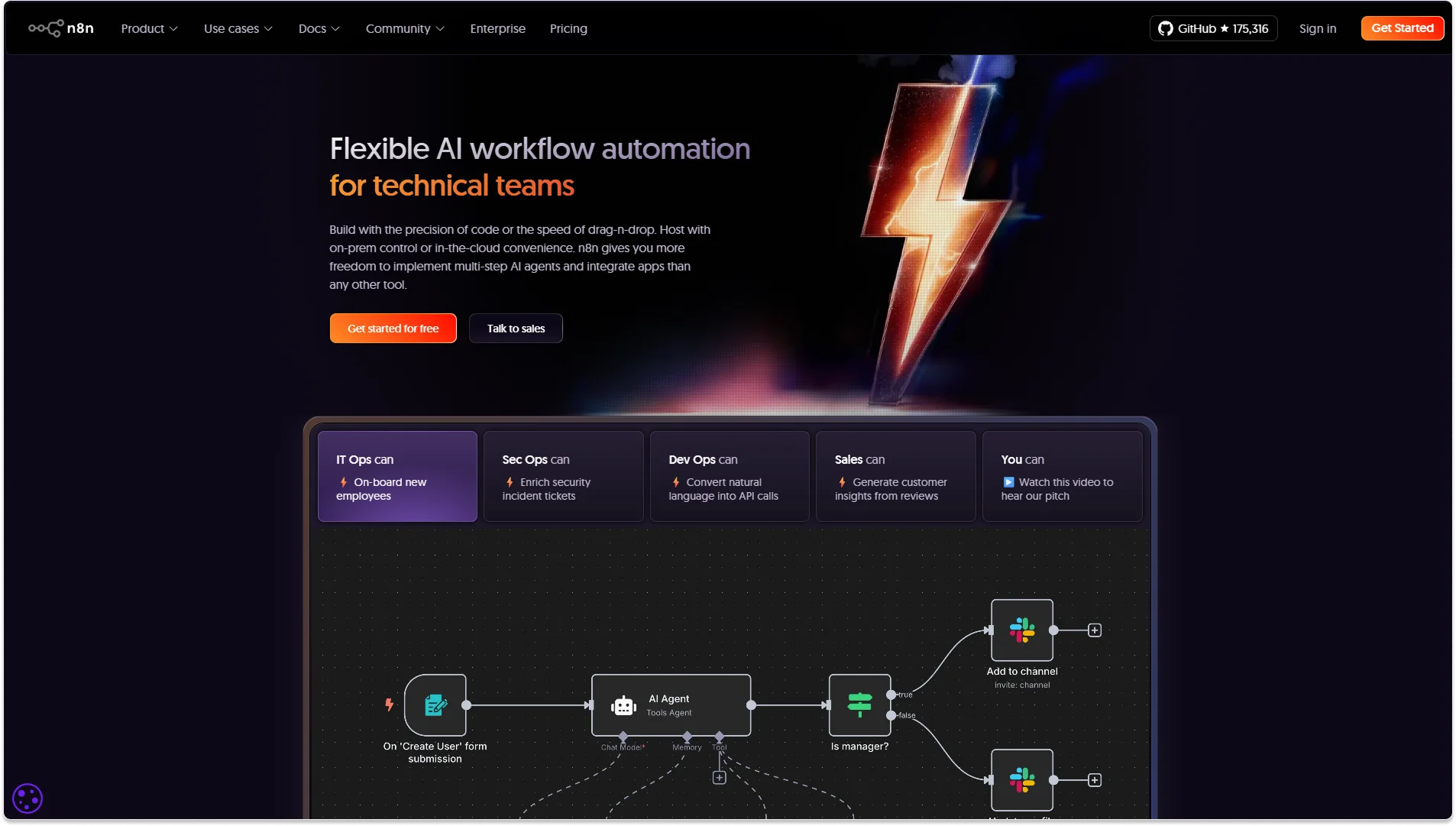
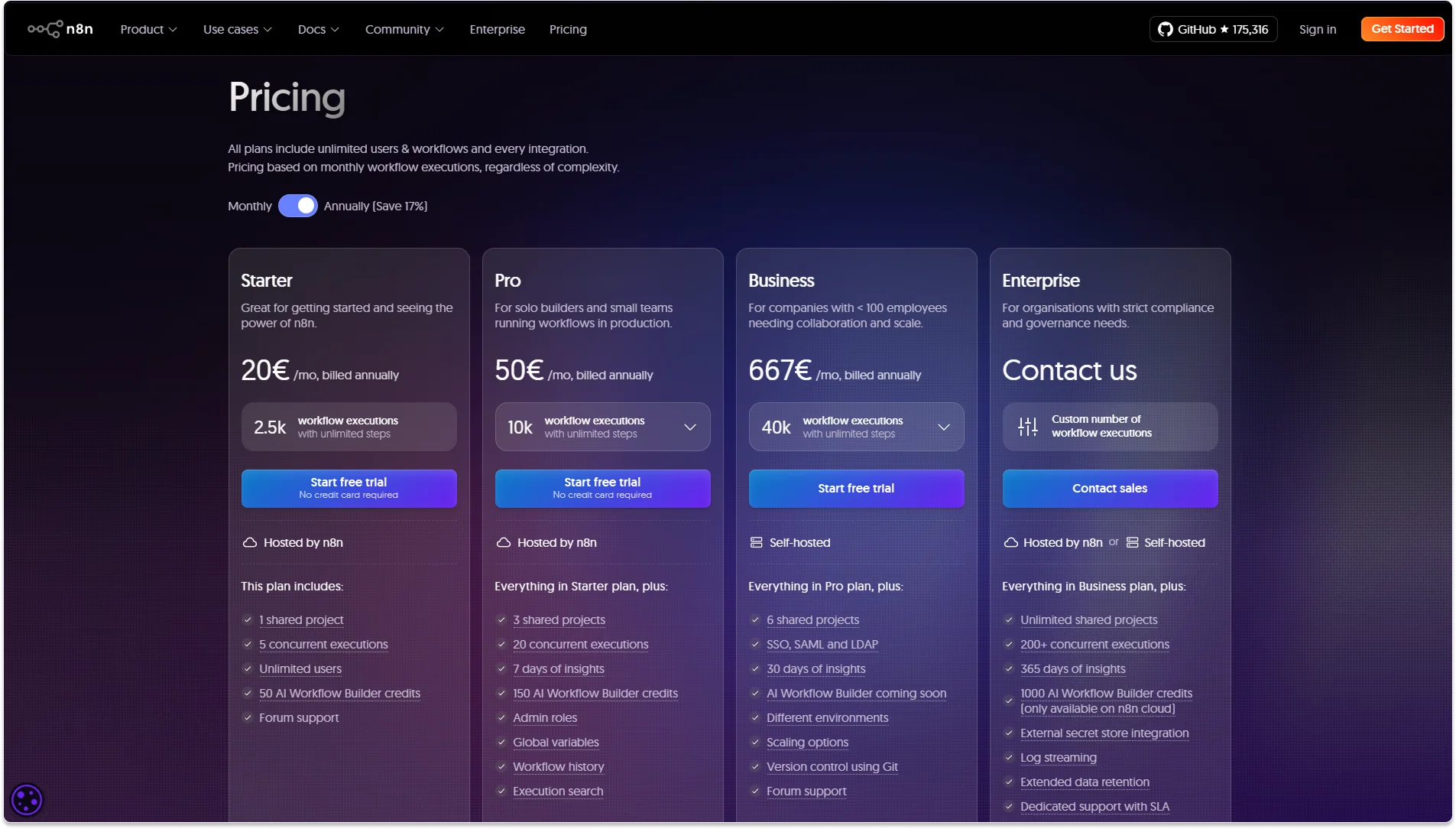
n8n is the open-source answer to Zapier. With over 1,000 native integrations and the ability to self-host on your own infrastructure (Docker or Kubernetes), it gives technical teams complete control over their data, workflows, and costs. The "fair code" licensing model means the community edition is free forever, and cloud plans are priced by workflow executions rather than per-seat or per-task, dramatically reducing costs for high-volume automation.
For DevOps teams, data engineers, and companies with strict data residency requirements, n8n is hard to beat.
Key Features
- Self-Hosted Option: Full on-premise or private cloud deployment with no limits on workflows, users, or executions, ideal for sensitive data and regulatory compliance requirements.
- 1,000+ Native Integrations: Covers databases, cloud platforms, CRMs, developer tools, and custom APIs via HTTP nodes, with Git versioning for workflow management.
- AI Workflow Support: Native nodes for calling OpenAI, Anthropic Claude, Google Vertex AI, Hugging Face, and other AI services within automation workflows.
- Execution-Based Pricing: You pay per workflow execution, not per seat or per task step, making it highly cost-effective at scale compared to per-step platforms like Zapier.
- Multi-Environment Support: Dev/production environment separation with Git-based version control, crucial for engineering teams maintaining complex workflow pipelines.
Pros
- Open-source with self-hosting means zero vendor lock-in and maximum data control
- All integrations available on every plan; no tier-gating of connectors
- Extremely cost-effective for high-volume use cases when self-hosted
Cons
- Requires DevOps expertise to self-host, configure, and maintain, not plug-and-play for non-technical teams
- UI is more functional than polished, with a steeper learning curve than Zapier for beginners
- Community support is strong, but enterprise support is paid; bugs may require community workarounds
Pricing
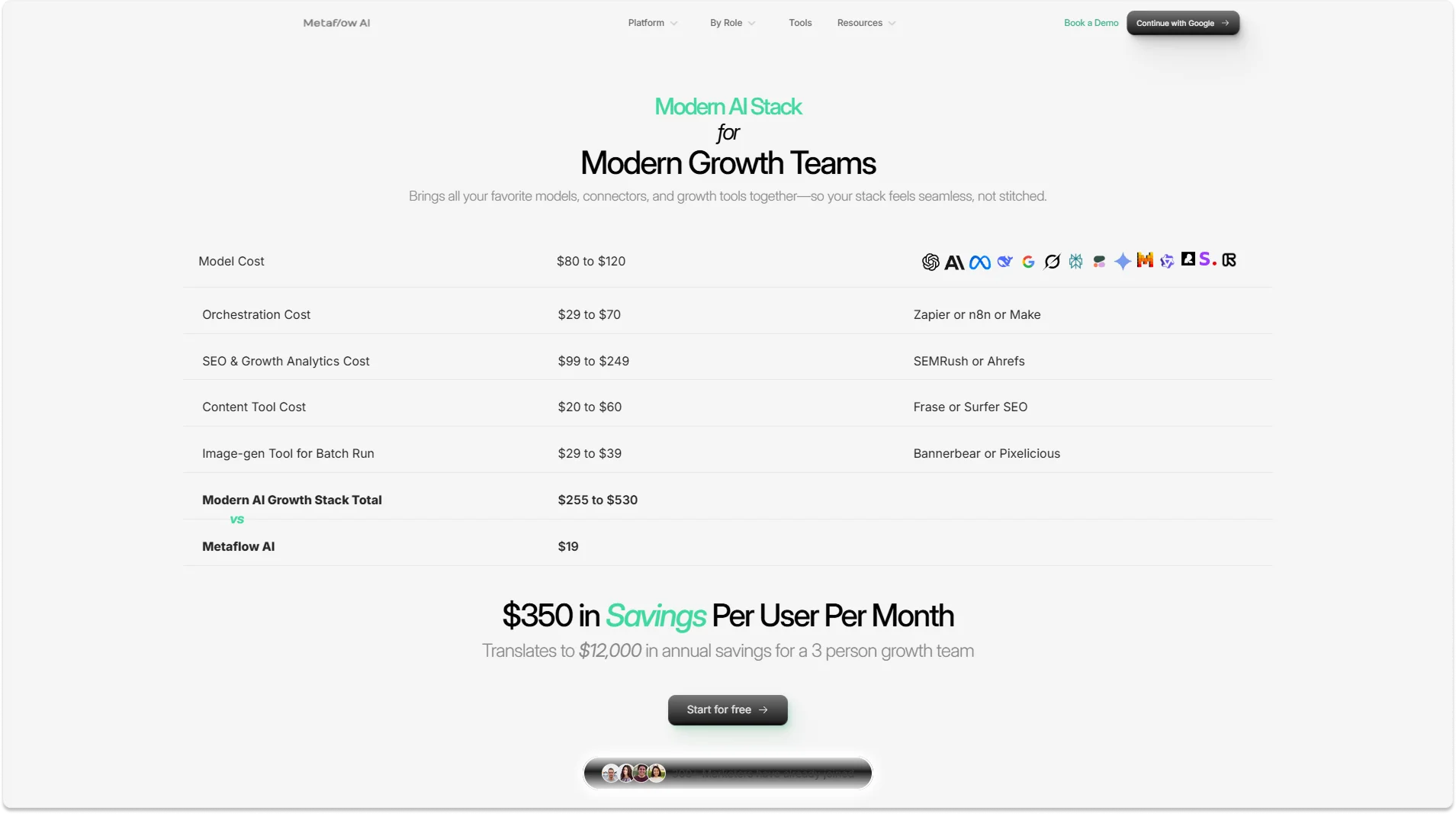
7. Metaflow AI
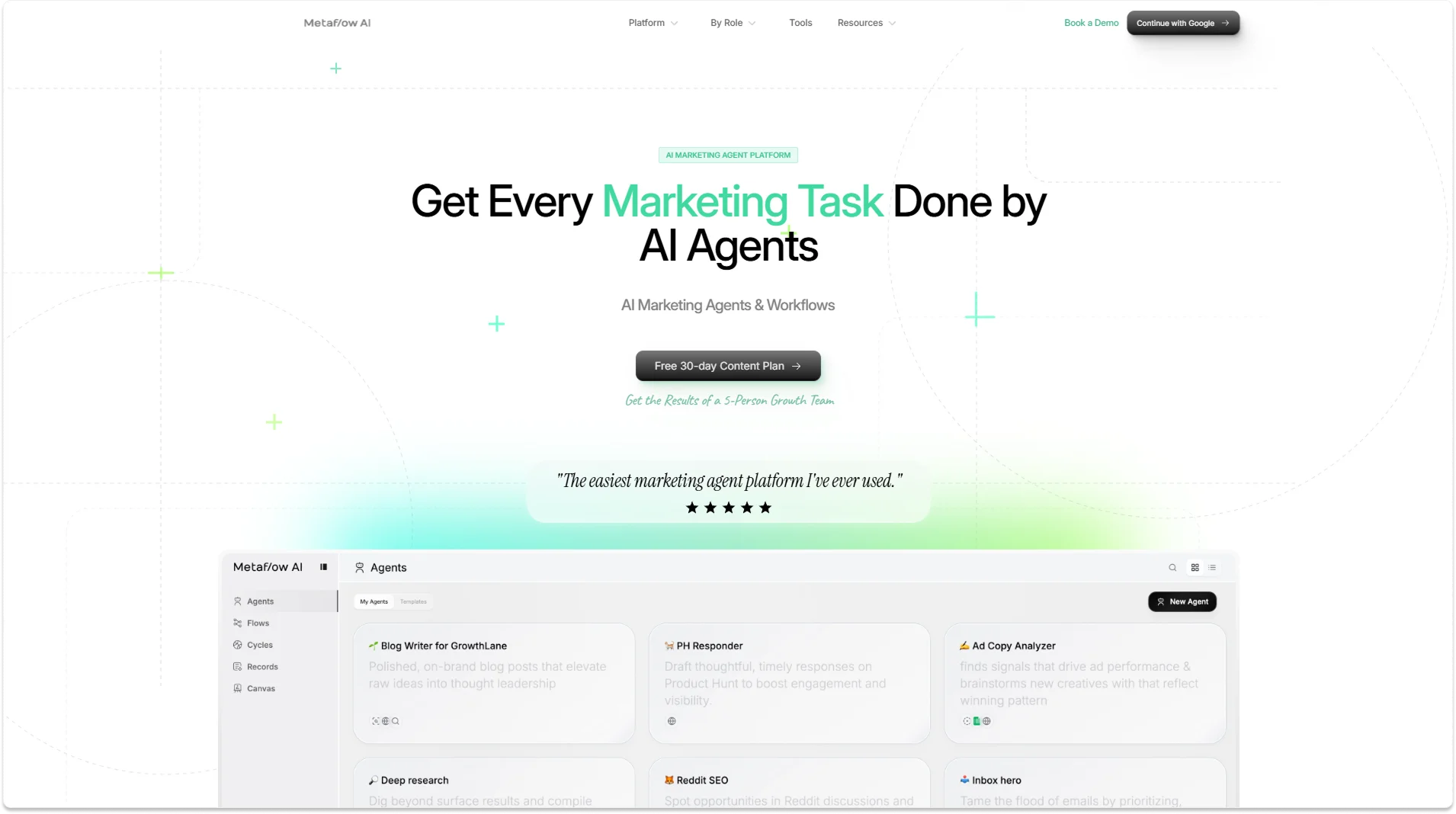
Metaflow AI describes itself as an "Agentic OS", a visual canvas where product builders, agencies, and consultants can create, deploy, and even sell AI-powered workflows. It supports 20+ frontier models (GPT-4o, Claude 3, Gemini 1.5, Llama 3, Mistral, and more) through a universal Model Connection Protocol (MCP), and connects to 2,500+ apps out of the box. Its unique positioning is as a platform for building AI services that generate revenue; it includes built-in billing to charge your own clients for agent usage.
Key Features
- Multi-LLM Visual Builder: A drag-and-drop canvas for sequencing 20+ frontier models, database lookups, API calls, and conditional logic into end-to-end agent workflows without code.
- Universal MCP Integrations: 2,500+ apps connected via Metaflow's Model Connection Protocol, plus the ability to bring your own API keys for any LLM or external service.
- Prebuilt Agent Templates: Ready-made workflows for SEO content pipelines, multilingual content generation, competitive research, and more, dramatically reducing time to first deployment.
- Built-In Agent Monetization: Metaflow includes billing infrastructure so agencies can charge clients directly for agent usage, unique in this category.
- Scheduled & Event-Triggered Execution: Agents can run on fixed schedules or trigger from webhooks, Slack events, or external API calls, enabling fully automated, round-the-clock workflows.
Pros
- Best price-to-feature ratio on this list for individual builders and small agencies
- Supports nearly every major LLM in one place; maximum model flexibility
- The monetization layer makes it uniquely suited for agencies building client-facing AI services
Cons
- Newer platform with a smaller community and documentation base than established players
- Execution credit limits on lower tiers may run out quickly for high-volume workflows
- No explicit SOC 2 or GDPR compliance documentation; enterprise vetting required
Pricing
8. Relevance AI
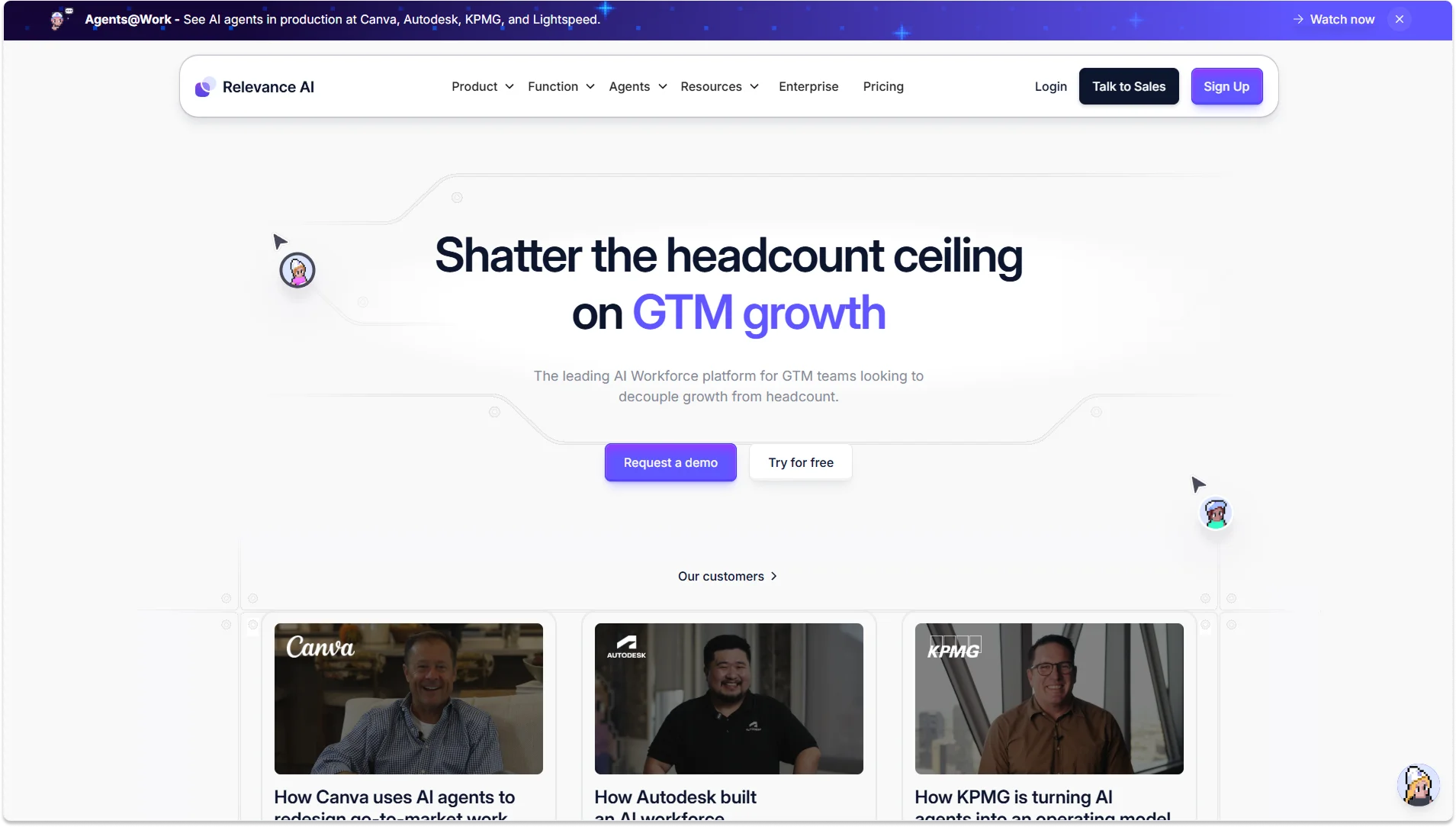
Relevance AI sits at the intersection of AI agent management and business workflow automation. Its "AI Workforce" concept lets you define agents in plain language, organize them into teams, and deploy them across Slack, email, phone, and web, all with built-in analytics, A/B testing, and approval gates. Uniquely, all plans (including the free tier) include SOC 2 and GDPR compliance, which is rare at this price point.
For sales and customer experience teams that want AI-driven outreach, qualification, and support, without building from scratch, Relevance AI offers the fastest path to production.
Key Features
- Natural Language Agent Creation: Define a new AI agent by describing what it should do; no visual programming required. Agents are versioned, monitored, and A/B testable out of the box.
- Workforce & Role Management: Organize agents into teams with builder vs. end-user role separation, activity logs, and cross-agent workflow chaining for complex multi-step processes.
- Voice & Chat Agents: Native support for phone calling agents and Slack-based conversational agents, deploy AI that operates across text and voice channels simultaneously.
- A/B Testing & Analytics: Run controlled experiments on agent workflows (e.g., two different email variants) with performance tracking and statistical outcome measurement.
- Bring Your Own LLM: Connect any LLM provider, OpenAI, Anthropic, Google, or custom models, with wholesale vendor pricing passed directly to users (unused credits roll over indefinitely).
Pros
- SOC 2 and GDPR compliance on every plan, including the free tier
- Unused credits roll over indefinitely; no monthly credit wastage
- Voice calling and Slack-native agents expand beyond text-only workflows
Cons
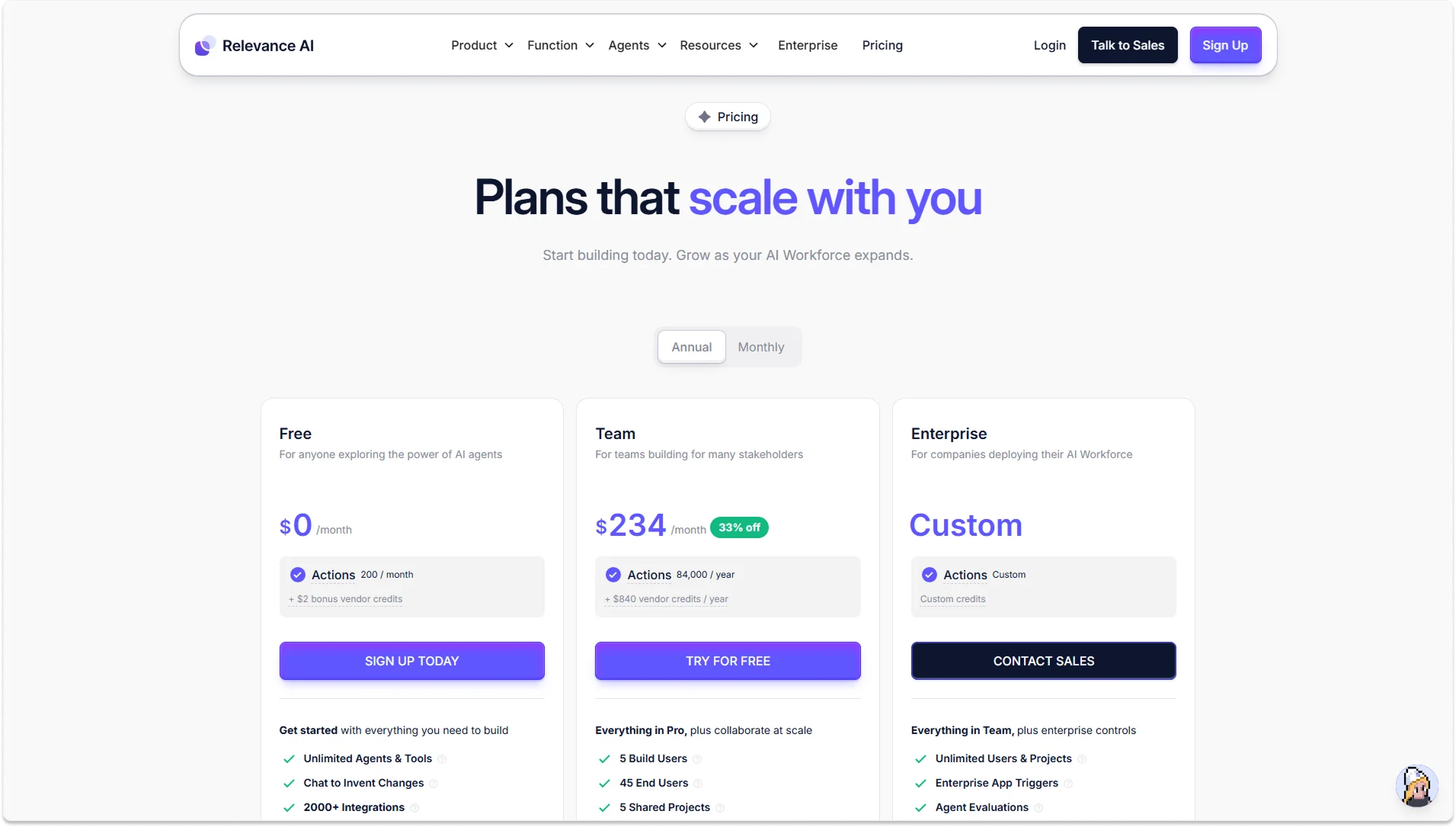
- Pricing splits between actions and vendor credits can be confusing when forecasting the total monthly cost
- Focused exclusively on AI agents, not a general-purpose automation platform like Zapier or n8n
- Smaller community and fewer prebuilt templates compared to more established players
Pricing
9. Writesonic
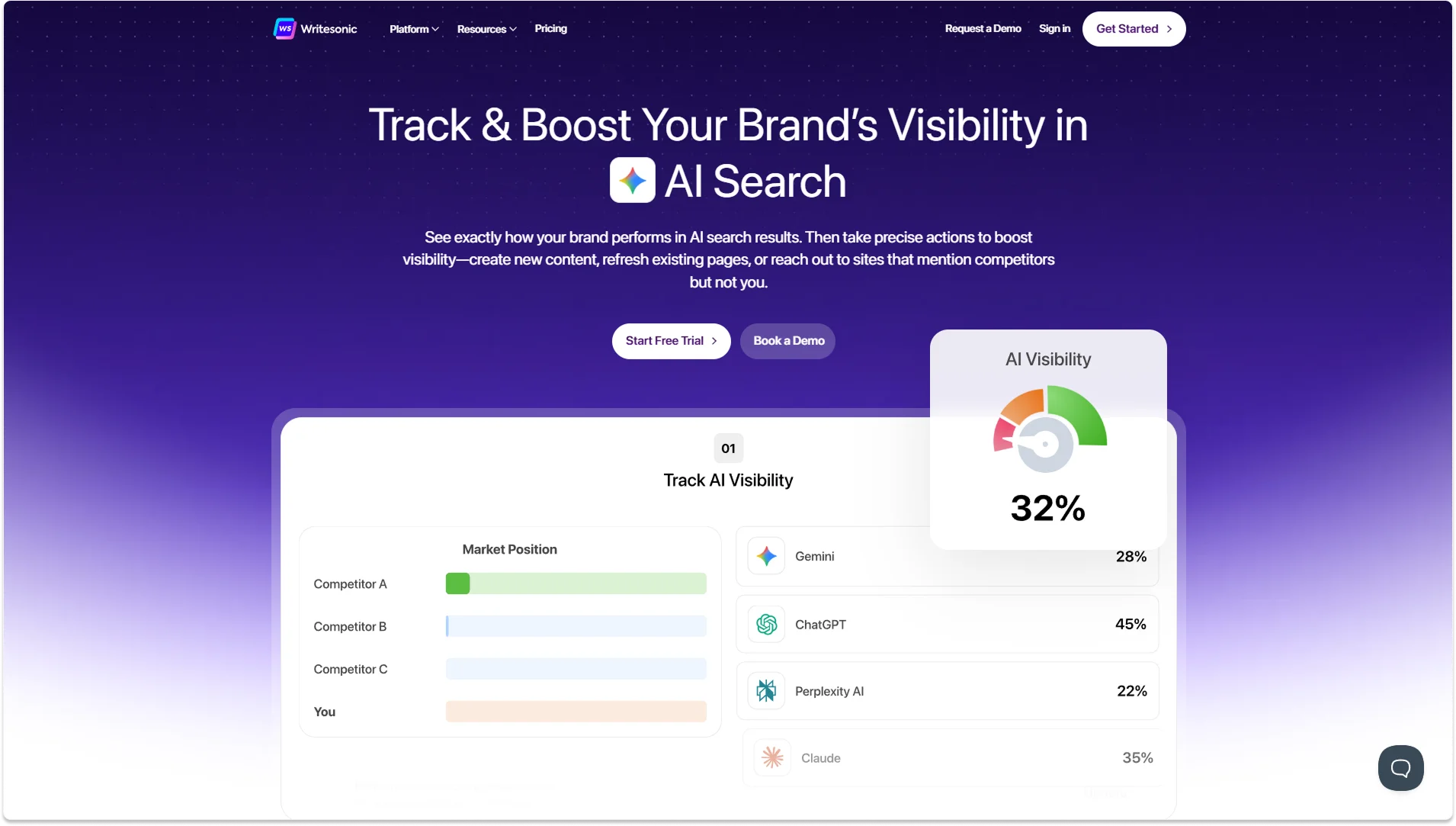
Writesonic has evolved from an AI writing tool into a full AI visibility platform, combining content generation with one of the most capable Generative Engine Optimization (GEO) modules available. Its AI article writer supports GPT-4o and Claude 3.7 Sonnet, while the GEO dashboard tracks your brand's presence and sentiment across ChatGPT, Perplexity, and Google AI Overviews. The site audit engine (capable of scanning 200+ pages per minute) and bulk article generation make it particularly strong for high-volume content teams.
Key Features
- GEO Tracking Dashboard: Monitors actual brand visibility, ranking position, and sentiment across ChatGPT, Perplexity, Google AI Overviews, and more, tracking specific prompts you define with volume and trend data.
- AI Article Writer (GPT-4o + Claude 3.7): Generates long-form SEO content with keyword optimization, competitor analysis, topical authority mapping, and auto-publishing to WordPress.
- Site Audit & Content Refresh: Scans sites at 200+ pages per minute to surface underperforming content, flag keyword gaps, and generate actionable refresh briefs automatically.
- Competitor & Content Gap Analysis: Compare your domain against up to 3 competitors for keyword gaps, share-of-voice in AI answers, and content opportunities, all in one dashboard.
- Bulk Article Generation: Queue and generate dozens of articles simultaneously against a content calendar, with brand voice consistency enforced across the batch.
Pros
- One of the most complete AI search + traditional SEO platforms in a single tool
- Genuinely tracks AI citations in real time, not just a diagnostic estimator
- Bulk generation and site auditing at scale make it practical for large content teams
Cons
- GEO tracking features only unlock at the $249/mo Professional tier; the Lite and Standard plans lack the core AI visibility tools
- Customer support is email-only, with no live chat, which slows resolution for urgent issues
- Long-form output still requires human editing to reach publication quality
Pricing
.webp)
10. Rankability
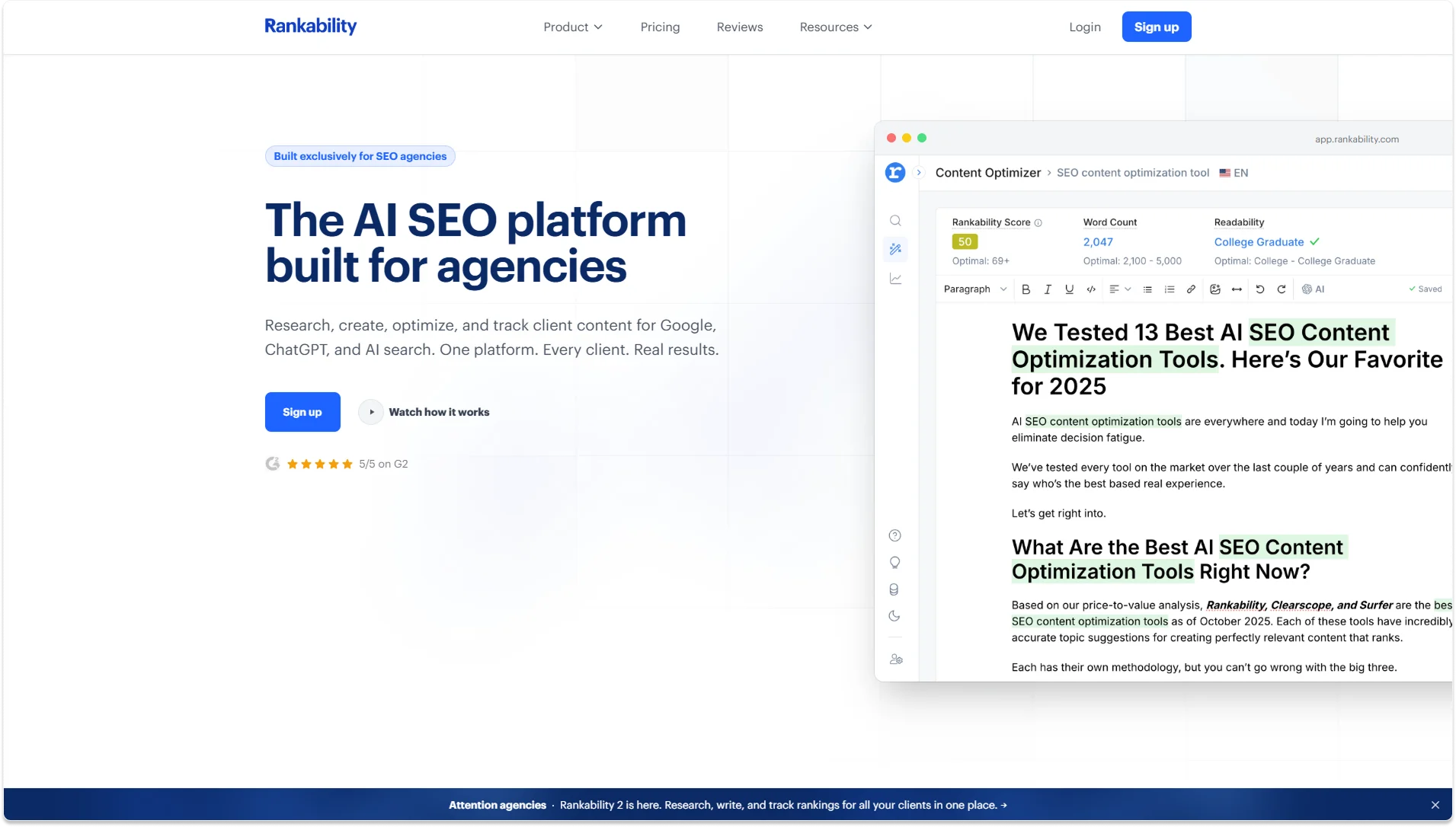
Rankability is an AI-powered SEO suite built specifically for agencies that manage multiple client accounts simultaneously. Every plan includes direct access to founder-led SEO coaching calls, making it as much an education platform as a software tool.
The AI Search Analyzer is Rankability's answer to the GEO trend: it scans generative AI results to surface where your (or your client's) content is being cited and where gaps exist.
Key Features
- Dual NLP Content Optimization: Combines IBM Watson and Google NLP to score and guide content optimization, delivering more semantically accurate keyword suggestions than tools relying on a single NLP engine.
- AI Search Analyzer: Tracks brand presence in GPT-powered search, Bing AI, and other generative engines, surfaces citation gaps, and recommends content to close them.
- Keyword Clustering & Golden Keywords Filter: Automatically groups keywords into topical clusters and surfaces high-volume, low-competition "Golden Keywords", eliminating hours of manual keyword research.
- Content Gap Analysis: Compares your domain against up to 3 competitors to identify valuable keywords they rank for that you don't, generating a ready-made priority content plan.
- Multi-Client Management: Organize separate projects per client with dedicated dashboards, white-label reporting, and bulk processing capabilities designed for agency workflows.
Pros
- Dual NLP engine (IBM Watson + Google NLP) delivers noticeably more accurate content suggestions
- Nathan Gotch-led SEO coaching calls are included in every plan, rare real-world educational value
- Strong rank tracking (daily, local, mobile) is built in at no additional cost
Cons
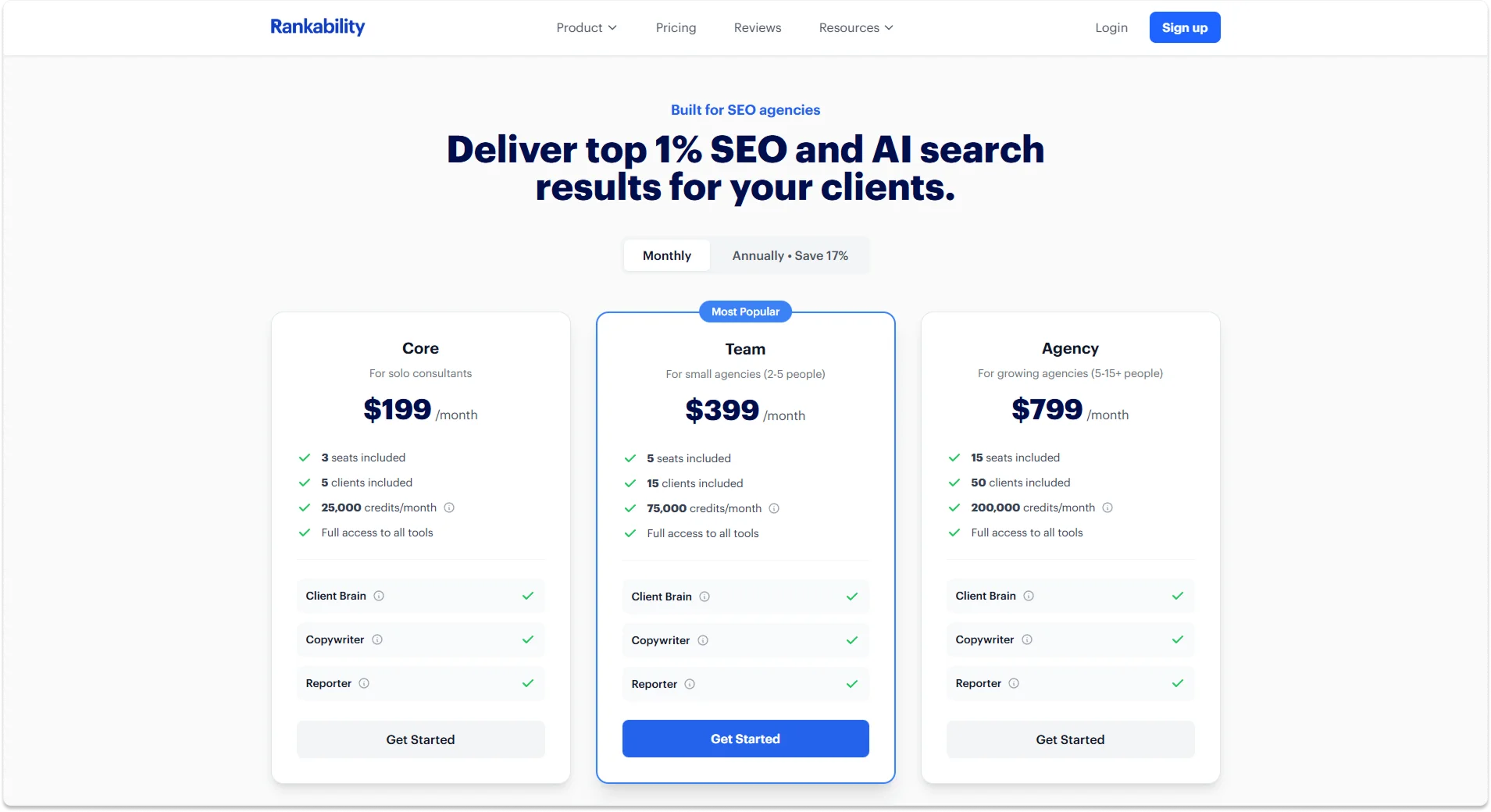
- Premium pricing makes it impractical for freelancers and solo creators
- Focused on on-page SEO content, limited utility for technical SEO, link building, or broader digital marketing
- The credit system means heavy users need to monitor usage or pay for add-on credit packs
Pricing
How to Choose the Right AirOps Alternative
If your core pain point is not knowing whether your content is being cited in AI-generated answers, prioritize platforms with genuine, real-time AI search visibility tracking like Atomic AGI. Diagnostic readiness scores are not enough; you need prompt-level citation data, sentiment, and share-of-voice metrics against competitors.
If the main issue is content that doesn't sound like your brand, look for a platform with robust brand intelligence capabilities: the ability to ingest your style guides, tone of voice, and product knowledge, and apply them consistently across every piece of output without manual re-editing.
If you're frustrated by AirOps's narrow focus on content production alone, and your team also handles sales outreach, lead enrichment, or RevOps processes, move toward a platform built around full workflow automation, one that can chain AI steps together with CRM data, conditional logic, and multi-LLM flexibility.
If data security and compliance are blocking adoption, especially in healthcare, finance, or government, prioritize platforms that offer on-premise LLM deployment, HIPAA compliance, and full audit trails rather than standard SOC 2 cloud offerings.
If the real blocker is integration complexity and your team spends more time routing data between tools than actually using AI, the platform you need is one built around app connectivity first, with AI layered on top, not the other way around.
If you're an agency or consultancy whose revenue depends on delivering AI-powered results to clients, look for platforms that support multi-client project management, white-label reporting, and ideally built-in billing infrastructure, so the platform itself becomes part of your service delivery.
Conclusion
AirOps is a solid content operations platform, and it will continue to improve. But "improving" doesn't solve the problems teams are experiencing today: a lack of true AI search tracking, no native agent capabilities, and hard learning that costs real time and money.
The alternatives on this list are not just substitutes; most of them are purpose-built for specific use cases that AirOps only partially addresses.
The AI search in 2026 moves fast. Pick the tool that's built for the exact problem you're trying to solve today, and that can credibly keep up with where AI search is headed tomorrow.
If AI search visibility is your priority with specialized AI agents that analyze data and execute optimization tasks continuously, start with AtomicAGI.
Frequently Asked Questions (FAQs)
What is the best free AirOps alternative?
Atomic AGI offers a permanently free plan with basic SEO analytics and site auditing. Relevance AI and Zapier also have free tiers, but with tighter usage limits. For full AI search tracking without a credit card, Atomic AGI's free plan is the strongest starting point.
Which AirOps alternative is best for tracking AI search visibility?
Any tool that claims "AI search readiness" is not the same as actual tracking. Atomic AGI and Writesonic both monitor real-time brand citations inside ChatGPT, Perplexity, Gemini, and Google AI Overviews, with prompt-level data, sentiment scoring, and competitor share-of-voice included.
How hard is it to migrate from AirOps?
For most teams, the migration itself is the easy part. Export your content templates, keyword lists, and workflow logic from AirOps; most alternatives accept CSV imports or have direct API connections. The real effort is in rebuilding your automations inside the new platform and retraining your team on a different interface. Budget a week for setup and a two-week parallel-run period where both tools are live before fully cutting over.
