Atomic AGI is a Semrush AI Toolkit alternative for teams comparing an integrated search workspace with the Semrush ecosystem. Semrush offers AI visibility, SEO research, audits, reporting and automation across different products and bundles. A fair comparison identifies the subscription needed for each job before comparing features or total cost.
Separate the base AI toolkit from the whole suite
Semrush AI Visibility, Semrush One, SEO tools, My Reports and Enterprise services have different scopes. The presence of a feature somewhere in the ecosystem does not establish that it is included in the base AI subscription. Equally, the base product should not be described as representing every capability Semrush offers.
Write down the actual jobs before evaluating: custom prompt tracking, technical crawling, competitive research, client reports and content execution. Assign the necessary Semrush product or add-on to each job. Compare that complete setup with the Atomic project plan and any specialist research tool the team would still retain.
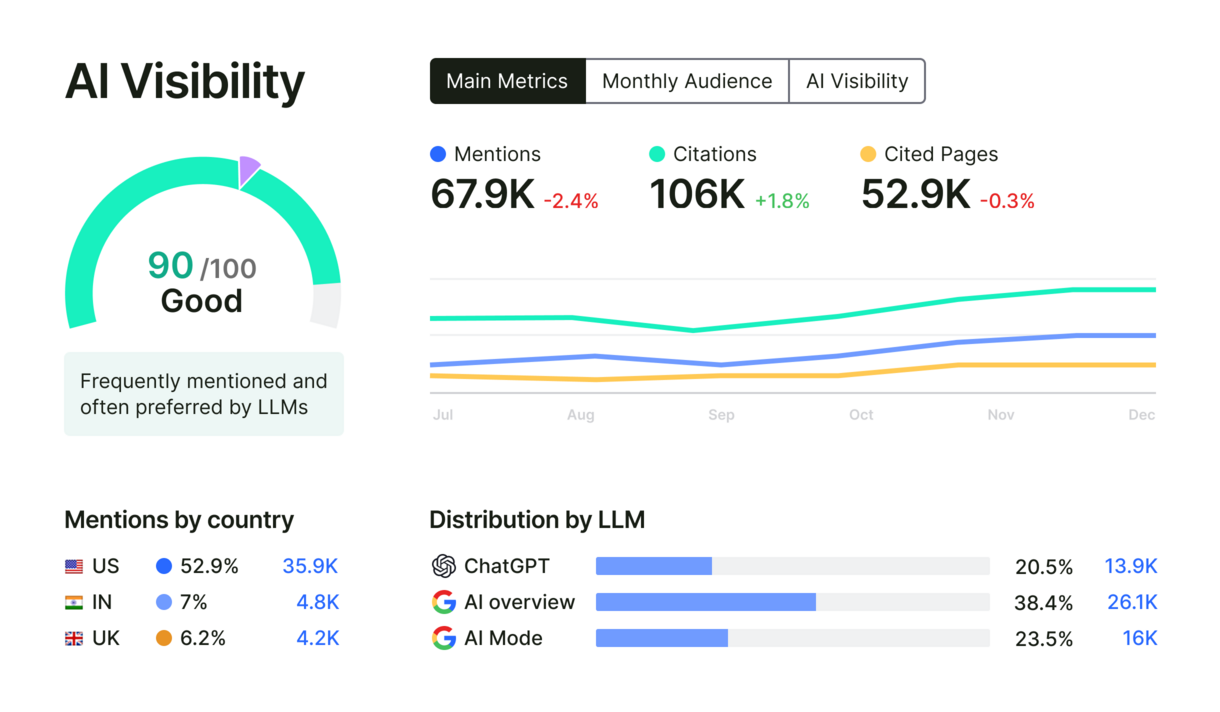
Why Atomic is better for a compact team managing one search project: Semrush’s AI Visibility overview is valuable for market-level monitoring and benchmarking. Atomic’s AI Visibility dashboard is a better fit when a small SEO team wants to move from an observed competitor result into Google performance, website coverage and technical investigation under one project plan. This is a workflow and packaging advantage, not a claim that Semrush’s wider suite lacks those disciplines. Include the required Semrush toolkits and reporting add-ons in the evaluation.
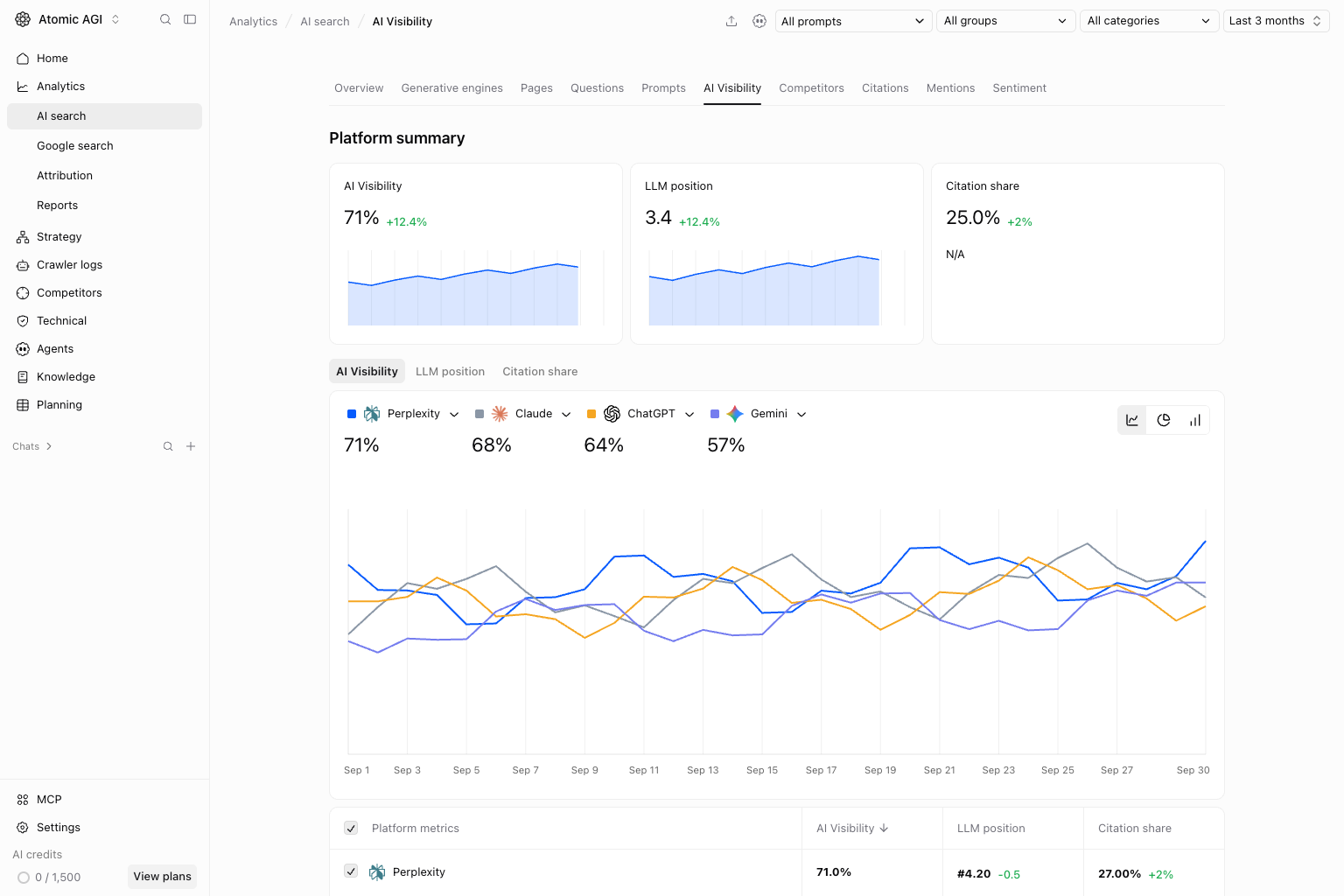
Compare custom prompts with market research reports
Semrush combines broad AI visibility research with a controlled custom-prompt panel. Its overview and competitor reports help investigate a market, while tracked prompts answer questions selected for the brand. These sources have different collection and refresh characteristics.
Atomic’s prompt observations sit beside first-party Google and website evidence. For a niche B2B product, build a panel around specific commercial questions and important markets. Test whether the research database covers the category and whether the custom panel captures the questions that matter. A large discovery dataset and a monitored buying question are complementary measurements.
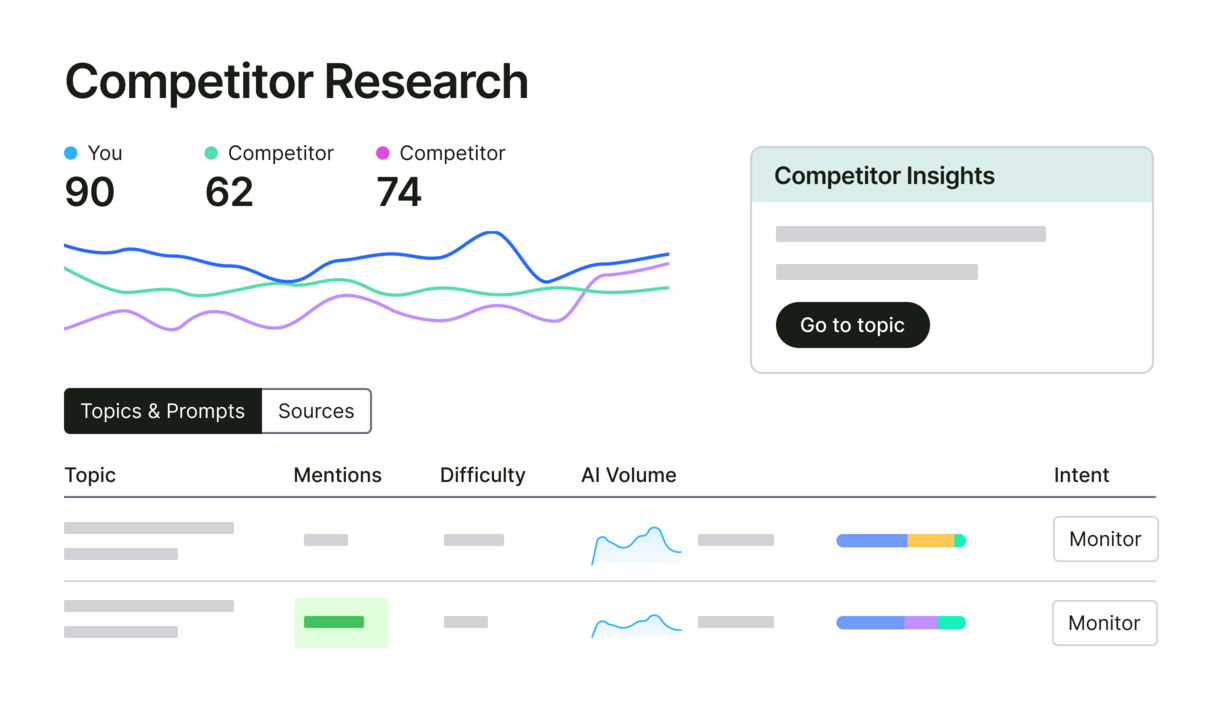
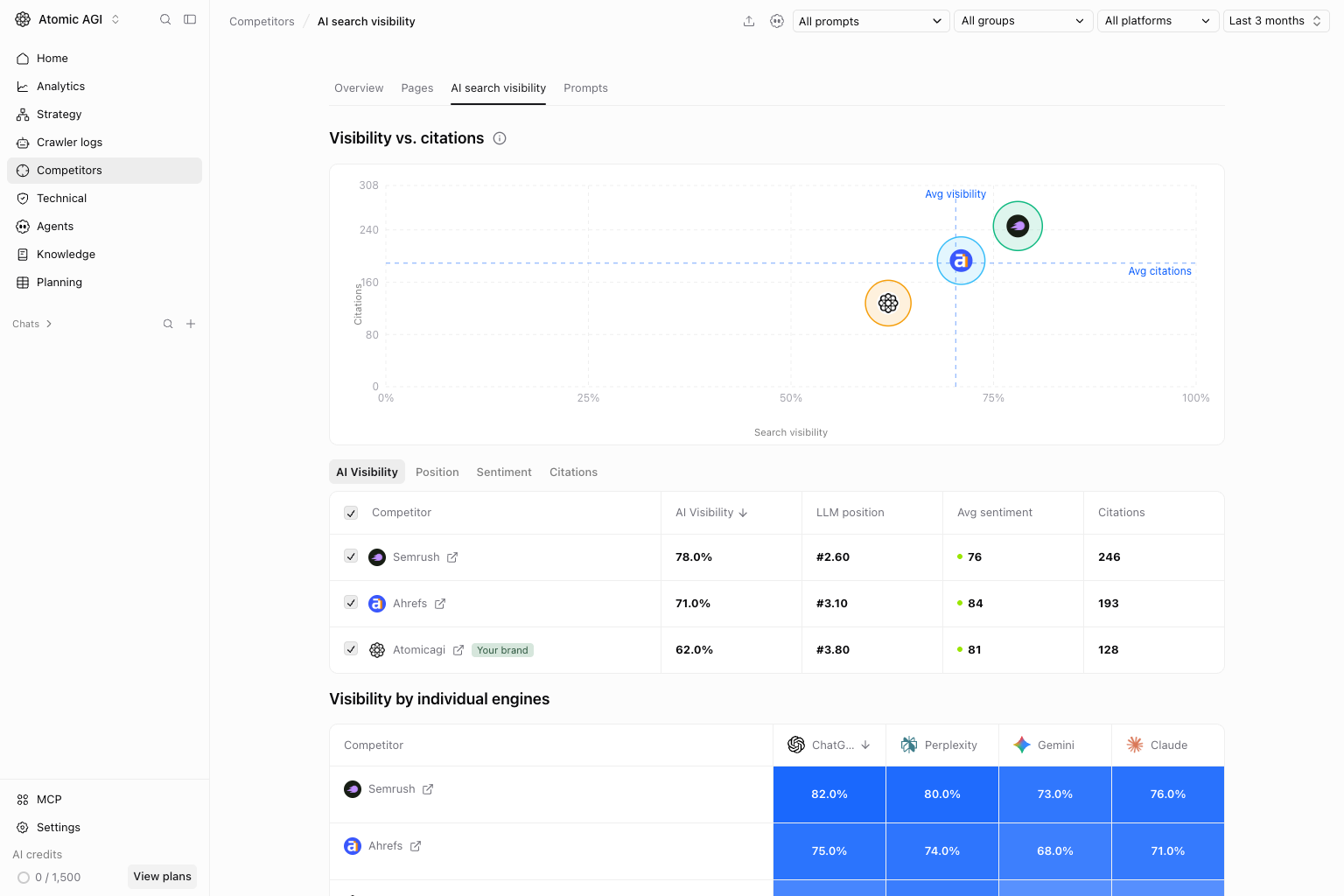
Why Atomic is better when competitive monitoring must lead to a website decision: Semrush’s competitive research compares AI visibility and topical presence. Atomic also has a dedicated competitor AI visibility view, shown below, with visibility versus citations, position, sentiment and engine-level comparisons. Atomic’s advantage for the SEO owner is the next investigation in the same project: check the competing prompts and pages, then use site coverage, Google performance and technical findings to choose the work. Match the prompt scope and dates before comparing vendors’ results; their scores are not interchangeable.
Connect Google performance without denying Semrush integrations
Semrush supports GSC and GA4 in its reporting and broader SEO workflows. Atomic also uses those sources, with query, landing-page, country and device investigation connected to AI-answer observations. Compare the analysis and required package, rather than claiming exclusive access to Google data.
For a declining product page, trace clicks, impressions, CTR, position and configured conversions over equivalent dates. Then inspect competing pages and technical findings. The useful result is a specific explanation and an owned task, not simply a dashboard that places several source totals next to each other.
Evaluate the audit required for the website
Semrush’s AI Search Health checks issues relevant to AI crawler access, and its wider Site Audit is a substantial technical SEO product. Atomic also groups SEO and LLM-readiness findings by issue and affected URL, with internal-link, cannibalization and indexing investigation nearby.
Use a known template defect during evaluation. Compare crawl capacity, affected-URL evidence, recurrence and how the finding reaches the team that fixes it. If your organization already depends on Semrush technical or backlink research, an Atomic evaluation does not require discarding that specialist capability before the replacement has been demonstrated.
Compare included execution with enterprise automation
Semrush offers MCP access and broader content tooling, with advanced AI Automations and workflows in Enterprise scope. Atomic provides specialist agents on Starter and visual Workflows and Grids on Team, connected to project evidence and authorized CMS actions.
Test a real refresh from a search finding through editorial approval and publication. Price the required automation package, users and review process. An external assistant connected to data can be valuable, but it is not the same purchase as a native recurring workflow with retained records, approvals and execution history.
When Semrush may be the better fit
Semrush deserves evaluation when a team relies on its keyword, backlink, market and competitive research datasets, or already runs client reporting across its ecosystem. A broader suite can reduce disruption for an established agency with those dependencies.
Atomic is relevant when the core need is a connected project workflow for Google performance, website coverage, technical diagnosis and reviewed operations. Compare the actual bundle and staff handoffs. Choose by the jobs completed and evidence retained, rather than assuming the lower price of one base toolkit represents the cost of the whole stack.
Compare the complete plan and operating cost
The reviewed Semrush AI Visibility pricing selection displays Base from $99 per domain per month, billed annually, with 25 custom prompts. Extra users, report packages and other toolkits change the total. Confirm checkout terms and whether Semrush One or Enterprise is required for the broader workflow being compared.
Atomic monthly USD plans, per project: Starter is $40 with 75 prompts, up to three models, four members and a 72-hour refresh. Team is $100 with 240 prompts, up to six models, ten members and a 48-hour refresh, adding Strategy, Workflows, Grids and crawler logs. Team Max is $200 with 420 prompts, up to six engines, twenty members and daily refresh. A Free plan is available. See current Atomic plan details.
Estimate the actual monitoring and production workload, including every domain, user, model, region, report and recurring action. A prompt definition, collected answer and content operation are different usage units. Compare the complete setup rather than assuming the cheapest entry plan covers the whole job.
Switch from Semrush AI Toolkit with a clear baseline
- Retain the setup: save the prompts, markets, competitors and reports available to your Semrush AI Toolkit account.
- Connect the project: add GSC, GA4 and relevant company knowledge to Atomic, with permissions appropriate to the work.
- Match the questions: rebuild a representative panel across the important engines and markets.
- Run an overlap: compare equivalent dates and source answers, accounting for different cadence and scoring. History is not automatically imported or interchangeable.
- Complete one reviewed improvement: inspect the saved CMS fields and live page, then measure search and business results separately.
Try Atomic with one real page problem
Try Atomic or book a demo. Bring a priority page, a commercial question and the outcome you need to explain. Use the product documentation to follow the investigation from evidence through reviewed work.
Reviewed 23 October 2026 using official product documentation and plan information. A × labeled “not documented” identifies the absence of an equivalent capability in the reviewed materials; it does not prove a custom integration is impossible. ✓ labels retain plan, beta and service qualifications. Product screenshots illustrate both interfaces; example values are not comparative performance results. This is a documented capability comparison, not a measured performance benchmark.