Atomic AGI is a Rankscale alternative for teams connecting AI monitoring with Google performance, site strategy and reviewed execution. Rankscale offers broad engine coverage, brand dashboards, page audits and credit-based tracking. It also advertises GA4, Search Console beta and MCP, so the decision concerns depth and operations rather than the mere existence of integrations.
Translate credits into the observations your team needs
Rankscale allows unlimited search-term definitions, while actual answer collection consumes credits. Engine selection, markets and refresh frequency therefore determine how much of the panel can run. The advertised maximum answer count is not a promise that every engine combination produces that many observations.
Build a sample budget for your most important commercial questions across the engines and countries you serve. Atomic instead publishes prompt allowances and cadence by project plan. Compare the resulting observation schedule, not just the size of the term library or a theoretical maximum answer count.
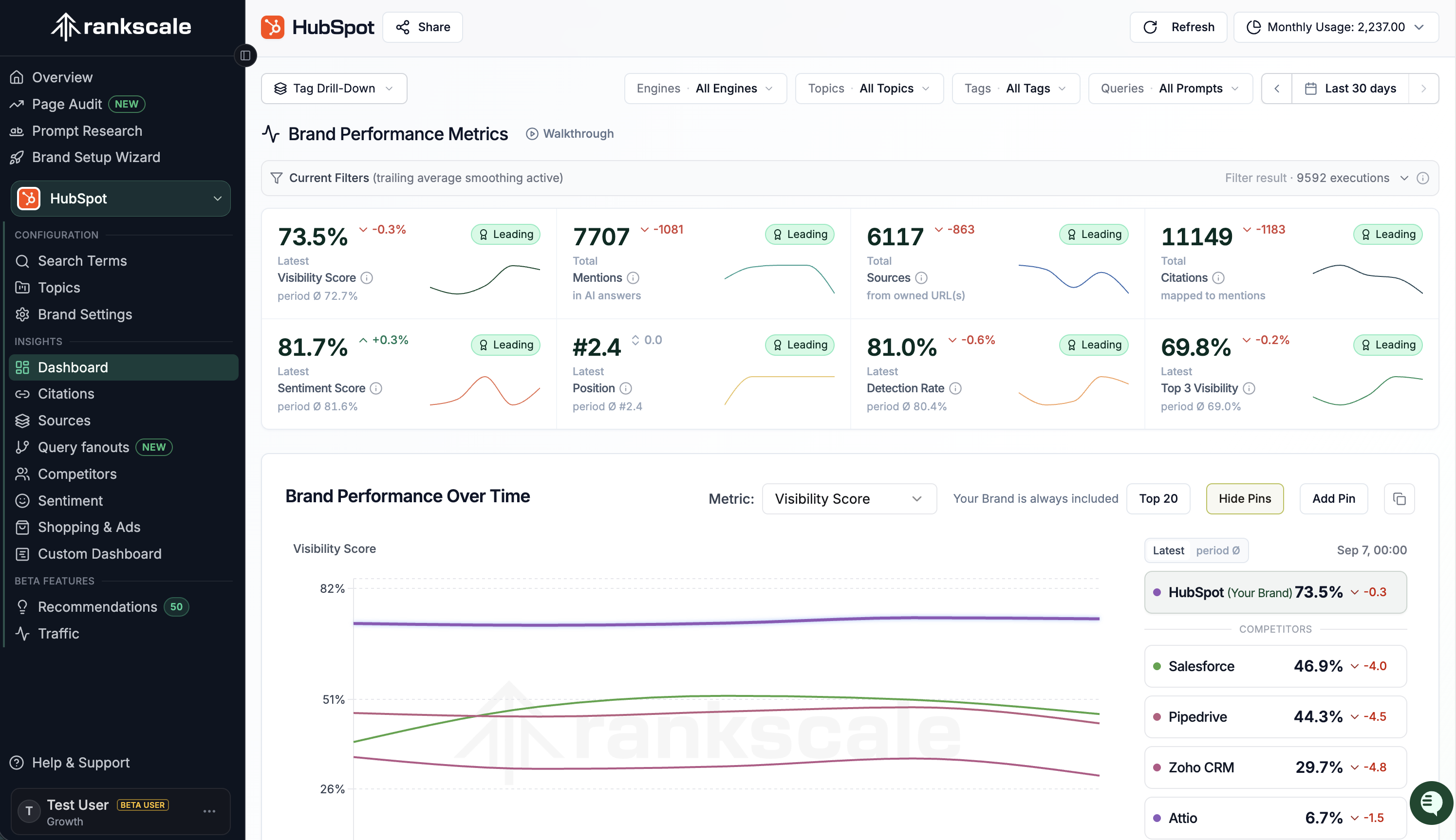
Why Atomic is better for connecting brand observations to a website investigation: Rankscale offers a broad visibility panel across AI engines. Atomic is a better fit when the SEO team needs the next step in the same project: prompt-level competing results, Google performance, attribution, coverage and technical evidence. The advantage is the connected operating process rather than the number of charts. Rankscale’s flexible credit model and engine coverage remain reasons to evaluate it, especially for agencies running varied research panels.
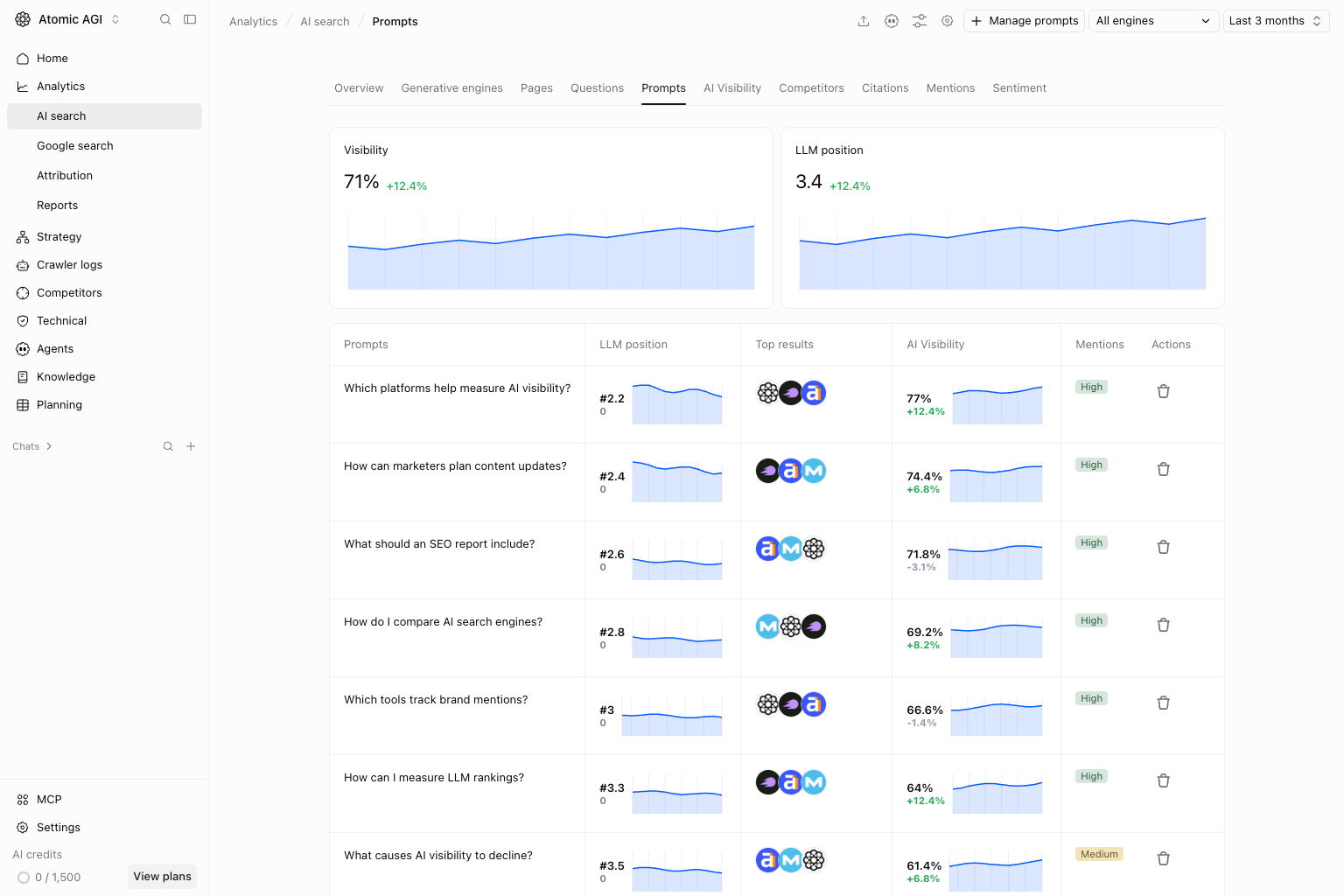
Recognize Google connections and test their depth
Rankscale advertises GA4 and a Search Console connection in beta. That makes a blanket “no Google data” comparison inaccurate. During evaluation, confirm whether the beta is available to your account and inspect the exact page, query, date and conversion reports you need.
Atomic’s Google workspace supports query and landing-page investigation with country and device context alongside AI observations. Give both products a page that lost clicks while AI visibility remained stable. The stronger fit is the one that helps the team explain the change and choose a specific response without rebuilding the analysis elsewhere.
Compare page readiness with sitewide diagnosis
Rankscale includes page audits and advertises a substantial set of technical checkpoints. These can be useful for checking an important landing page’s AI readiness. Atomic’s technical workspace combines audits with issue groups, affected URLs, internal-link analysis, cannibalization and indexing investigation.
For a site migration, inspect more than one URL. Ask which templates share a defect, which redirects or duplicate pages are involved and how findings become a prioritized backlog. A high-quality single-page check and a sitewide operating workflow can both be valuable, but their scope should be compared explicitly.
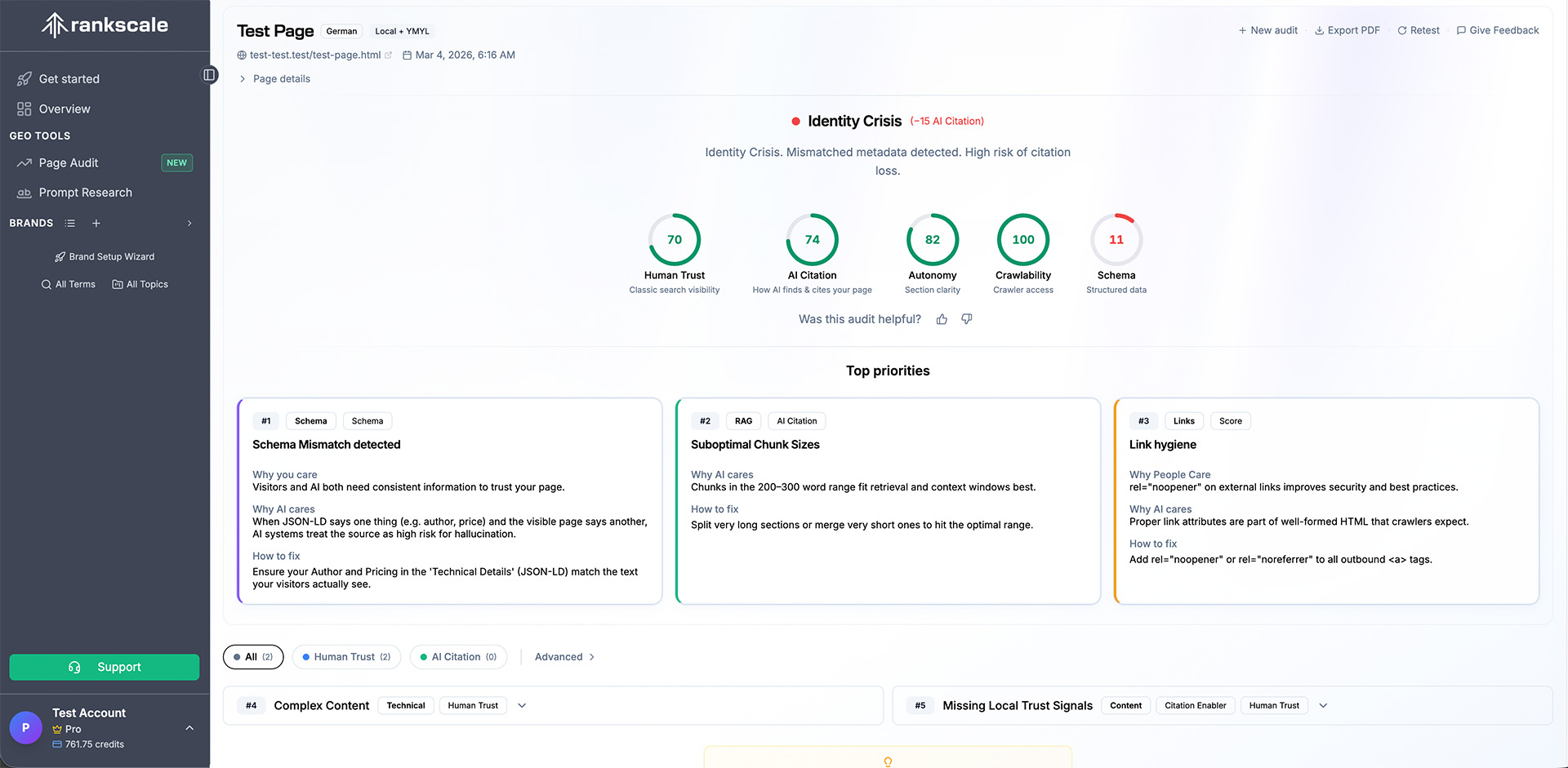
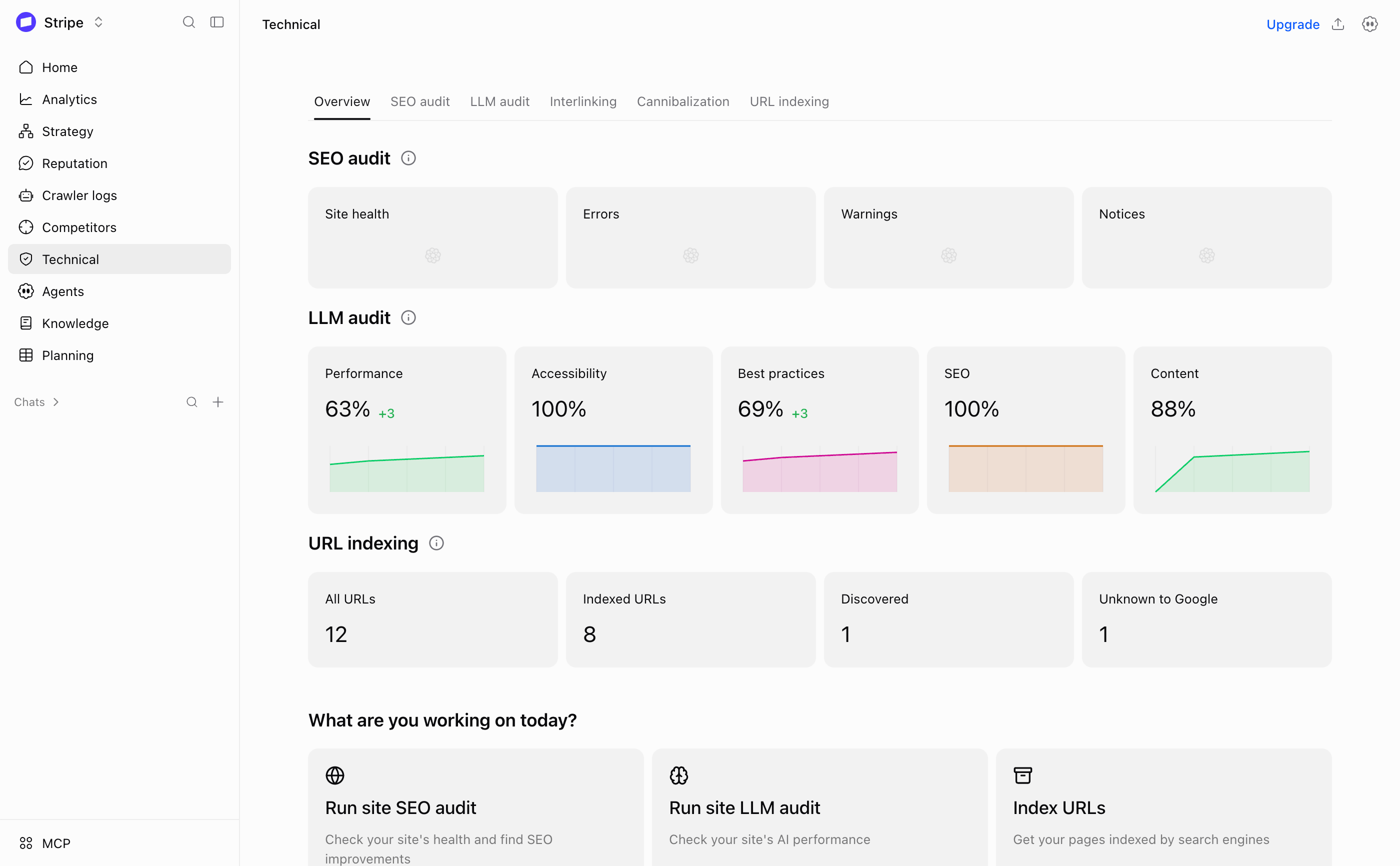
Why Atomic is better for reviewing the complete technical backlog: Rankscale’s page-readiness audit is useful for examining a selected URL. Atomic’s technical investigation technical overview is a better starting point for a team responsible for the whole site because it connects SEO and LLM audit groups, affected URLs and indexing, with related internal-link and cannibalization investigation. That supports deciding which issue to fix first across many pages. Do not infer that Rankscale lacks audits; compare the same site scope, issue evidence and follow-up task.
Map the content gap to an existing or missing page
Rankscale’s competitor, citation and query-fan-out research can reveal what AI systems discuss and which sources influence answers. Atomic adds a sitewide view of entity, cluster and funnel coverage, connecting market subjects to owned pages and competitor gaps.
For an agency client with strong educational content but weak buying-stage visibility, list the comparison, integration and use-case pages that exist today. Then distinguish missing subjects from weak pages and overlapping intent. That produces a bounded editorial brief instead of a recommendation to add more prompts or publish another broad article.
Compare assistant analysis with native execution
Rankscale’s MCP beta lets an external assistant read live data and, with separately enabled permissions, create terms or run tracking that spends credits. This is meaningful assistant access and should be shown with a positive check. It does not by itself establish a native CMS production workflow.
Atomic’s agents use project evidence and company knowledge, while Workflows and Grids on Team organize recurring research, review and authorized publication. Test a refresh from the initial citation gap to the saved CMS item. Compare the number of external services and manual handoffs required to finish and verify the change.
When Rankscale may be the better fit
Rankscale merits evaluation for agencies prioritizing broad engine selection, flexible credit allocation and multiple brand dashboards. Its page audits, Looker Studio support and higher-tier REST API can fit an analytics-led workflow with established production tools around it.
Atomic is relevant when the same project must combine Google SEO, site coverage, technical investigation and recurring execution. Compare the agency’s complete delivery process rather than replacing a specialist monitoring tool merely because another product includes more operational features. Preserve a dataset or engine that the client still requires.
Compare the complete plan and operating cost
Rankscale’s monthly plans list Pro $99 with 1,200 credits, Pro+ $229 with 3,000 and Growth $385 with 5,500. Audit and brand-dashboard allowances also change by tier. Calculate engine-specific execution costs and cadence; unlimited term creation and advertised answer maxima are not unlimited tracking.
Atomic monthly USD plans, per project: Starter is $40 with 75 prompts, up to three models, four members and a 72-hour refresh. Team is $100 with 240 prompts, up to six models, ten members and a 48-hour refresh, adding Strategy, Workflows, Grids and crawler logs. Team Max is $200 with 420 prompts, up to six engines, twenty members and daily refresh. A Free plan is available. See current Atomic plan details.
Estimate the actual monitoring and production workload, including every domain, user, model, region, report and recurring action. A prompt definition, collected answer and content operation are different usage units. Compare the complete setup rather than assuming the cheapest entry plan covers the whole job.
Switch from Rankscale with a clear baseline
- Retain the setup: save the prompts, markets, competitors and reports available to your Rankscale account.
- Connect the project: add GSC, GA4 and relevant company knowledge to Atomic, with permissions appropriate to the work.
- Match the questions: rebuild a representative panel across the important engines and markets.
- Run an overlap: compare equivalent dates and source answers, accounting for different cadence and scoring. History is not automatically imported or interchangeable.
- Complete one reviewed improvement: inspect the saved CMS fields and live page, then measure search and business results separately.
Try Atomic with one real page problem
Try Atomic or book a demo. Bring a priority page, a commercial question and the outcome you need to explain. Use the product documentation to follow the investigation from evidence through reviewed work.
Reviewed 23 October 2026 using official product documentation and plan information. A × labeled “not documented” identifies the absence of an equivalent capability in the reviewed materials; it does not prove a custom integration is impossible. ✓ labels retain plan, beta and service qualifications. Product screenshots illustrate both interfaces; example values are not comparative performance results. This is a documented capability comparison, not a measured performance benchmark.