Atomic AGI is a Profound alternative for teams that own Google SEO as well as AI search. It brings search performance, website coverage, technical diagnosis and reviewed execution into one project. Profound combines AI-answer intelligence with marketing agents, conversation-demand research and product-level shopping analysis. The decision is which evidence your team needs before it acts.
Connect AI visibility with the Google results behind your pipeline
A brand can gain AI mentions while losing Google clicks to its most valuable pages. Atomic’s Google Search Console views let you inspect the queries, landing pages, CTR and position behind that change, then compare the same pages with AI-search observations and GA4 outcomes.
For a SaaS team, that makes the investigation concrete: did a commercial page lose rankings, did the query mix change, or does the brand simply fail to appear in AI recommendations? Each finding points to different work. A declining Google landing page may need technical repair or a refresh; an AI citation gap may require better coverage or stronger supporting sources.
Profound also connects GA4, including transactions and purchase revenue. Its Agent Analytics adds AI crawler and referral evidence. Atomic’s distinction here is the GSC query-performance workspace alongside the rest of the investigation, rather than exclusive access to conversion data.

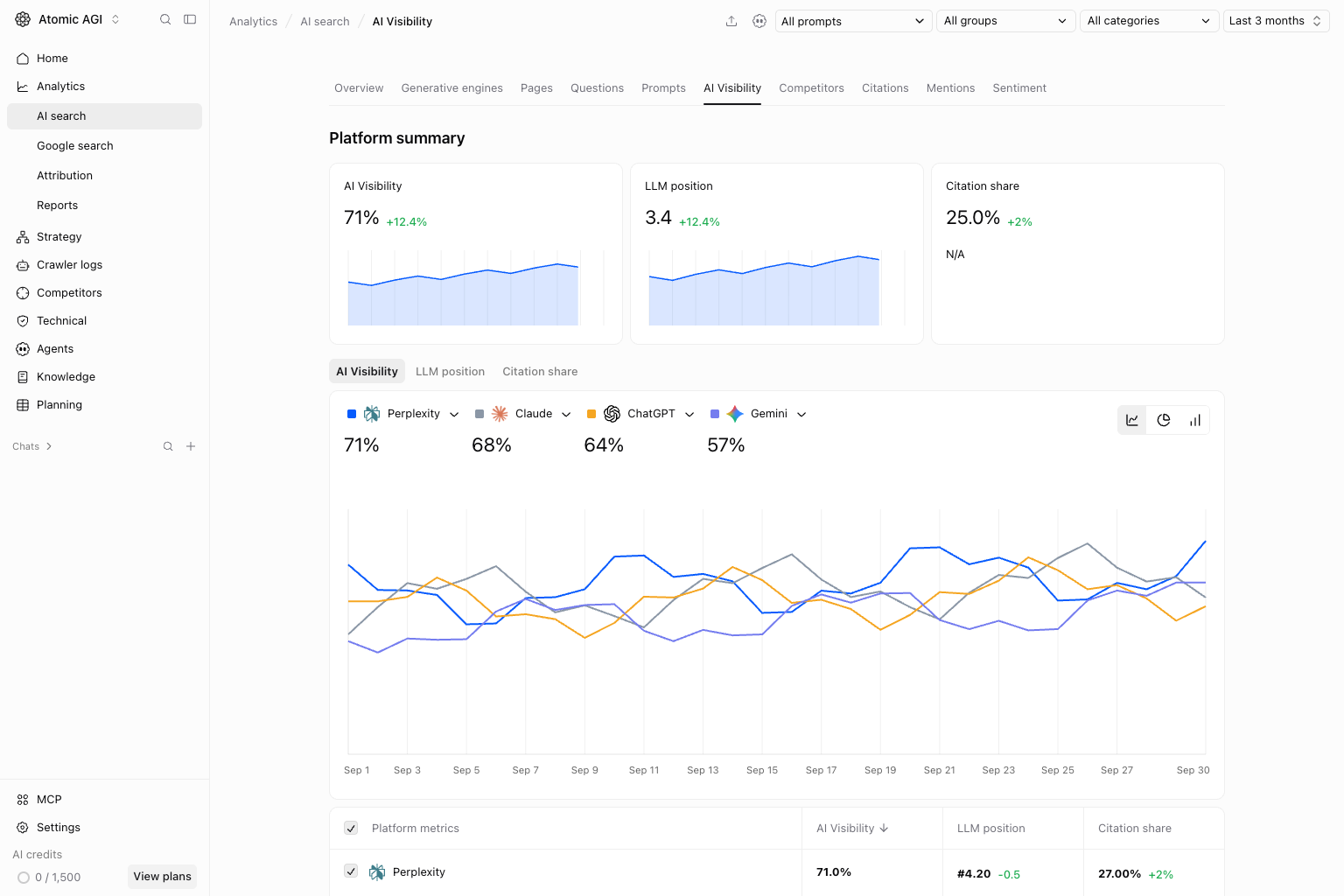
Why Atomic is better for a team owning Google SEO as well as AI visibility: Profound’s overview is built for understanding brand presence in AI answers. Atomic’s AI Visibility dashboard compares ranked exposure, position and citation share across engines alongside Google search, attribution and technical investigation. The practical advantage is being able to investigate the page behind a missing mention within the same search workspace. This is a better fit for an SEO operating queue, not evidence that Profound’s visibility measurements are less accurate.
Prioritize website coverage, not just another tracked prompt
Atomic’s entity, cluster and funnel views connect the subjects a market cares about with the pages already on your site. On Team and above, use that coverage to decide whether to create a missing comparison, strengthen a weak category page or consolidate overlapping articles. Competitor page evidence helps explain why a subject deserves attention.
Consider a software company appearing in educational answers but missing from buying recommendations. Before adding more top-of-funnel articles, inspect whether its comparison and integration pages cover the commercial questions. Connect those gaps to existing URLs and their performance so the next brief has a specific purpose.
Profound’s Prompt Volumes answers a different question: what demand and intent exist across AI conversations? Its topic and audience research can inform the prompt panel and content strategy. That research dataset and Atomic’s site-coverage map are useful at different stages; neither should be presented as an interchangeable score.
Separate crawler access from a complete technical SEO investigation
Both products can help investigate AI bots. Profound’s Agent Analytics examines server-log activity, verifies crawlers and supports multiple hosting and CDN sources. Atomic’s crawler logs, available on Team and above, expose requests by bot, URL and response from supported connected sources.
The additional Atomic workflow is the sitewide technical investigation: open an issue group, identify affected URLs, inspect internal links and check overlapping pages or indexing problems. Its LLM audit adds AI-readiness checks. This is useful when the problem is a broken template or competing URLs rather than simply a missing AI-bot visit.
For example, when a product page disappears from recommendations, check whether it returns the right response, is discoverable through internal links and has a competing version before rewriting it. A successful bot request establishes access, not a guaranteed citation. Keep the request evidence and the observed answer separate.
Give agents the search context needed for the job
Both Atomic and Profound offer agents that use company knowledge. Atomic’s agents can work across the project’s search analytics, page content, audit findings and competitor evidence. That context suits jobs such as explaining a loss of Google clicks, selecting a refresh candidate or preparing a brief from a verified website gap.
Profound’s AI Marketer and Context Manager support brand-aware marketing work, while its Agent Builder combines research, drafting and CMS delivery. Choosing Atomic should depend on the search and website evidence available to the agent, not on a claim that Profound lacks automation.
Carry a page investigation through review and publication
On Atomic Team, Workflows and Grids connect repeatable steps with the records being worked on. A content team can keep a URL, its investigation, the proposed change and its review status together, then publish through an authorized CMS connection.
For a decaying comparison page, a practical sequence is:
- Diagnose: inspect Google queries, AI-answer gaps, existing page coverage and technical findings.
- Prepare: turn the evidence into a targeted change, retaining the original page and its native CMS structure.
- Review: check the claims, layout and requested changes before publishing.
- Verify: read back the saved fields and inspect the actual live result, then monitor search performance separately.
Profound supports human approvals, CMS publishing and Sheets for batch agent work too. Test the same page-level task in both products. Evaluate the inputs available, the quality of the proposed change and the effort needed to review it, rather than comparing the existence of a workflow builder.
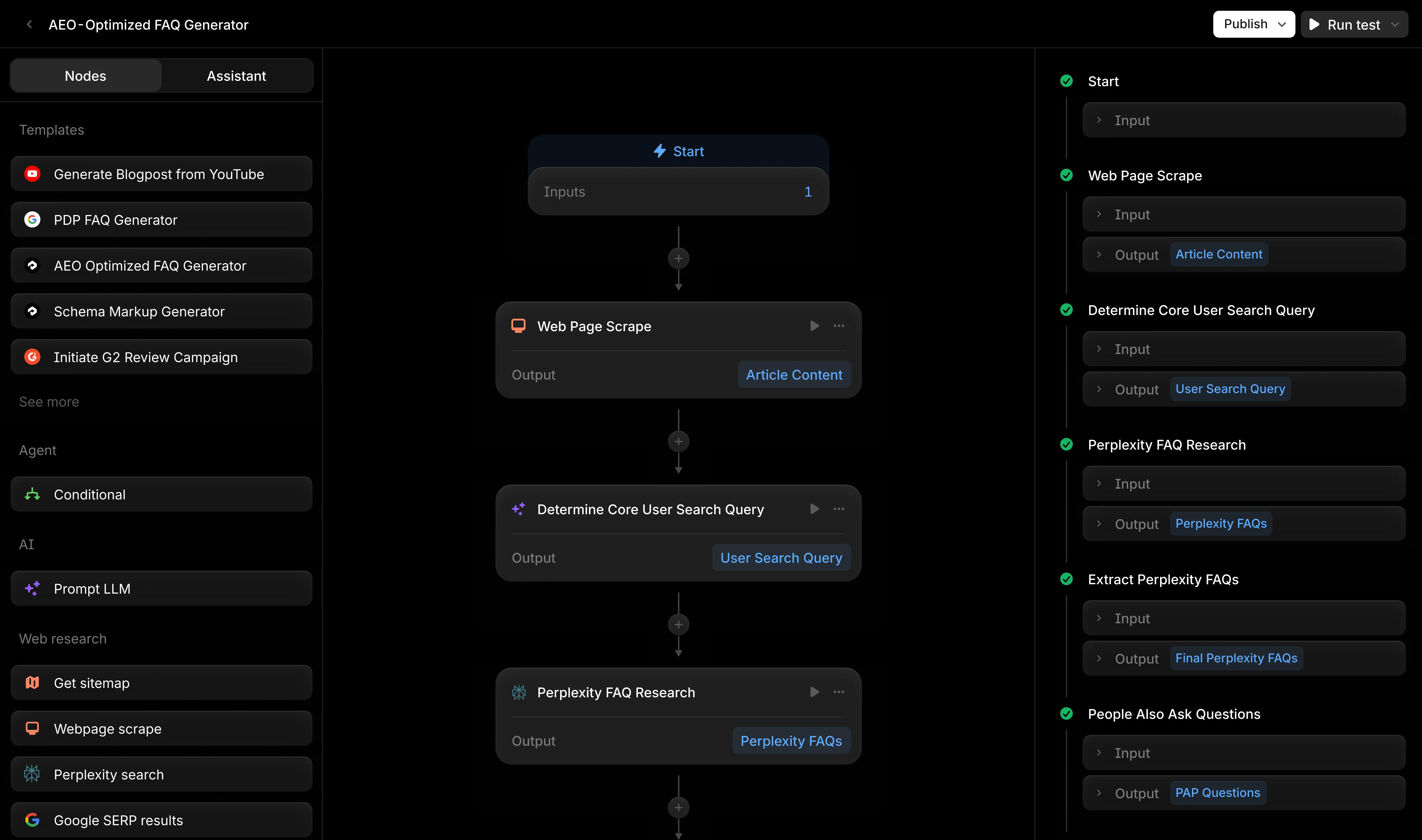
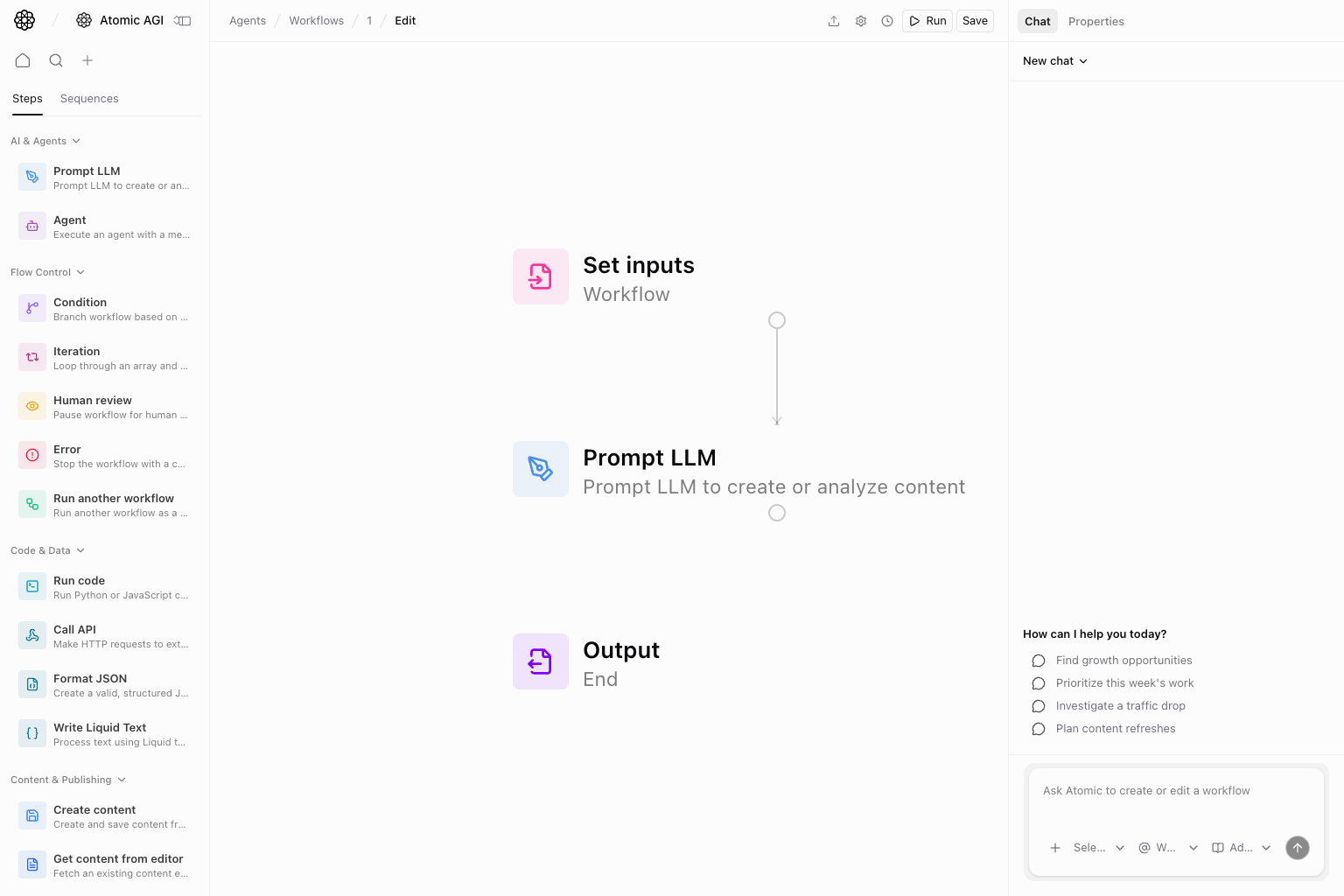
Why Atomic is better for a page investigation that becomes recurring work: Profound has a real agent builder and Sheets; automation is not exclusive to Atomic. Atomic’s workflow tools advantage for this use case is that the workflow can start with its connected Google performance, site audits and coverage evidence, then use review and authorized publishing steps. The visual editor below shows how that investigation can become a reusable sequence. Evaluate the same inputs and review checkpoints in both products before choosing.
When should you choose Profound instead?
Profound deserves a close look when AI conversation research, SKU-level shopping visibility or enterprise governance are central to the purchase. Its Shopping workspace examines product attributes and merchant placement, while Prompt Volumes helps research topics beyond a manually selected prompt list. Atomic’s brand and page tracking should not be sold as a replacement for those specialized datasets.
A large team that needs many collaborators, multiple markets and enterprise access controls should evaluate Profound’s quoted package against those requirements. A team primarily responsible for Google SEO, website structure and AI search may find Atomic’s integrated investigation more relevant to its daily work.
Compare daily tracking, team access and the whole package
Atomic’s monthly project plans are Starter at $40, Team at $100 and Team Max at $200. Their prompt allowances are 75, 240 and 420, with refresh every 72 hours, 48 hours and daily respectively. Included seats are 4, 10 and 20. Strategy, Workflows, Grids and crawler logs start on Team. Check the current Atomic plans for the complete allowances.
Profound’s brand pricing page currently lists a seven-day trial and custom Enterprise pricing. Enterprise combines a tailored prompt allowance with daily tracking, up to nine answer engines, unlimited seats, API access and exports. AI Marketer usage is credit-based. Confirm the package’s prompt, market and agent allowances in the quote.
If daily observations are essential, compare Atomic Team Max with the relevant Profound package. If a smaller team can work with a slower refresh and needs site strategy plus execution, evaluate Atomic Team. A trial’s prompt count is not an ongoing subscription price, so this comparison does not claim a percentage saving against an unpublished quote.
Switch with an overlapping measurement period
- Retain the important setup: save your Profound prompts, markets, competitors and reports, using the export access available to your plan.
- Connect the project: add GSC, GA4 and company knowledge to Atomic, then choose the permissions and plan needed for the work.
- Rebuild a representative panel: match commercial questions, engines and markets rather than maximizing prompt count.
- Run both systems together: compare equivalent dates and answers while accounting for different refresh schedules and scoring methods.
- Complete one reviewed improvement: record what changed and monitor its effect. Historical scores and exports are not automatically imported or interchangeable.
Try Atomic on a page your team needs to improve
Start with Atomic or book a demo. Bring one commercial page, a small prompt panel and a question about its performance. Follow that question from the source data through diagnosis and a reviewed change before deciding which platform fits your team.
Reviewed 23 October 2026 using both vendors’ official documentation and pricing. “No equivalent workspace documented” identifies a gap in the reviewed documentation, not proof that a custom integration is impossible. Product images illustrate the interfaces; this is a capability comparison rather than a measured performance benchmark.